
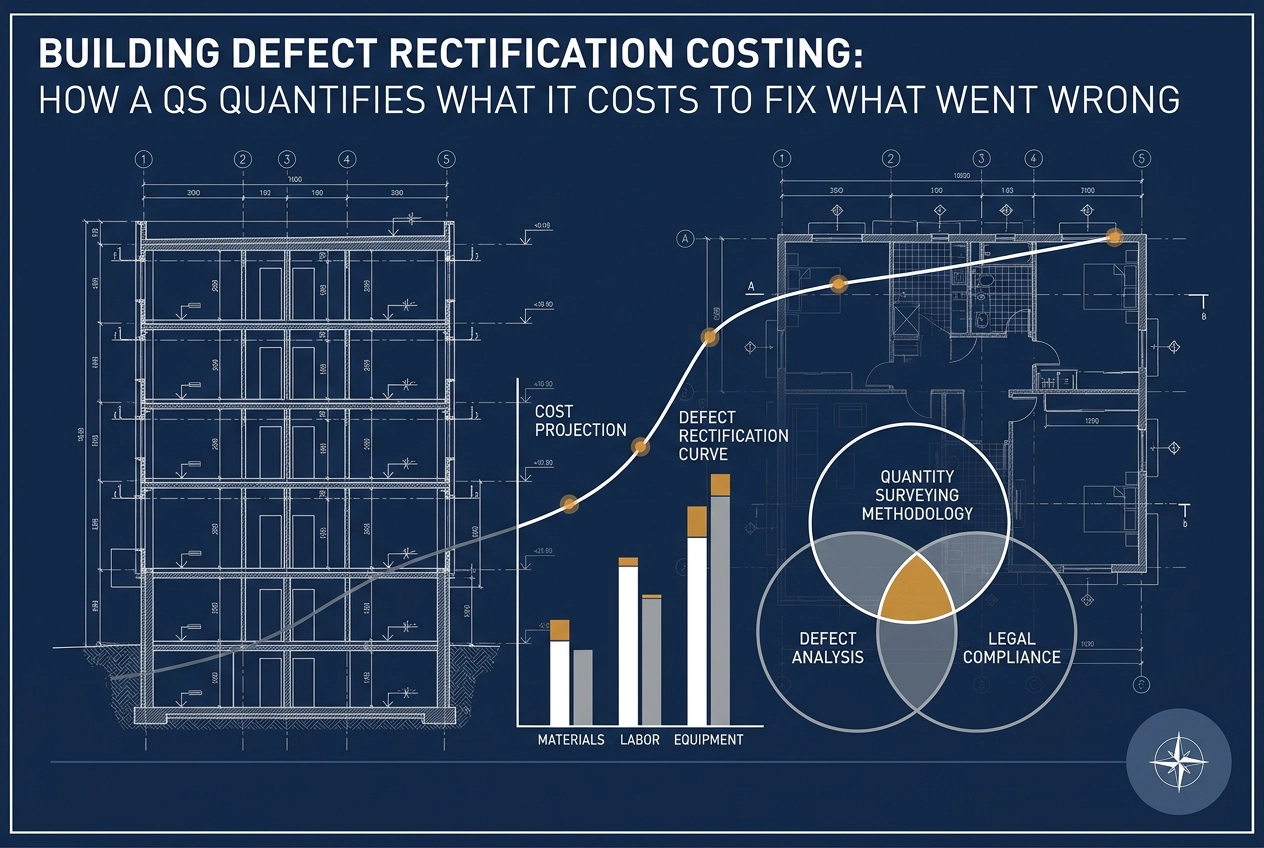
When a construction defect dispute reaches litigation or tribunal, one document consistently shapes the outcome: the defect rectification cost report prepared by a qualified quantity surveyor. Yet many legal professionals, strata managers, and insurers encounter these reports without a clear understanding of how the figures are derived, or how to assess whether the methodology behind them is credible. That gap can be costly.
A rigorous defect rectification cost report is not a lump sum drawn from experience or industry averages. It is a structured quantity-surveying exercise, governed by frameworks such as RICS NRM2, that isolates each defective element, defines the remedial scope, and prices the works at current market rates. When a building expert witness presents these findings in dispute proceedings, the credibility of every figure depends entirely on the discipline of the methodology underpinning it.
This tutorial walks through each stage of that methodology, from scope definition and elemental isolation through to trade-by-trade pricing and calibrated contingency allowances. By the end, you will know how a QS builds the number, what makes a report defensible under challenge, and how to read one with confidence.
What Defect Rectification Costing Actually Is (and What It Is Not)
Defect rectification costing is a structured quantity-surveying exercise grounded in documented methodology. It is not a lump sum drawn from experience, a percentage applied to an original contract value, or a figure benchmarked against similar projects. Each of those shortcuts produces a number; none produces a defensible cost position.
The discipline differs fundamentally from a standard construction estimate. A conventional estimate is forward-looking: the QS prices planned works against a defined scope. Defect rectification costing works in reverse. The QS starts from observed or reported failures and works backward to establish what remedial works are genuinely required, element by element, trade by trade. RICS Defects and Rectifications (2nd edition, August 2024) formalises this as a distinct professional practice, explicitly separating it from standard construction delivery and requiring independent judgment at each stage.
The process spans four sequential stages: scope definition, elemental isolation, trade-by-trade pricing, and contingency calibration. Each demands independent professional judgment. Compressing any stage, or substituting professional assessment with rule-of-thumb allowances, weakens the entire cost position.
Two misconceptions are common among legal professionals and strata managers. The first is that a QS "prices from experience," applying mental benchmarks developed over years of practice. The second is that defect remediation costs can be reliably derived from the original construction contract rates. Both assumptions are incorrect. Rectification works occur in a different market context, under different site conditions, and often require trade sequencing and access methodologies that bear no resemblance to the original build program. For a fuller picture of how defect costs connect to insurance and claims frameworks, see Building Defects, Insurance Claims, and the Cost Connection.
Why Methodology Drives Credibility in Construction Disputes
That distinction between methodology and mere outcome is precisely what separates a defensible expert report from one that collapses under cross-examination.
In litigation and adjudication, tribunals do not simply accept a QS figure because it comes from an experienced practitioner. They interrogate the reasoning behind it. The auditable path to a number is what withstands scrutiny, as established in the opening section.
The RICS Final Account Procedures (1st Edition), specifically Sections 3.8 and 3.9, establish defect costing as a contractually and procedurally defined exercise. The standard requires itemised scope and pricing aligned to contract terms. Aggregate settlement figures, or global deductions applied without itemised support, do not satisfy this framework and will not satisfy a tribunal applying it.
The cost consequences of unstructured costing are well documented. A 2024 analysis of UK public sector projects found that average cost overruns exceeded 20% of approved budgets on projects without rigorous early cost management. While that finding relates to project delivery rather than dispute costing, it illustrates the same principle: without structured methodology, cost positions become indefensible.
Expert witness credibility rests on three demonstrable qualities: independence from the instructing party's preferred outcome, pricing sourced from the current market rather than historical benchmarks, and scope assumptions that are explicitly stated and traceable. Experience alone does not satisfy any of these. A QS who relies on professional judgement without documented support offers an opinion; a QS who documents methodology offers evidence.
Opposing legal teams understand this. The most common challenge vectors in defect rectification disputes target scope definition (arguing over-inclusion or omission), rate sourcing (asserting rates are outdated or market-inconsistent), and contingency justification (challenging percentages applied without documented rationale). Each attack vector corresponds directly to a methodological requirement. For practitioners involved in dispute resolution and expert witness services in infrastructure, rigorous methodology is not a formality; it is the foundation of every defensible cost position.
Stage One: Scope Definition and Elemental Isolation
Scope definition is where a defect rectification cost report either earns or loses its credibility. Because the previous stage establishes why methodology matters, this stage addresses how that methodology begins in practice.
The first discipline a QS applies is elemental isolation: separating each defective element into a discrete, identifiable scope item. Visible damage is only the starting point. The more consequential work involves identifying what remedial action is required to fix each defect properly, not merely what is immediately apparent on site. A crack in a rendered façade may indicate substrate movement; costing the render repair without addressing the underlying cause produces a figure that is both incomplete and indefensible.
Scope definition is built from documents, not from site observation alone. The QS must conduct a thorough review of all available evidence before reaching a cost position: building inspection reports, structural or waterproofing engineering assessments, original drawings, specifications, and any relevant correspondence. The step of defining the scope of work is foundational regardless of the claim type, and in defect rectification it carries particular weight because the scope directly determines the quantum. RICS guidance establishes patent and latent defects as requiring separate treatment, both must be scoped before pricing begins.
Bundling unrelated defects into a single cost line is a structural weakness. It prevents independent verification of individual items, obscures the rationale behind the total, and gives opposing experts an easy target. Each defect receives its own scope entry.
Secondary and consequential works must be captured at this stage. Waterproofing membrane rectification, for example, almost always requires demolition and reinstatement of overlying tiling and screeds; those items are separate scope lines with separate quantities and rates, not an absorbed allowance.
When initial access works expose hidden defects or secondary damage beyond the original scope, the QS must process those findings through a documented scope variation, not absorb them silently into contingency. Contingency covers cost uncertainty within defined scope; it does not substitute for scope completeness.
Stage Two: Measurement and the RICS NRM Framework
With each defective element scoped and isolated, the QS's next task is measuring the precise quantum of remedial work required for every item. This means calculating the actual volume, area, linear metres, or unit count that will carry a price, converting a list of defects into a set of measurable, priceable quantities.
RICS NRM2 (New Rules of Measurement: Detailed Measurement for Building Works) provides the standard framework for this stage. Now in its second edition (reissued October 2022 as RICS practice information), NRM2 governs how quantities are calculated across its tabulated work sections, including dedicated sections for demolitions and alterations, repairs, and conservation. Applying NRM2 ensures quantities are calculated consistently and, critically, defensibly if challenged in proceedings.
Measurement in defect rectification is materially different from measuring new construction works. The starting point is an existing, often partially deteriorated or obstructed condition rather than a clean design intent. Measured quantities must therefore account for the removal of failed materials, making good of substrates, and practical site constraints such as restricted access or occupied tenancies. NRM2's sections on demolition and alterations directly address this, which is why applying a standard new-build measurement approach to defect work is methodologically inadequate.
Where a report must be read by legal professionals or strata managers rather than quantity surveyors, the QS can apply RICS NRM1 elemental cost planning principles to organise measured items by building element (structure, envelope, services, finishes). This grouping makes the report's architecture legible to non-technical readers without sacrificing the underlying measurement rigour. The full scope of quantity surveying services across the project lifecycle draws on both NRM tiers for exactly this reason.
Measurement transparency is non-negotiable in expert evidence. Every quantity in a defect rectification report must be traceable to a specific source: a drawing reference, an inspection record, or a documented site measurement. Quantities that cannot be traced to a defined source are a legitimate challenge point in proceedings and undermine the credibility of the entire report.
Stage Three: Trade-by-Trade Pricing at Current Market Rates
With measured quantities established, the QS turns to the task that most directly determines the defensibility of a rectification cost report: applying current market rates to every priced item.
Historical rates are not acceptable in dispute contexts. Contract rates from the original build reflect the pricing environment, trade relationships, and preliminary structures of a project that may be years in the past. Industry averages suffer the same problem. In proceedings, an opposing expert will test whether rates reflect what a contractor would actually charge today to perform the remedial works described. Only current market pricing withstands that scrutiny.
Pricing Trade by Trade
The QS prices each measured item within its trade category. Structural repairs, waterproofing, tiling, mechanical and hydraulic systems, electrical, finishes, and external works each draw on the relevant subcontractor market rather than a single blended rate applied across the schedule. This matters because rate variation between trade categories is material, not marginal. Waterproofing membrane rectification involves specialist labour, manufacturer-specified products, and warranty requirements that produce unit rates structurally different from structural concrete repair, which involves breaking out, profiling, proprietary repair mortars, and potentially engineer-supervised placement. Mechanical plant replacement operates on a supply-and-install model with its own pricing logic entirely. Global rate adjustments applied across dissimilar trades introduce error by design.
For those working across strata and multi-residential projects, trade-specific rate variation is a routine complexity given the mix of building elements typically involved in common-property defect claims.
Rate Sources That Support Defensibility
Defensible rate sourcing draws from four categories: current subcontractor quotations obtained for the specific scope; published cost databases where pricing is current and regionally calibrated to the Sydney or NSW market; recent tender returns for comparable remedial works; and direct supplier pricing for materials where supply costs are a significant cost driver. Each source should be documented. Rates without an identifiable source are a legitimate challenge point.
Preliminaries and Margin
A common and consequential omission is the failure to include site establishment costs, superintendent or project management fees, and builder's margin within the rectification costs schedule. These are real project costs. Excluding them understates the true cost of defect remediation and produces a figure that cannot be defended as representing full reinstatement.
The Pricing Date Requirement
In the current construction environment, with elevated labour and materials costs across NSW, rates sourced twelve months prior may materially understate current costs. The date of pricing must be stated explicitly in the report. Without it, the rate currency cannot be assessed, and the entire pricing basis becomes vulnerable to challenge.
Stage Four: Contingency Allowances, Calibrated, Not Arbitrary
Pricing each scope item at current market rates establishes the cost floor. Contingency sits above that floor, and it is where defect rectification reports are most frequently contested in proceedings.
Contingency must be earned by documented uncertainty, not assumed. Inserting a standard percentage across the board, with no rationale linking the allowance to specific unknowns, is the most common methodological weakness a QS expert can bring to a report. Opposing counsel will identify it immediately, and a flat application is difficult to defend under cross-examination.
The uncertainty that warrants contingency in defect rectification is genuine and well-recognised. Damage behind wall and ceiling linings cannot be fully quantified until access works are complete. Substrate condition is unknown until finishes are removed. Site access constraints, including occupied buildings, strata common areas, or shared services, introduce cost variability that is difficult to eliminate at the scoping stage. Each of these is a documented, articulable reason for an allowance; none of them justifies a single uniform percentage.
Recognised industry guidance supports a Class A estimate accuracy range of ±5–10% for non-standard projects and significant renovations, a category that covers defect rectification work where forensic scope and partially unknown site conditions are the norm. Framing contingency bands within that recognised accuracy range gives the allowance a principled basis rather than an assumed one. Effective risk management and cost change control as feedback mechanisms underpin exactly this approach, calibrating allowances to the uncertainty actually present rather than applying them as a default.
Calibration means the contingency for each scope item reflects its individual uncertainty profile. A structural defect with a confirmed extent and detailed engineering scope warrants a lower allowance than a waterproofing failure where membrane condition beneath tiled finishes is entirely unknown. Applying 15% uniformly across both misrepresents the risk distribution and conflates low-uncertainty items with genuinely unpredictable ones.
One distinction must be drawn clearly. Contingency is not a substitute for scope completeness. It covers known uncertainty about defined items; it does not compensate for categories of defect work the QS has failed to identify. Missing an entire trade or defect category is a scope adequacy problem. Treating that gap as a contingency question obscures the omission rather than resolving it.
How to Read and Assess a QS Defect Rectification Report
With contingency methodology established, the next practical question is how to evaluate the report in front of you.
Apply four assessment criteria to any QS defect rectification report: scope completeness, measurement transparency, rate currency, and contingency justification. A report that satisfies all four can withstand scrutiny in proceedings; one that fails any of them has an exploitable weakness.
Red Flags Worth Identifying Immediately
Certain structural deficiencies signal a poorly prepared report before a single rate is examined:
Lump-sum or trade-total pricing without itemised quantities, making independent verification impossible
Rates that are undated or unsourced, providing no basis to assess current market alignment
A single uniform contingency percentage applied across all scope items without rationale
Scope confined to visible defects, with no account taken of consequential works required to execute the rectification properly
Any of these warrants a formal query before the report is relied upon in a dispute or claim.
What a Credible Report Discloses
A properly prepared building expert witness report identifies every document relied upon, states the date of pricing explicitly, and discloses all assumptions made about site access, substrate condition, or inaccessible areas. Quantities must be presented in a format that allows an opposing expert or legal adviser to check them independently. If the measurement basis is opaque, the report cannot be effectively tested, and its evidential value is materially reduced. Good-practice criteria for a credible report include an executive summary, a basis-of-report section, explicit scope-of-calculation statements, and detailed calculation schedules that allow trade-by-trade verification of preliminaries, rates, and contingency content. The AIQS Competency Standards require that the report be prepared independently and clear of any influence from the instructing party.
For a broader overview of what a QS report should contain, the frequently asked questions on our site address common structural and content queries.
Two Practical Verification Checks
Scope completeness: Place the defects schedule in the QS report alongside the defects schedule prepared by the building inspector or structural engineer. Any item present in one document but absent from the other requires a documented explanation. Silence is not an acceptable response in proceedings.
Rate credibility: Confirm that rates reflect the current Sydney or NSW subcontractor market. Rates drawn from interstate benchmarks, or from cost databases not updated within the preceding 12 months, are a legitimate challenge point without explicit adjustment factors applied.
Preliminary Estimate Versus Expert Report
This distinction matters significantly. A preliminary estimate prepared to support negotiation carries no formal evidential obligation; methodology can be approximate and assumptions broad. A fully documented expert report prepared for tribunal or court use operates under a different standard entirely, requiring disclosed methodology, traceable quantities, sourced rates, and signed compliance with the applicable expert witness code of conduct. Accepting a preliminary estimate as though it were a formal expert report is a procedural error with real consequences in contested proceedings.
Where Defect Rectification Reports Are Challenged and How a QS Defends Them
Knowing how to read a report is one thing; understanding how opposing parties will attack it is another. Four challenge vectors appear consistently in litigation and adjudication involving rectification costs: scope over-inclusion, rate inflation, unjustified contingency, and failure to address betterment.
Scope over-inclusion is the argument that the QS has priced works beyond what the specific defects require. The defence is a documented, item-by-item linkage between each identified defect and its corresponding remedial scope. Where that linkage is explicit in the report, the challenge loses traction. Where scope items are bundled or the connection to a specific defect is implicit, the opposing expert has a legitimate target.
Betterment arises when rectification works would deliver an outcome exceeding the original specified standard. The opposing party may argue that a proportional deduction is warranted. A QS defends against this by demonstrating that like-for-like reinstatement at the original specification has been priced. Where betterment is genuinely unavoidable, for example where a discontinued product must be substituted with a current equivalent, the report should acknowledge it explicitly and address the adjustment rather than ignore it.
Rate challenges typically take the form of an opposing expert arguing that a lower-cost method, or different trade sequencing, would achieve the same outcome. The QS does not need to demonstrate the cheapest theoretical option; the standard is reasonable and practical remediation reflecting actual market conditions. For cases where contractual and costing frameworks intersect, the principles outlined in Dispute Resolution and the Cost-Plus Contract are directly relevant to how rate reasonableness is assessed.
Contingency challenges are most effective against reports that apply a single flat percentage across all scope items. As established in Stage Four, differentiated allowances with documented rationale for each item profile are the defence.
On inspection, a report grounded in physical site access, documented measurements, and contemporaneous records carries materially greater evidential weight than one prepared from drawings and secondary sources alone. RICS Practice Statement 4, governing expert witness inspections, underpins this requirement. Reports that rely solely on secondary documentation are structurally more vulnerable to challenge, regardless of the quality of the pricing applied to them.
The Relationship Between Defect Costing and Contract Frameworks
Beyond withstanding challenge, a defect rectification report must also be correctly anchored to the contractual framework that governed the original works. That framework determines not just what qualifies as a defect, but how it must be identified, notified, and priced.
Contractual context defines the costing basis. Under RICS Final Account Procedures, defects addressed during the rectification period are a prescribed component of the final account. They require itemised costing, not a global deduction from retention. A report that simply reduces the final account by a round-number allowance fails this standard and is procedurally vulnerable from the outset.
Contractor default shifts the rate basis entirely. Where the original contractor has failed to rectify within the contractual defects liability period and a third party is engaged to complete the works, the owner's recoverable cost is what the market actually charges for that substitute engagement. The QS must price against current subcontractor market rates, not the rates in the original contract. Applying original contract rates to third-party works systematically understates the claim and misrepresents the true cost of remediation.
Post-completion proceedings require current-market pricing. When a QS is instructed after practical completion, in the context of live proceedings, the task differs materially from contract-stage defect costing. Preliminaries, program allowances, and the original contractor's overhead structure are no longer relevant reference points. The report prices works as they would be procured today, in the current Sydney and NSW subcontractor market, with the pricing date explicitly disclosed.
Reconciling the defects schedule is a prerequisite. Where a defects liability certificate has been issued or is in dispute, the QS must map each defect in the expert report against the contractual defects schedule, clearly identifying which items fall within the rectification period and which constitute a separate claim for latent defects or post-certificate damage. Keeping these categories distinct preserves the legal utility of the report.
Insurance and warranty claims impose additional requirements. Strata building defect claims and home warranty insurance claims each operate under specific procedural frameworks governing how costs must be documented, presented, and substantiated. A QS report prepared without reference to the applicable claims framework may be technically sound yet procedurally non-compliant, limiting its utility in the relevant proceedings.
What a Rigorous Defect Rectification Cost Report Delivers
Across the methodology covered in this guide, one principle remains constant: a defect rectification cost report is only as reliable as the process that produced it. Regardless of the contractual or claims framework it operates within, the document must demonstrate structured reasoning, not simply arrive at a number.
A credible report satisfies all four criteria established earlier: itemised scope, traceable measurements, current sourced rates, and calibrated contingency with documented rationale. That standard applies regardless of the claim type or forum.
When engaging a quantity surveyor for defect rectification costing, instruct the practitioner to inspect the site directly, record all scope assumptions in writing, date all pricing explicitly, and structure the report to align with the specific proceedings or claims framework in which it will be used. A report prepared for NCAT proceedings has different evidential requirements from one supporting an insurance claim; format and disclosure obligations differ accordingly.
Quantity Surveyors Sydney provides independent defect rectification costing and building expert witness reports for legal proceedings, strata disputes, and insurance claims across Sydney and NSW. Each report is prepared by qualified practitioners, based on direct site inspection, and structured to withstand scrutiny in dispute contexts.
Conclusion
Defect rectification costing is not simply a matter of estimating repair costs. It is a structured, methodologically rigorous process that determines whether a claim succeeds or fails under scrutiny. When done correctly, it delivers the four-pillar framework this guide has detailed.
A credible QS report transforms a disputed building defect into a defensible cost position. It withstands cross-examination, survives opposing expert review, and gives decision-makers a reliable basis for determining liability.
If you are facing a strata dispute, insurance claim, or construction litigation in NSW, do not rely on a cost report that cannot answer the four criteria outlined above. Engage a qualified quantity surveyor early, instruct them thoroughly, and ensure the report is built to last the full distance of your proceedings.