
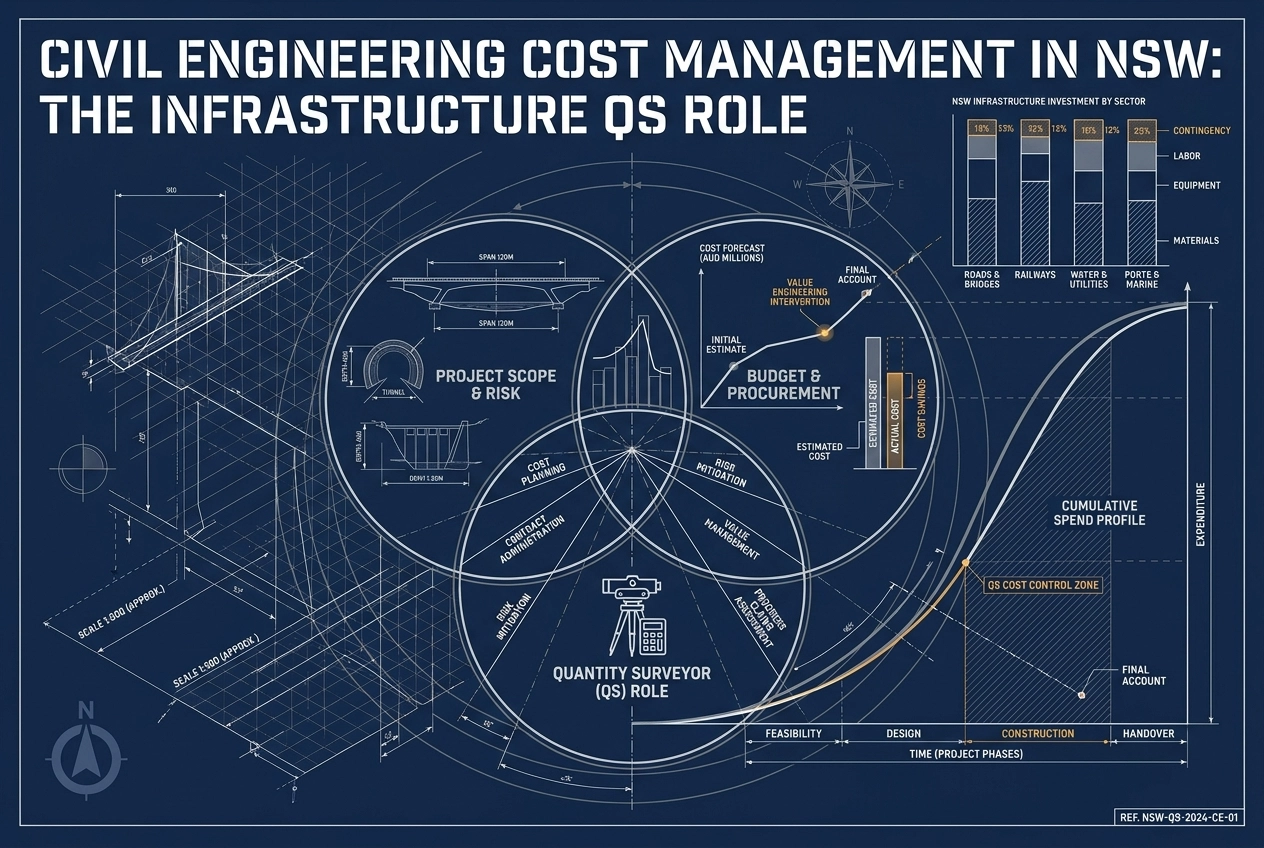
New South Wales is home to some of Australia's most ambitious infrastructure projects, from sprawling motorway networks to complex water treatment facilities. Behind every successful delivery lies a discipline that rarely makes headlines but consistently determines whether projects are completed on time and within budget. Civil engineering cost management is that discipline, and in NSW, the quantity surveyor plays a central role in making it work.
For professionals navigating the infrastructure sector, understanding how cost management functions across the project lifecycle is no longer optional. It is a core competency that shapes procurement strategies, informs design decisions, and ultimately protects public and private investment. Yet the specific responsibilities of an infrastructure QS are often misunderstood or conflated with building sector equivalents.
This analysis unpacks the distinct nature of civil engineering cost management in the NSW context. Readers will gain a clearer picture of the QS role across feasibility, design, procurement, and construction phases, explore the cost drivers unique to civil infrastructure, and understand why rigorous financial oversight is essential in an environment where project values routinely reach the billions.
What Civil Engineering Encompasses and Why Specialist Cost Advisory Matters
Civil engineering is a discipline far broader than conventional building construction. Where building projects deliver structures, civil engineering delivers the systems and networks that underpin entire economies: road and rail transport corridors, bridges and tunnels, water treatment and distribution systems, wastewater networks, energy transmission infrastructure, stormwater drainage, land remediation programs, and marine structures including wharves, jetties, and port facilities. Each of these asset classes involves distinct engineering disciplines, regulatory frameworks, procurement methods, and commercial structures that demand specialist expertise well beyond the scope of residential or commercial building practice.
The commercial complexity inherent to civil projects creates conditions where cost and commercial risks can escalate rapidly without structured oversight. Multi-discipline scopes require coordination across civil, structural, hydraulic, electrical, and environmental engineering simultaneously. Contracts are frequently high-value, extending into the hundreds of millions of dollars, and delivery timelines often span multiple years across shifting market conditions. Material cost volatility, labour availability constraints, latent ground conditions, and regulatory approvals all introduce financial uncertainty that, left unmanaged, can significantly erode project viability. This is precisely where the infrastructure quantity surveyor adds measurable value.
The infrastructure QS role extends across the full project lifecycle. At the front end, it encompasses feasibility-stage cost planning, investment case development, and procurement strategy. Through delivery, it covers tender management, contract administration, progress claim assessment, variation control, and commercial management. Infrastructure Australia's 2026 Infrastructure Priority List confirms that high-capacity transport, freight networks, water security, and clean energy are the defining investment themes of the current cycle, creating sustained demand for independent cost advisory services across New South Wales.
The NSW infrastructure pipeline, driven by Transport for NSW capital works programs, Water NSW delivery commitments, and federal co-funded initiatives, represents an unprecedented volume of civil project activity. Infrastructure NSW maintains a formal Cost Control Framework as a recognised discipline within state project governance, reflecting how seriously cost oversight is treated at the program level. This article is written for government agencies, developers, engineers, contractors, and project managers seeking a clear and practical understanding of how specialist quantity surveying services generate tangible value across the full spectrum of civil engineering projects.
Civil Engineering Project Types and Their Commercial Characteristics
Each civil engineering project type carries a distinct commercial profile, and understanding those differences is fundamental to producing cost plans, procurement strategies, and risk assessments that reflect the actual work on the ground.
Roads and Highways
Roads and highways are among the most material-intensive categories of civil infrastructure. Earthworks and pavement packages frequently represent the dominant cost components, and both are acutely sensitive to commodity market movements. Fuel price fluctuations affect plant-intensive earthmoving operations, while bitumen, as a petroleum derivative, introduces direct exposure to global oil market volatility. Experienced cost managers monitor these indices throughout project development, adjusting cost plans to reflect anticipated procurement windows and market conditions at the time of tender. Scope definition for earthworks, including cut-to-fill calculations and spoil disposal allowances, must be resolved early to prevent cost estimates from carrying unquantified risk.
Bridges and Structures
Bridge and major structure projects introduce layers of commercial complexity not present in road pavement works. Temporary works, including falsework, formwork, and construction staging, can represent a substantial proportion of contract value and require careful measurement and risk allocation. Structural steel and precast concrete elements frequently carry extended procurement lead times, and delays in confirming design details can cascade into programme and cost impacts. Specialist subcontractor procurement for post-tensioning, piling, and bearings demands early market engagement and realistic allowances for current supply chain conditions.
Rail and Transit Infrastructure
Rail infrastructure projects combine civil earthworks and structures with complex systems scopes covering signalling, overhead wiring, and communications. Managing the interface between these disciplines is one of the most commercially consequential challenges in rail delivery. Possession windows, the scheduled periods during which live rail networks are taken out of service to allow construction access, drive significant cost premiums and programme constraints. Phased delivery models, common on urban rail upgrades, require cost plans structured to reflect access limitations and the disruption costs associated with working within operational environments.
Water and Wastewater
Water and wastewater projects typically sit within regulated asset frameworks, where capital investment decisions are benchmarked against asset replacement costs and assessed against whole-of-life expenditure obligations. Constructing within live operational settings, whether inside a functioning treatment plant or alongside pressurised distribution mains, introduces risk premiums that must be explicitly identified in cost risk assessments. Shutdown and isolation requirements, temporary bypass provisions, and commissioning handover obligations all carry cost implications that generic building construction frameworks are not structured to capture. Project Management for Construction: Cost Estimation confirms that ongoing operation and maintenance obligations must be assessed alongside capital costs in total lifecycle evaluations.
Utilities and Energy
Underground services, including high-voltage power cables, gas mains, telecommunications conduits, and water distribution pipework, each carry distinct cost profiles depending on depth, diameter, ground conditions, and proximity to existing services. Trenchless installation methods such as horizontal directional drilling and pipe jacking involve significantly higher unit rates than open-cut trenching but reduce surface disruption, traffic management costs, and reinstatement obligations. Connection infrastructure, including substation tie-ins, valve chambers, and metering installations, requires specialist estimating inputs drawn from utilities-sector cost databases rather than general civil benchmarks.
Land and Civil Remediation
Remediation projects present some of the most commercially uncertain scopes within civil engineering. Subsurface conditions cannot be fully characterised until excavation commences, and contamination extents frequently differ from pre-construction assessments. This uncertainty makes contingency assessment and formal cost risk quantification especially critical. Cost estimating guidance for major projects cautions against false precision and early optimism, endorsing structured cost and schedule risk analysis as the appropriate methodology where scope uncertainty is material. Risk registers for remediation works must be calibrated to reflect the potential for scope escalation, regulatory variation requirements, and waste classification changes.
The Case for Civil-Specific Frameworks
Across all of these project types, a consistent principle applies: measurement conventions, cost databases, and risk registers must be developed from civil engineering foundations, not adapted from building construction frameworks. Civil works are measured and priced using methodologies such as the Civil Engineering Standard Method of Measurement, and cost benchmarks must draw on infrastructure-sector data sources that reflect the actual cost structure of earthworks, pipelines, structures, and utility installations. Applying building construction logic to civil infrastructure cost management produces estimates that misrepresent scope, understate risk, and fail to support informed investment decisions.
How Civil Engineering Differs from Building Construction Cost Management
Civil engineering cost management operates under fundamentally different rules than building quantity surveying, and conflating the two disciplines carries genuine commercial risk for clients and project teams alike.
Measurement conventions establish the first point of difference. Building projects are typically measured using trade-based or elemental frameworks aligned to building-specific standards. Civil works, by contrast, are governed by civil-specific measurement methodologies such as the Civil Engineering Standard Method of Measurement (CESMM) and, in highway and transport contexts, standards derived from the Manual of Contract Documents for Highway Works. These frameworks define how earthworks, drainage structures, pavements, and civil finishes are quantified, and they produce a cost plan architecture that is structurally different from anything a building-oriented QS would naturally produce. Applying building measurement conventions to civil quantities routinely produces gaps and distortions that only become visible once tenders are returned.
Cost structure reinforces this separation. Building projects are conventionally broken down by trade packages: concrete, formwork, brickwork, mechanical services, hydraulics, and fit-out. Civil projects carry an entirely different elemental composition. Earthworks and bulk excavation, sub-base and pavement layers, stormwater and drainage networks, retaining structures, and traffic management can collectively represent the majority of project cost before a single building element is introduced. A cost plan that does not reflect this composition will misrepresent where project risk actually sits. As the distinction between quantity surveyor and civil engineer roles makes clear, cost and commercial management on civil works demands a discipline-specific understanding of how value is distributed across civil infrastructure.
Procurement complexity is a further differentiator. Civil contracts are frequently awarded to large, commercially sophisticated contractors who carry dedicated claims and commercial management teams. These organisations are experienced in identifying and prosecuting claims for latent conditions, scope variation, delay, and disruption. A QS advising the client must have matching expertise in civil contract administration, claims assessment, and variation management under instruments such as AS 2124, AS 4000, or NEC-based contracts as applied in NSW infrastructure delivery. Without that capability, the client's commercial position is exposed.
Design uncertainty compounds procurement risk on civil projects. Unlike building projects that typically proceed to tender on largely resolved documentation, civil projects frequently advance through Reference Design, Concept Design, and Preliminary Engineering stages, with significant scope still unresolved at the point of cost planning. Cost plans must explicitly carry structured design risk allowances calibrated to the stage of design development, not fixed contingency percentages borrowed from building practice. Geotechnical uncertainty, environmental constraints, and utility conflicts can all shift the cost base materially between plan iterations.
Regulatory and approvals costs represent a category that is often underweighted or absent entirely from building-focused cost frameworks applied to civil projects. In NSW, environmental impact assessment requirements, biodiversity offset obligations, infrastructure contribution frameworks including Voluntary Planning Agreements and Works-in-Kind mechanisms, and works authorisations under the Roads Act 1993 can each generate cost and programme consequences that must be identified and quantified early. Early QS engagement to cost-model approval conditions is not optional on complex civil projects; it is a prerequisite for a credible business case.
The risk of applying building QS practice to civil projects is not theoretical. It produces contingency assessments that do not reflect civil-specific risk profiles, procurement strategies misaligned to civil contracting market realities, and cost plans that lack the commercial depth required to withstand scrutiny at gateway reviews or inform sound investment decisions.
The Quantity Surveyor's Role Across the Civil Engineering Project Lifecycle
The quantity surveyor's contribution to civil engineering projects is most valuable when it begins at the concept stage and continues without interruption through to final account close-out. Engaging a specialist infrastructure QS only at tender stage, a still-common practice among some project owners, forfeits the compounding benefits of early cost discipline and leaves clients exposed to budget surprises at precisely the point when design flexibility has been exhausted.
At the feasibility and business case stage, the QS prepares order-of-magnitude cost estimates, typically accurate to within plus or minus 30 to 50 percent depending on the information available, to support investment decision-making before significant design expenditure is committed. These early estimates feed directly into cost-benefit analyses, funding applications, and gateway approvals, providing decision-makers with a credible financial envelope against which project options can be tested. Early QS involvement at this stage also ensures that contingency allowances, escalation provisions, and risk budgets are established on a structured basis rather than as arbitrary percentages applied after the fact.
During cost planning and design development, the QS produces and progressively updates elemental cost plans as the project advances from reference design through preliminary design to detailed design. Each iteration refines unit rates, quantities, and risk provisions in response to developing design information, ensuring that the approved budget remains the active reference point for design decisions rather than a static figure produced at inception. Value engineering assessments conducted at key design milestones identify opportunities to reduce cost or improve constructability without compromising technical performance, a function that carries particular weight in civil infrastructure where earthworks, structures, and services interfaces are major cost drivers. According to RICS guidance on quantity surveyor roles, this lifecycle engagement, spanning cost planning, procurement, tendering, and commercial management, defines contemporary professional practice.
Procurement strategy and tender management represent a critical QS contribution that extends well beyond preparing bills of quantities. Advising on the appropriate contract model, whether a lump sum, schedule of rates, target-cost, or alliance arrangement, requires an understanding of risk allocation principles, the client's appetite for cost certainty versus flexibility, and the maturity of the design at the time of market engagement. The QS prepares tender documents, evaluates submitted prices for completeness and arithmetic accuracy, benchmarks rates against market data, and provides a structured recommendation to support contract award decisions. This analysis reduces the risk of selecting a contractor on the basis of an unrealistically low tender, a recurring source of cost and programme problems on civil infrastructure projects.
Throughout construction, the QS administers the commercial provisions of the contract by assessing progress claims, certifying payment, administering variations, and maintaining the project cost report as the authoritative record of the project's financial position. Cash flow forecasting, updated monthly, gives the client and project financiers visibility over future payment obligations and funding requirements. As quantity surveying in construction practice confirms, this active cost monitoring function, tracking actual expenditure against budget while forecasting cost to complete, is fundamental to maintaining financial control during the delivery phase.
Commercial management provides the broader discipline within which contract administration operates. The QS tracks all change events, assesses their cost and time implications, negotiates with contractors on disputed valuations, and ensures that the client's commercial exposure is understood and managed at all times. Identifying cost risk events before they crystallise as formal claims is a core skill at this stage, enabling early mitigation or provision rather than reactive settlement.
At project close-out, the QS negotiates and settles the final account, prepares cost-to-complete analyses for any outstanding work, and compiles lessons-learned benchmarking data to inform future projects. Cost data captured at close-out, including unit rates, waste allowances, and risk outturn figures, builds the benchmarking database that underpins more accurate estimates on the next project. Clients commissioning infrastructure assets also benefit from QS-prepared replacement cost assessments and asset registers that support ongoing asset management obligations. The consistent principle across all of these stages is straightforward: independent QS engagement from concept through close-out produces better cost outcomes, fewer disputes, and more efficient project delivery than episodic engagement at individual project milestones.
NSW Procurement Frameworks for Civil Engineering Projects
Procurement strategy is one of the most consequential decisions made on any civil engineering project, and NSW clients have access to a structured suite of frameworks that carry meaningfully different risk profiles, cost certainty implications, and delivery outcomes. Selecting the right model requires both an understanding of the available options and an honest assessment of the project's scope definition, risk tolerance, and timeline pressures.
GC21: The NSW Government Standard Contract
The GC21 Edition 2 is the NSW Government's primary general conditions of contract for construction, typically applied to projects valued at $2 million or more and widely used across civil and infrastructure works. Its design reflects a cooperative contracting philosophy that prioritises risk allocation, dispute mitigation, and alignment with government procurement policy. For quantity surveyors operating in the NSW market, GC21 defines the commercial framework within which payment provisions, progress claims, and variations must be administered. A specialist QS brings structured assessment of contractor payment claims against certified progress, prepares independent variation determinations, and supports dispute avoidance by maintaining accurate, contemporaneous cost records throughout construction.
Design and Construct, ECI, and Alliance Models
Design and Construct procurement is widely used for civil projects where the client seeks to transfer design risk to the contractor. Under this model, the QS contributes at two critical points: developing the Employer's Requirements to define functional and technical outcomes with sufficient rigour to support fair tender evaluation, and preparing reference cost estimates that allow meaningful comparison of D&C submissions. Evaluating D&C tenders requires more than price comparison; it demands assessment of design assumptions, risk-loaded allowances, and the commercial structure underlying each submission.
Early Contractor Involvement represents a more collaborative alternative, increasingly applied to complex civil works where scope uncertainty is high and constructability risk is real. By bringing contractor expertise into the design development phase, ECI reduces the likelihood of costly redesign or construction-phase surprises. The QS supports this process through pre-tender cost planning that reflects contractor input, providing budget validation as the design evolves toward a bankable estimate.
Alliance contracting is reserved for the highest-complexity civil programs, particularly in transport and water infrastructure, where uncertainty makes fixed-price delivery commercially impractical. The QS role in alliance projects centres on establishing the Target Outturn Cost, the agreed benchmark against which actual project performance is measured, and providing ongoing monitoring to identify cost trends and performance variances before they compound.
Managing Contractor and Construction Management Delivery
Managing contractor and construction management models are relevant for staged or technically complex civil programs where a single head contract is not appropriate. In these structures, the QS provides independent cost monitoring across trade packages, supports procurement of individual work packages, and delivers cost verification reports that give the client confidence in the integrity of expenditure as the program advances.
As The Procurement Decision in Australia notes, procurement strategy choices are rarely straightforward; contracting structure and pricing methodology are deeply intertwined, and the consequences of misalignment between model and project characteristics are typically felt in cost and schedule performance. An independent QS with practical experience across GC21, D&C, ECI, alliance, and managing contractor frameworks helps clients select the model that genuinely fits their project's risk profile, delivery timeline, and budget certainty requirements, rather than defaulting to familiarity or precedent.
Cost Drivers and Escalation in NSW Civil Engineering Projects
Understanding cost escalation in NSW civil engineering projects requires more than tracking commodity prices. It demands a structured, evidence-based approach to forecasting, risk quantification, and procurement design that accounts for the specific market conditions shaping project delivery in 2026.
Labour Shortages and Wage Pressures
Labour availability remains one of the most significant cost pressures on NSW civil construction. Shortages across key civil trades, including formwork carpenters, civil plant operators, and specialist earthworks crews, are contributing to sustained upward wage pressure that shows little sign of easing. As the ASCE noted in January 2026, the sustainability of soaring civil engineering salaries is under active industry debate, reflecting a structural imbalance between demand for skilled civil professionals and available workforce supply. In NSW, this dynamic is amplified by the concurrent delivery of major transport, water, and energy infrastructure programs competing for the same limited pool of experienced site personnel. Cost plans that rely on historical labour rates without applying current market adjustments risk systematic understatement of project costs from the outset.
Material Cost Volatility and Supply Chain Concentration
Structural steel, reinforcement, concrete, and fuel continue to exhibit price volatility driven by global commodity markets, energy costs, and supply chain disruptions that are difficult to predict at early project stages. The Altus Group's Australian Construction Material Price Outlook and Rider Levett Bucknall's Oceania publications, including the RLB Riders Digest Australia 2026, both confirm that construction cost escalation is expected to remain elevated through the current cycle. QS practitioners address this exposure by applying industry cost indices from Rawlinsons, Rider Levett Bucknall, and Turner and Townsend to escalate base-date cost plans forward to the anticipated construction period, ensuring budget projections reflect real procurement conditions rather than historical pricing. The Deloitte 2026 Engineering and Construction Industry Outlook similarly identifies supply chain constraints and workforce pressures as defining challenges for the global sector this year.
Supply chain concentration compounds these pressures. A relatively small number of civil contractors hold the capacity and resources to competitively tender large infrastructure packages in NSW, which reduces competitive tension and can inflate tender returns. This market reality reinforces the importance of well-structured procurement strategies, early market engagement, and independent tender analysis to ensure clients receive genuine market pricing rather than a reflection of constrained competition.
Program Compression and Contingency Frameworks
Government delivery timelines across NSW's major infrastructure pipeline are generating concurrent demand peaks that further tighten access to labour, plant, and materials. When multiple large programs proceed simultaneously, contractors price risk premiums into their preliminaries and general costs, and subcontractor availability narrows. These pressures feed directly into cost escalation that base-date estimates cannot capture without explicit allowances.
Academic research published in the MDPI Buildings journal in 2025 confirms that resource constraints, design changes, and contractor management capability are recurring drivers of cost overruns across the global construction industry, reinforcing that escalation risk is systemic rather than exceptional. Managing this exposure requires robust contingency and risk allowance frameworks, including quantified cost risk registers that assign probability-weighted values to identified cost risks. Applying probabilistic contingency analysis, such as P50 and P90 allowance levels, gives clients a defensible and transparent basis for budget setting that reflects genuine exposure rather than arbitrary percentage additions. Embedding these tools into cost plans from concept stage ensures escalation risk is managed proactively throughout the civil project lifecycle.
Digital Transformation in Civil Engineering Cost Management
The civil engineering sector in Australia is undergoing a meaningful shift in how project costs are estimated, monitored, and reported. According to the Australian Institute of Quantity Surveyors (AIQS), BIM adoption across Australian construction rose 37% over the two years preceding 2025, with civil infrastructure increasingly included alongside building projects in BIM-enabled delivery frameworks. This trajectory reflects a broader industry recognition that digital tools, when properly integrated into cost management workflows, produce more reliable financial outcomes across complex project lifecycles.
BIM and Model-Based Quantity Take-Offs for Civil Works
For civil engineering projects specifically, BIM offers measurable practical advantages that extend well beyond visualisation. Model-based quantity take-offs generated directly from Civil 3D environments reduce manual measurement time and substantially improve accuracy compared to traditional drawing-based methods. Where earthworks volumes, pavement layers, drainage networks, or structural elements were previously measured through time-intensive manual calculation, model-derived quantities can be extracted with greater precision and updated automatically as design iterations occur. Equally important is clash detection during design development; identifying conflicts between underground utility corridors, structural interfaces, and service crossings before construction begins directly reduces the risk of costly rework on-site, where rectification costs are significantly higher than resolution at the design stage. A systematic review published in Geo-spatial Information Science in 2026 confirms that AI and machine learning integrated with BIM environments are producing measurable improvements in construction cost estimation accuracy, reinforcing the case for model-based workflows on civil infrastructure projects.
Integrated Platforms and AI-Assisted Forecasting
Disconnected spreadsheet workflows are progressively being replaced by integrated digital cost platforms that support real-time budget monitoring, automated cost reporting, and audit-ready financial records. For government agencies, infrastructure owners, and project financiers, this shift delivers a material improvement in financial visibility; cost data is no longer consolidated manually at month-end but is available continuously, enabling faster decision-making at critical budget milestones. Analysis from CMiC's 2025 construction software trends report identifies cloud-based platforms with embedded AI capabilities as increasingly standard expectations across complex project lifecycles, not emerging luxuries.
AI-assisted cost forecasting tools are now entering mainstream quantity surveying practice. Machine learning models analyse historical project cost data to identify patterns, flag potential cost risk events, and generate forward projections that are statistically better calibrated than manual estimates alone. The important qualification, consistent across industry sources, is that these tools supplement rather than replace experienced QS judgement. Interpreting model outputs, applying project-specific context, and managing commercial risk through construction still depends on professional expertise that no algorithm currently replicates.
Emerging Tools and the Client Benefit Case
Digital twins and blockchain-based smart contracts represent the next horizon for civil infrastructure cost management. Digital twins enable ongoing cost and condition monitoring across an asset's operational life, with implications for how quantity surveyors support lifecycle cost planning and asset management advisory. Blockchain-based contracts offer the prospect of automated, milestone-triggered payment processes that reduce disputes over progress claims and variations. These applications remain near-future rather than standard practice in Australian civil infrastructure, but their trajectory is clear and practitioners should be positioning to engage with them.
For clients engaging quantity surveying services today, the practical value of a digitally capable practice is straightforward: faster, more accurate cost information at the decision points that matter most. Budget overruns on civil infrastructure projects frequently originate not from cost events themselves, but from delayed or incomplete financial reporting that allows those events to compound before they are acted upon. Digital workflows close that reporting gap, giving clients the financial clarity needed to manage contingencies, adjust scope, or escalate risks before they become unmanageable.
Dispute Resolution and Expert Witness Services in Civil Engineering
Civil engineering contracts generate a disproportionate share of construction disputes in NSW, and the structural reasons are not difficult to identify. Scope definition at tender stage is rarely complete on major infrastructure works; ground conditions, latent conditions, and design development all introduce variables that translate into variation claims, cost overruns, and programme delays. The commercial stakes compound the risk. On large transport, utilities, or water infrastructure contracts, even a modest percentage disagreement over quantum can represent millions of dollars in dispute. Contract administration practices that appear adequate during delivery frequently prove insufficient when a dispute crystallises and the parties must reconstruct the evidentiary record under adversarial pressure.
Security of Payment and Adjudication in Civil Construction
The Building and Construction Industry Security of Payment Act 1999 (NSW) applies directly to civil construction contracts, and its procedural consequences are severe for respondents who fail to engage correctly. A payment schedule must be issued within strict statutory timeframes; failure to do so exposes the respondent to liability for the full claimed amount regardless of the underlying merits. Adjudication claims arising from civil engineering contracts frequently involve disputed variations, contested progress assessments, and complex interactions between contractual entitlements and statutory obligations. Preparing an effective adjudication response, or prosecuting a well-founded payment claim, requires accurate and independently prepared quantum assessments grounded in the actual project cost record rather than reconstructed estimates assembled under time pressure.
Delay, Disruption, and Forensic Quantum Analysis
Delay and disruption claims on civil engineering projects present particular analytical challenges. Quantifying the cost consequences of design changes, unforeseen site conditions, or employer-caused delays requires a recognised methodology, including time impact analysis or windows analysis, applied to contemporaneous project records. The methodology must withstand scrutiny from an opposing expert and, ultimately, from an adjudicator, arbitrator, or court. Prolongation costs, acceleration expenses, disruption to productivity, and loss and expense all require separate evidentiary treatment, with each head of claim tethered to the entitlement basis established under the applicable contract, whether AS 4000, GC21, NEC4, or another standard form. Forensic cost analysis that is reconstructed retrospectively, without supporting cost records, carries significantly diminished persuasive force in formal proceedings.
Independence as a Commercial Differentiator
An independent quantity surveyor engaged as an expert witness in arbitration, court proceedings, or statutory adjudication must be demonstrably free of conflicts with the contractor, project team, or any party with a financial interest in the outcome. Adjudicators, arbitrators, and courts assess the credibility of expert evidence partly through the absence of those conflicts. An advisory-only practice, one that has provided no delivery services on the project in dispute, carries structural independence that project-side firms cannot replicate. Expert opinions on quantum, value of works, reasonable costs, and contract entitlements carry weight proportional to the rigour of the underlying analysis and the integrity of the expert's position. Where the evidence does not support a position being advanced, an independent expert must say so, a discipline that protects the client from overreaching claims that collapse under cross-examination.
Dispute Avoidance Through Early Engagement
The most effective dispute resolution strategy begins well before any dispute arises. Early and continuous QS engagement in contract administration builds the contemporaneous record of cost events, variation instructions, progress assessments, and site conditions that forms the evidentiary foundation of any future claim. Variation registers maintained in real time, progress claims assessed against accurate measurement, and cost event notices issued promptly all reduce the reconstruction burden if proceedings become unavoidable. Clients who invest in rigorous contract administration throughout delivery consistently find that disputes are fewer, narrower in scope, and less costly to resolve than those where commercial management was treated as a secondary concern.
The NSW Infrastructure Pipeline and Demand for Civil Engineering Advisory Services
New South Wales carries one of the largest state-funded infrastructure programs in Australia, and the scale of current and committed capital investment across transport, water, energy, and social infrastructure is generating sustained, material demand for specialist civil engineering cost advisory services. Australia's five-year major public infrastructure pipeline has grown to $242 billion, representing a $29 billion increase in a single year, with NSW identified as one of the jurisdictions where public investment is projected to rise by more than 200 percent, particularly in areas tied to energy transition and urban connectivity. For infrastructure owners, government agencies, and private sector participants operating within this pipeline, the commercial complexity of these programs makes independent cost management and procurement advisory support an operational necessity rather than an optional service.
Transport, Water, and Energy Programs Driving Civil Construction Demand
Transport infrastructure accounts for more than $129 billion of the national pipeline, and NSW's contribution to that figure is substantial. The Sydney Metro network expansion program continues to represent one of the most significant civil engineering programs in Australia's history, with tunnelling, station construction, and systems integration works generating extensive procurement activity across multiple contract packages. The Western Sydney Airport surface access network, including rail and road connections to Nancy-Bird Walton Airport, is progressing through design and procurement phases that require rigorous cost planning and contract strategy from the earliest investment stages. Ongoing highway upgrades and freight corridor improvements across regional NSW add further demand for civil engineering cost advisory services beyond the metropolitan area.
Water infrastructure investment presents an equally significant demand stream. Water NSW and Sydney Water are both managing multi-year capital programs covering dam safety upgrades, water treatment facility enhancements, aging pipeline renewal, and recycled water schemes. Each of these project categories carries distinct cost drivers, contracting structures, and risk profiles, making specialist cost management support essential from feasibility through to construction completion.
Energy transition is now the fastest-growing segment of the infrastructure pipeline nationally, with transmission projects projected to more than double to $36 billion over the next five years. NSW's Electricity Infrastructure Roadmap and associated Renewable Energy Zone programs involve geographically dispersed civil works across regional corridors where cost benchmarks are least mature and contractor market depth is thinnest.
Co-Funding Governance and the Role of Independent Cost Verification
State and federal co-funding arrangements introduce a further layer of cost governance requirements across the NSW pipeline. Programs supported through Commonwealth infrastructure funding agreements typically require independent cost verification, financial assurance, and structured gateway reviews as conditions of funding approval. These obligations align directly with the services provided by a specialist infrastructure quantity surveyor and create recurring engagement points throughout the project lifecycle. For government agencies navigating these requirements, and for private sector clients pursuing project financing within the pipeline, access to an independent infrastructure quantity surveyor with demonstrated experience across transport, water, and energy project types provides a material and practical advantage in investment decision-making, procurement strategy, and delivery management.
Sustainability, Value Engineering, and the Evolving QS Role in Civil Projects
Sustainability targets are no longer aspirational additions to NSW infrastructure procurement; they are embedded structural requirements. Transport for NSW's Sustainable Infrastructure Program (SIP), aligned to the 2026 Decarbonising Infrastructure Delivery Roadmap published by Infrastructure NSW, places carbon accountability alongside cost and schedule as a core procurement consideration. The SIP's Engineering Cost and Carbon Library, comprising over 5,000 construction resources with defined baseline carbon values, institutionalises embodied carbon reporting as a standard cost planning input rather than a voluntary overlay. For quantity surveyors working on civil infrastructure, this creates a direct professional obligation: carbon must be quantified with the same rigour applied to material volumes, labour rates, and preliminaries.
The QS contribution in this environment extends well beyond conventional measurement. Where a specification decision involves a choice between standard reinforced concrete and a lower-carbon alternative using supplementary cementitious materials, or where circular economy procurement policies require minimum recycled content thresholds, the QS provides the cost translation that allows clients to assess trade-offs clearly. Research on comparable projects demonstrates that low-carbon material selections need not carry prohibitive cost premiums when evaluated properly; a mass timber structural system, for example, has been shown to achieve a 78% reduction in embodied carbon compared to a steel equivalent at a cost premium of approximately 1.25%. Without independent cost analysis, procurement decisions default to lowest-first-cost outcomes that may carry greater whole-of-life exposure.
Value engineering in civil projects operates most effectively when it is structured and applied early. A formal value engineering process, drawing on function analysis to distinguish between what an asset element must do and how it is currently specified to do it, identifies genuine scope for cost reduction without degrading performance, safety, or compliance. On civil infrastructure, this frequently surfaces opportunities in earthworks methodology, drainage system configuration, pavement design, and materials specification. The QS, with visibility across cost, scope, and commercial risk simultaneously, is well positioned to facilitate this process at design development stage when the cost impact of design changes remains manageable.
Whole-of-life cost analysis further expands the advisory scope. Infrastructure clients across NSW are increasingly required to assess total lifecycle obligations, covering maintenance regimes, operational energy consumption, and end-of-life decommissioning, rather than capital cost alone. The modern infrastructure QS is expected to operate simultaneously as a cost manager, commercial risk advisor, sustainability analyst, and data-informed planner. Firms grounded in genuine civil engineering project experience, and capable of delivering across this expanded mandate with credibility, are significantly better placed to support clients through the complexity of contemporary infrastructure delivery.
Engaging a Specialist Infrastructure Quantity Surveyor for Civil Engineering Projects
The case for engaging a specialist infrastructure quantity surveyor on civil engineering projects rests on four interdependent pillars: cost certainty, procurement expertise, contract administration discipline, and independent dispute support. Each delivers measurable value, but their combined effect across a project lifecycle is greater than the sum of its parts. Projects without structured cost management oversight typically overrun by 10 to 30 percent, and in an environment where Australian construction costs remain more than 30 percent above pre-COVID levels, that exposure is commercially significant for any client with capital at risk.
Early engagement is the single most effective lever available to clients. A quantity surveyor introduced at feasibility and business case stage, rather than only at tender, shapes cost plans when design decisions are still fluid and changes carry minimal financial consequence. Front-end involvement allows for rigorous risk quantification, realistic contingency allocation, and procurement strategies calibrated to the specific commercial characteristics of the project. Civil projects are particularly sensitive to inadequate front-end planning; variables such as ground conditions, utilities conflicts, staged construction sequencing, and traffic management requirements each carry cost risk profiles that only structured early analysis can properly capture.
Independence is equally important. An advisory-only practice with no contractor affiliations provides government agencies, developers, and legal practitioners with cost and commercial advice that is free from commercial conflict. This matters in procurement, where impartial tender evaluation is essential, and in disputes, where independent quantum assessments and expert witness reports must withstand rigorous scrutiny.
Quantity Surveyors Sydney provides civil engineering cost management, infrastructure advisory, and expert witness services to clients across Sydney and New South Wales. Contact the team directly for project-specific advice, because each civil project carries its own cost risk profile and tailored analysis will always deliver more reliable outcomes than generic benchmarks.
Conclusion
Civil engineering cost management in NSW is a specialised discipline that demands technical depth, sector-specific knowledge, and a clear understanding of how infrastructure projects differ from traditional building works. The infrastructure QS brings measurable value at every stage, from early budget setting and procurement strategy through to final account resolution. Getting this expertise right protects investment, reduces risk, and keeps complex projects on track in one of Australia's most active construction markets.
If you are involved in planning, funding, or delivering infrastructure in NSW, now is the time to engage a qualified quantity surveyor with proven civil engineering experience. Do not wait until cost pressures emerge. Build that expertise into your project team from day one. The projects that succeed are rarely the ones with the biggest budgets; they are the ones with the strongest cost discipline behind them.