
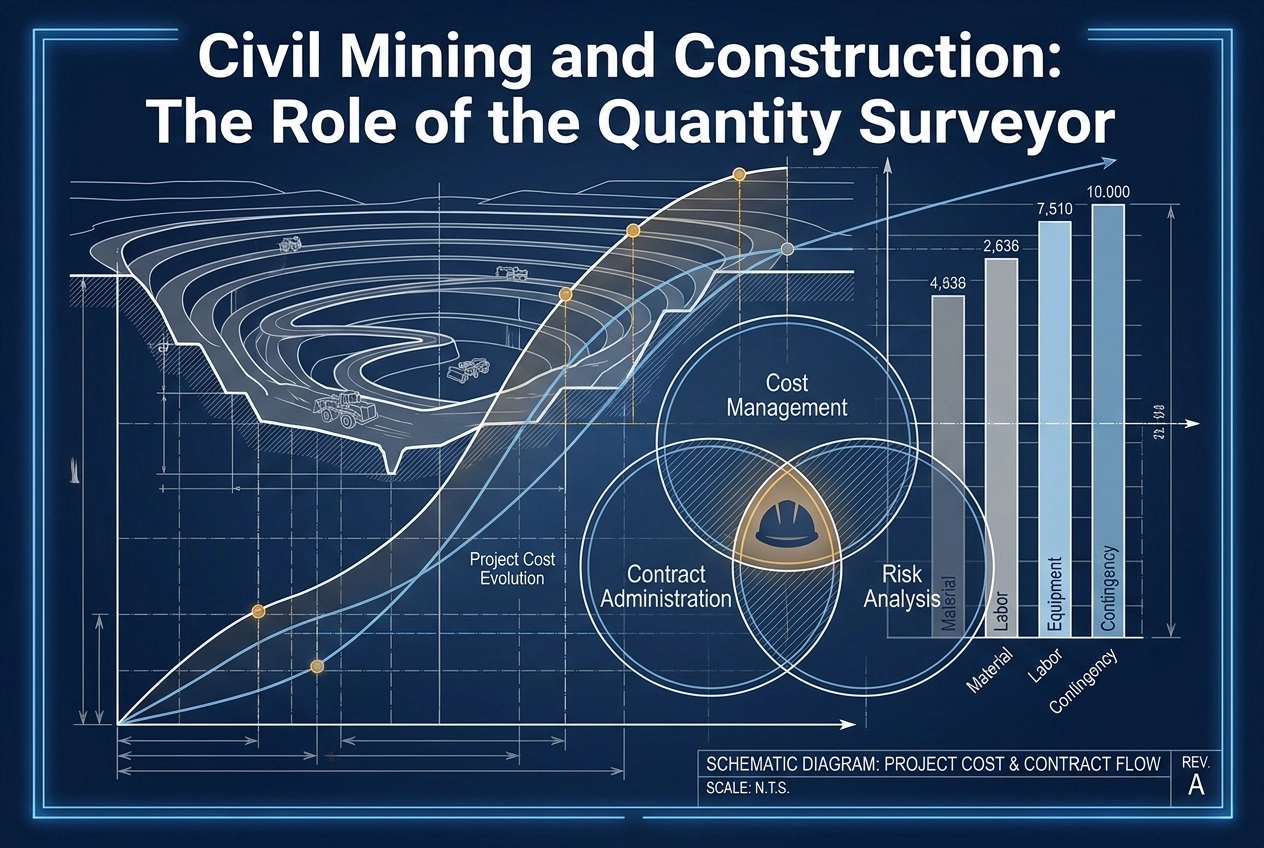
Few industries demand the level of financial precision and technical acumen required in civil mining and construction. These sectors operate at the intersection of enormous capital investment, complex logistics, and unforgiving environmental conditions, where a miscalculation in cost planning can cascade into catastrophic project failure. Yet, one professional role consistently proves instrumental in keeping these high-stakes ventures financially viable and operationally sound: the quantity surveyor.
This analysis examines the critical functions that quantity surveyors perform across civil mining and construction projects, moving beyond the conventional understanding of the role as purely cost-focused. Experienced practitioners in this field will recognise that modern quantity surveyors serve as strategic advisors, contract specialists, and risk managers, embedded within project lifecycles from initial feasibility through to final account settlement. Readers can expect a rigorous exploration of procurement strategy, cost control methodology, contractual frameworks, and the unique challenges that distinguish mining and heavy civil environments from conventional construction. If you work in or around these industries, understanding the full scope of this discipline is not optional; it is essential.
What Civil Mining and Construction Encompasses
Civil mining and construction describes a specialist sector of civil engineering focused on delivering the physical infrastructure that enables resource extraction to occur. It is a broad and technically demanding field encompassing bulk earthworks and excavation, haul road construction, processing facility civil works, tailings storage facilities (TSFs), ROM pad construction, pipelines, site drainage, power reticulation, water supply infrastructure, and the full suite of non-process infrastructure (NPI) that supports mining operations. Civil works in this context are not incidental to a mining project; they form its operational foundation. Without engineered access roads, correctly graded drainage, structurally sound TSF embankments, and well-sequenced earthworks platforms, a mine cannot function, finance, or be insured.
What distinguishes civil mining construction from general infrastructure or building construction is not merely the technical scope but the operational environment in which it is delivered. Projects are frequently located in remote or regionally isolated corridors, where site establishment costs, labour mobilisation, and supply chain logistics represent a material proportion of total project cost, sometimes accounting for 15 to 25 percent of a package value before a single cubic metre of material is moved. Contract structures also differ significantly from the urban construction market. Engineering, Procurement and Construction Management (EPCM) contracts are the dominant delivery model for mining capital projects, with EPC and alliance contracting used where the owner seeks greater cost certainty or where collaborative risk-sharing is commercially appropriate. Each structure carries distinct implications for how a quantity surveyor defines scope boundaries, manages variations, and certifies progress payments. The interface between civil works and process plant scopes, specifically the handover point between structural concrete and mechanical installation, is a persistent source of claims and disputes requiring disciplined scope definition from the earliest procurement stage.
The quantity surveying role in construction applies across every stage and project type within this sector. On a greenfield mine site, the QS may be engaged during prefeasibility to develop order-of-magnitude cost plans for bulk earthworks and haul road networks. During detailed design, the role shifts to preparing bills of quantities, structuring tender packages, and conducting commercial evaluation of contractor submissions. Through construction, the QS administers contracts, assesses progress claims, manages the variation register, and supports the resolution of disputes before they escalate. On brownfield or operational sites, such as a civil upgrade to an existing processing facility or the extension of a TSF embankment, the scope is often tighter but the commercial complexity is higher, given the interaction with live operations, production constraints, and existing contract frameworks.
The client base engaging specialist QS services across civil mining and construction is broad and varied. Mining project owners, from major resource companies to mid-tier developers advancing projects through feasibility and front-end engineering design (FEED), require independent cost assurance at each project gate. Civil and EPCM contractors operating under negotiated or tendered packages need commercial management support to control costs against awarded budgets. Engineering firms developing design packages benefit from QS input to align design decisions with cost targets. Government agencies managing resource corridor infrastructure, including sealed access roads, port access upgrades, and regional utilities, require procurement advisory and contract administration services consistent with public accountability frameworks. Project financiers, including institutional lenders and export credit agencies, routinely require an independent quantity surveyor to review and certify cost estimates as part of bankable feasibility study requirements and ongoing drawdown certification during construction.
Mining-adjacent civil works represent a growing and distinct area of demand within this sector. Water supply and treatment infrastructure, high-voltage power transmission lines, access roads connecting mines to rail terminals or ports, and the increasingly regulated domain of tailings management each constitute standalone civil scopes with their own cost drivers, measurement conventions, and risk profiles. The 2020 Global Industry Standard on Tailings Management, co-developed by the International Council on Mining and Metals and the UN Environment Programme, has materially increased the compliance, design, and cost management burden associated with TSF construction and ongoing monitoring. As the energy transition drives new investment in lithium, copper, and nickel projects across remote Australian corridors, demand for specialist cost management across these interconnected civil scopes is strengthening. Civil and mining capital project professionals increasingly recognise that a well-structured QS engagement, beginning at feasibility and maintained through to project close-out, is one of the most effective mechanisms available for controlling cost and programme outcomes on high-risk, high-value civil mining works.
Quantity Surveying Services Across the Project Lifecycle
Effective quantity surveying in civil mining and construction is not a single-point service. It is a structured, staged discipline that engages at every phase of a project's lifecycle, from the first investment question through to final account resolution. Understanding where these services apply, and why each stage carries its own commercial significance, is fundamental to managing the cost and contractual risk inherent in complex civil infrastructure.
Feasibility and Concept Stage
At the earliest stage of project development, before engineering design has advanced beyond a concept, decision-makers require credible cost intelligence to support investment cases and funding approvals. Order-of-magnitude estimates, developed through parametric benchmarking against comparable civil and mining projects, provide the cost inputs that underpin business cases and gate-approval submissions. At this stage, estimate accuracy typically falls within a Class 5 range per AACE International classification, reflecting the inherent uncertainties of early-stage scope definition. The discipline lies not in false precision, but in clearly communicating cost ranges, key assumptions, and the risk provisions required to make an investment decision on defensible grounds. Establishing cost certainty before capital commitment is made protects project owners from the compounding consequences of underestimated budgets and inadequately funded programs.
Cost Planning and Budget Development
As design progresses through pre-FEED and FEED stages toward detailed design, cost plans must evolve in parallel. Progressive cost planning, structured to reflect each design milestone, allows project owners and their financiers to track cost growth, validate scope decisions, and intervene where budget pressure emerges. Cost modelling of design options enables structured comparison of alternatives, giving engineering and commercial teams the evidence base to make value-driven decisions. Formal value engineering workshops, conducted at key design stages, systematically assess scope elements against cost and functional outcomes, identifying opportunities to optimise without compromising project delivery objectives or safety standards. This staged approach transforms cost planning from a reporting function into an active project management tool.
Bills of Quantities and Tender Documentation
Detailed bills of quantities for civil earthworks, drainage, pavements, structures, and utilities scopes form the commercial backbone of competitive tender processes. A well-prepared BoQ defines scope with sufficient precision to obtain comparable contractor submissions, reduce post-award scope disputes, and support robust contract administration throughout construction. Equally important is the tender analysis and normalisation process, which examines each submission for scope gaps, pricing qualifications, rate anomalies, and alternative interpretations. Without rigorous normalisation, apparent price differences between contractors can obscure genuine commercial risk, leading to award decisions that carry hidden exposure.
Contract Administration and Progress Claim Assessment
Through construction, the quantity surveyor operates as the independent commercial manager of the contract. This encompasses assessing contractor progress claims against physical works completed, evaluating and certifying variations in accordance with contract entitlements, maintaining cost-to-complete forecasts, and managing the formal correspondence record. In high-value civil and mining contracts, independent progress claim assessment is a particularly critical function. Over-certification, whether resulting from inadequate site measurement, insufficient scrutiny of schedule-of-rates applications, or acceptance of unsupported claims, carries direct financial risk for project owners. Under contracts such as AS 4000 or NEC4, the payment certification framework creates legally enforceable obligations; precision and independence in this role are not optional.
Final Account and Close-Out
At project completion, the independent assessment of contractor final accounts brings the commercial lifecycle to a structured close. This involves resolving outstanding variations, assessing any unagreed claims, and reconciling the final certified sum against the approved budget. Beyond settlement, the production of post-project cost reports, capturing actual unit rates, productivity data, and cost drivers across civil scopes, creates a benchmarking resource that directly improves the accuracy of future estimates. For organisations managing ongoing infrastructure pipelines, this close-out intelligence compounds in value across successive projects, strengthening both procurement outcomes and investment decision quality.
Cost Challenges Unique to Mining Construction Projects
Mining construction projects present a cost management challenge that is fundamentally different in character from general civil infrastructure work. The geographic remoteness, logistical complexity, and multi-contractor environments that define this sector introduce structural cost drivers that require explicit identification, quantification, and management from the earliest stages of project development. Treating these factors as contingency items rather than modelled cost components is one of the most consistent causes of cost plan failure across the resource sector.
Remote Site Cost Premiums and FIFO Workforce Costing
Construction in regional and resource corridor locations attracts measurable premiums across every cost category. Labour rates for remote site work typically reflect locality allowances, travel time, and market scarcity for skilled civil tradespeople and supervisors willing to work in isolated locations. Materials procurement costs incorporate extended freight distances, limited supplier competition, and the logistics of managing supply chains into areas without established road or rail access. Plant hire and fuel costs are similarly elevated when mobilisation distances are significant and local refuelling infrastructure is absent. These premiums are not marginal adjustments; they represent structural cost differentials that must be modelled as discrete line items within cost plans and priced explicitly within tender documents.
Fly-in fly-out workforce arrangements compound these premiums by introducing a parallel layer of direct costs that are entirely absent from urban or regional construction. Charter airfares or commercial aviation costs, purpose-built camp accommodation or off-site facility hire, living allowances, and the productivity differentials inherent in roster-pattern work arrangements all contribute to a civil labour cost profile that can be substantially higher than schedule rates alone suggest. Proper quantification of FIFO costs requires disaggregating the total labour cost into its constituent elements, including mob and demob time within rosters, rather than applying a blended rate that obscures the true cost structure.
Site Establishment, Demobilisation, and Contract Structure
Site establishment and demobilisation costs are among the most consistently underestimated components in early-stage mining project estimates. On greenfield mining projects, which represent the dominant project type in new resource development, the complete absence of existing infrastructure means that camp construction, access road formation and maintenance, fuel and water supply systems, temporary power generation, and communications infrastructure must all be delivered before productive civil construction work can begin. Industry cost engineering practice indicates that these costs can represent 10 to 20 percent or more of total project cost on remote greenfield sites, yet feasibility-stage estimates frequently treat establishment costs as a minor preliminary or reduce them to a percentage allowance without independent quantification.
Contract structure selection adds another layer of commercial complexity. Under an EPC model, the contractor assumes responsibility for all activities from design through procurement and construction, transferring significant cost certainty risk to a single party but typically attracting a premium for that risk assumption. Under an EPCM model, the EPCM contractor manages the construction process on behalf of the owner while construction contracts remain with the owner, preserving scope flexibility and owner control but retaining cost risk within the owner's organisation. As noted in analysis of EPCM arrangements on mining projects, this model allows adjustments in project scope and scale in response to market conditions, which carries particular value across multi-year project timelines. Alliance contracting introduces shared risk and reward mechanisms that can align contractor and owner incentives on complex projects, but requires sophisticated commercial management to realise those benefits. Each model creates different QS intervention points, cost reporting obligations, and variation management disciplines.
Commodity Volatility and Interface Management
Civil mining construction is acutely exposed to price movements in steel, explosives, fuel, and aggregate, the core material inputs for earthworks, concrete structures, access infrastructure, and site development. Projects with development and construction timelines extending two to five years cannot be costed on the basis of current pricing without explicit escalation modelling. As of early 2026, global procurement complexity has reached unprecedented levels driven by macroeconomic and geopolitical uncertainty, with contractor capacity constraints placing upward pressure on both pricing and risk transfer terms. Cost plans for mining projects must incorporate index-linked escalation provisions, identify long-lead procurement candidates for early award, and allocate commodity price risk through contract mechanisms rather than absorbing it in contingency.
Interface management between civil construction scope and process plant, mechanical, electrical, and instrumentation scopes represents a further and often underappreciated source of variation and claims exposure. The boundaries between these disciplines are inherently ambiguous, and without clearly defined scope interfaces supported by rigorous contract structuring and proactive cost management, variation orders accumulate and schedule impacts compound. Failure to manage these interfaces formally, with all change requests transmitted through documented channels, creates audit trail gaps that weaken the owner's position in any subsequent claims or dispute resolution process. Addressing interface cost risk requires investment at the contract drafting stage, not at the point when variations have already been incurred.
Infrastructure Pipeline Driving Civil Construction Demand
Australia's infrastructure investment cycle has entered a period of historic scale, and the downstream implications for civil construction cost management are substantial. Queensland's 2026-27 Budget commits a record $119.241 billion over four years, the largest capital program in the state's history, with $29.616 billion allocated in 2026-27 alone supporting 71,500 jobs. This is not a short-term stimulus measure. It represents a structured, multi-year capital pipeline that creates sustained forward demand for cost planning, procurement advisory, contract administration, and independent cost assurance services across transport, utilities, health, and resource corridor infrastructure. For infrastructure quantity surveyors, the significance lies not just in the volume of work but in the complexity and duration of delivery programs that require professional cost management engagement from concept through to final account.
Transport and mobility investment of $11.165 billion in 2026-27 forms the backbone of Queensland's capital program, with the full four-year transport allocation reaching $55.9 billion. The $9 billion Bruce Highway Targeted Safety Program, restored under an 80:20 federal-state funding arrangement, is among the largest single civil works programs in the country. Projects of this scale and duration require specialist QS input at every phase: early-stage cost planning and business case support, procurement strategy and tender management, progress claim assessment during construction, and commercial close-out on completion. These are not roles that generalist practitioners are positioned to fill effectively on corridor-scale civil infrastructure. According to industry analysis of Queensland's 2026-27 capital program, the breadth of investment spans transport, health, energy, water, and regional enabling infrastructure simultaneously.
A defining feature of Queensland's capital program is its geographic distribution. A striking 69.3% of capital investment is directed outside Greater Brisbane, supporting 48,500 regional jobs across the state. This concentration of civil infrastructure and mining-adjacent construction in regional and resource corridors creates specific cost management challenges. Logistics premiums, labour market thinness, limited subcontractor competition, and site-specific procurement conditions all affect cost plan accuracy in ways that cannot be addressed with metropolitan benchmarks. Specialist infrastructure quantity surveyors with direct experience in regional and resource corridor delivery bring cost intelligence that is not replicable from a general practice base. The infrastructure workforce implications of this regional pipeline are equally significant, with Construction Skills Queensland estimating an average annual workforce shortfall of 18,200 workers over the next eight years, peaking near 50,000 in the current financial year.
NSW presents an equivalent and parallel pipeline for Sydney-based infrastructure practitioners. Sydney Metro network expansions, the Snowy 2.0 transmission and enabling works program, Hunter Valley resource sector upgrades, and sustained road and water infrastructure investment across regional NSW collectively represent a programme of civil construction activity that mirrors Queensland's scale at the state level. These projects share the same commercial management demands: front-end cost assurance, procurement strategy development, risk and contingency modelling, and ongoing contract administration through delivery.
The scale of national infrastructure investment is also reshaping the nature of QS engagement itself. Government clients and private infrastructure owners are increasingly seeking independent cost assurance and project controls capability, not simply post-design measurement. As programme complexity increases and contractor insolvency risk remains elevated, the value of front-end cost planning and structured procurement advice is demonstrably higher than it was in less pressured markets. Engaging a specialist infrastructure quantity surveyor, rather than a generalist practice, directly affects the reliability of cost plans, the competitiveness of tender outcomes, and the commercial resilience of projects through delivery. Sector-specific cost benchmarks, procurement knowledge, and familiarity with civil construction contract frameworks are not peripheral advantages; they are foundational to achieving cost certainty on programs of this scale and duration.
Procurement Strategy and Contract Structuring in Civil Mining
Procurement decisions made at the front end of a civil mining project carry cost and commercial consequences that persist through every subsequent phase of delivery. Selecting the appropriate contract model is not a formulaic exercise; it requires structured analysis of where the project sits in terms of scope definition maturity, the owner's risk tolerance, prevailing market capacity, programme constraints, and the specific commercial objectives driving the investment. A lump sum contract delivers price certainty but only where scope and design are sufficiently complete to support competitive fixed-price tendering. Forcing a lump sum procurement on an immature scope transfers uncertainty to contractors, who respond with inflated contingency loadings or, in a constrained market, by declining to tender altogether. Schedule of rates contracts suit civil mining works where quantities cannot be confidently fixed at award, allowing payment against measured outputs while preserving competitive tension across the unit rates. For larger, more complex programmes, EPC delivery transfers engineering, procurement, and construction risk to a single contractor, providing schedule and cost certainty where scope is well-defined, while EPCM structures retain owner control and flexibility at the cost of retaining more delivery risk internally. Alliance and GMP models occupy a middle ground, appropriate where collaborative risk-sharing better reflects the project's risk profile and the owner's capability to actively participate in delivery governance.
Tender Management and Market Engagement
Structuring a tender package that attracts genuinely competitive responses requires more than issuing documentation. In the current civil construction market, where contractor capacity is stretched across a substantial infrastructure pipeline, owners who present poorly scoped, risk-heavy tender packages are increasingly finding themselves with limited field responses or commercially uncompetitive pricing. Specialist quantity surveying input at tender preparation stage directly shapes these outcomes. A well-structured tender package defines scope boundaries clearly, allocates risk in a manner the market can price with reasonable confidence, and presents commercial conditions that experienced civil contractors recognise as workable. Unrealistic liquidated damages provisions, overly broad latent conditions clauses, or ambiguous interface responsibilities all create pricing uncertainty that contractors resolve by loading rates. Independent QS advice at this stage identifies where contract conditions are likely to generate adverse market responses and recommends adjustments that improve competitiveness without compromising the owner's commercial position.
Tender Analysis, Normalisation, and Risk Allocation
When civil contractor submissions are received, they rarely arrive in a form that permits direct comparison. Tenderers interpret scope differently, apply varying approaches to provisional sums, price contingency at different rates, and structure their rate schedules to protect margins across anticipated scope variations. Rigorous tender normalisation, conducted by an independent quantity surveyor, adjusts submissions to a common basis, removing the distortions introduced by differing scope interpretations and pricing strategies. This process enables decision-makers to distinguish genuine price competition from pricing that reflects risk premiums or scope exclusions, and supports defensible award recommendations aligned with value for money objectives.
Risk allocation within the contract terms is equally consequential. In civil mining contracts, the treatment of geotechnical uncertainty, adverse weather, site access constraints, and construction interface management carries direct cost implications. Under EPC contract structures, the contractor bears the majority of these construction phase risks, pricing them accordingly. Under EPCM or schedule of rates arrangements, the owner retains greater exposure to these same variables. A quantity surveyor engaged during contract preparation should model the cost implications of alternative risk allocation positions, advising on where risk transfer is commercially achievable and where retaining risk internally, supported by appropriate contingency and project controls, produces a better overall commercial outcome.
Schedule of Rates Preparation
For civil mining works where full scope definition is not achievable at tender, a well-constructed schedule of rates is one of the most effective tools available to protect the owner's commercial position. The document must go beyond a basic list of items; it requires carefully measured work items that reflect the anticipated scope, provisional quantities set at realistic levels, daywork provisions structured to prevent abuse during variation-intensive phases, and rise-and-fall mechanisms where contract duration creates material cost escalation exposure. A poorly prepared schedule of rates becomes a mechanism through which contractors recover margin through rate manipulation on high-volume items, particularly earthworks, drainage, and pavement works where actual quantities routinely diverge from tender estimates. Quantity surveying expertise applied at this stage creates the commercial framework within which cost management during construction becomes meaningful and enforceable.
Dispute Resolution and Security of Payment in Civil Contracts
Dispute avoidance and resolution has emerged as the defining commercial challenge for construction professionals operating across Australia and New Zealand in 2026. The RICS Australasia Commercial Management of Construction Conference, scheduled for Sydney on 30 April 2026, places dispute avoidance, programme and delay management, and alternative dispute resolution (ADR) at the centre of its agenda. This professional consensus reflects a measurable increase in the frequency and financial value of civil construction claims, driven by contract complexity, compressed programmes, escalating costs, and the high-stakes nature of civil mining delivery environments.
Security of Payment Obligations in Civil and Mining Contracts
Security of Payment (SOP) legislation now operates across every Australian state and territory, creating a statutory framework that governs the timing and process for progress claims, payment schedules, and adjudication. In NSW, the Building and Construction Industry Security of Payment Act 1999 applies to civil and mining construction contracts, obliging respondents to issue a payment schedule within prescribed timeframes or risk the full claimed amount becoming payable. Civil works, earthworks, drainage, utilities, and mining-related construction facilities are expressly captured under equivalent legislation in other jurisdictions, including Western Australia's Building and Construction Industry (Security of Payment) Act 2021, which commenced for contracts entered into on or after 1 August 2022. Victoria's regime underwent its most significant reform since 2002, with amendments effective 15 April 2026 abolishing reference dates, extending the payment claim window to six months, and restricting adjudication responses from raising reasons not previously identified in the payment schedule. For a comprehensive overview of how security of payment in Australia applies across jurisdictions, practitioners should review the applicable state statute at contract formation.
The QS Role in Adjudication Support
When a payment dispute proceeds to statutory adjudication, the quantity surveyor plays a technically critical role on both sides of the process. For claimants, the QS prepares or reviews adjudication applications, quantifies the claimed amount with supporting cost evidence, and ensures that items are presented with sufficient particularity to withstand scrutiny. For respondents, the QS assesses the payment schedule, identifies overstated or unsubstantiated claims, and provides technical cost analysis to support the adjudicator's determination. Statutory adjudication is designed to operate quickly; depending on the applicable legislation, a determination can be reached in less than a month. The interim and binding nature of adjudication outcomes makes precise, well-documented QS input essential from the outset. The role of a specialist Security of Payment adjudicator in construction is distinct from that of the QS advisor, but the two functions interact closely throughout the process.
Delay, Disruption, and Prolongation Cost Claims
Large civil mining projects routinely give rise to complex delay and disruption claims where programme slippage translates directly into significant prolongation cost exposure. Quantifying these claims requires detailed analysis of the as-built programme against the planned baseline, identification of delay events and their contractual characterisation, and precise measurement of time-related site overheads, extended equipment hire, and extended labour costs. Contra-charges and back-charges applied by principals or head contractors add a further layer of complexity, requiring the QS to assess whether the contractual basis for those deductions is valid and whether the quantum claimed is reasonable. This work sits at the intersection of quantity surveying and programming expertise, and produces the defensible, evidence-based analysis that adjudicators, arbitrators, and courts require.
Expert Witness Services in Construction Disputes
Where civil construction disputes escalate beyond adjudication to expert determination, arbitration, or litigation, an independent QS expert provides written reports and oral evidence on quantum matters. The scope of expert witness services typically includes the valuation of variations, assessment of prolongation costs, analysis of actual against tendered rates, and damages quantification across complex multi-party claims. Expert witnesses in construction disputes are subject to strict obligations of independence and compliance with expert witness protocols, including the capacity to prepare joint reports and give concurrent evidence. The credibility and utility of expert QS evidence depends on demonstrated impartiality, rigorous methodology, and clear, accessible reasoning that assists the tribunal rather than simply advancing a party's position.
Proactive Dispute Avoidance as a Commercial Priority
The most effective and cost-efficient approach to dispute management in civil mining construction remains prevention rather than resolution. Clear, unambiguous contract documentation at tender stage, rigorous tender analysis that identifies programme and pricing risks before award, and disciplined variation management throughout the project life cycle substantially reduce the claims exposure that leads to formal dispute processes. Contemporaneous record-keeping, notice compliance, and the maintenance of a live variation register are fundamental commercial disciplines in civil mining environments, where the volume and value of scope changes can accumulate rapidly. Notice-based time bars present a particular risk; failure to comply with prescribed notification periods can extinguish otherwise valid contractual entitlements, regardless of the underlying merit of a claim. Front-end investment in commercial management infrastructure consistently delivers better outcomes than reactive dispute management after claims have already crystallised.
Project Controls and Cost Management for Civil Infrastructure
Effective project controls in civil infrastructure and mining construction depend on the integration of cost forecasting, earned value analysis, and programme performance data into a single, coherent framework. When these functions operate in isolation, warning signals are routinely missed. Cost overruns materialise without prior indication, and schedule slippage translates into financial exposure before corrective action becomes possible. A properly structured project controls or cost management framework fuses cost to schedule, ensuring that the management of one discipline actively informs the other. For civil mining projects in particular, where scope complexity, remote logistics, and ground condition uncertainty amplify risk at every phase, integrated controls are not a process refinement; they are a fundamental requirement of commercially sound project delivery.
Cost reporting and forecasting provide the visibility that project owners, public funding agencies, and construction lenders require to make timely commercial decisions. Structured cost reports should track committed costs, actual expenditure, forecast final costs, and contingency drawdown at regular intervals aligned to project milestones. These reports serve a dual function: they support internal governance and they satisfy external funding reporting obligations. For government capital programs and private sector projects with construction finance in place, the format, frequency, and level of detail required in cost reports are often prescribed by funding agreements. Quantity surveying practitioners are well positioned to prepare, maintain, and certify these reports throughout the construction phase, providing independent assurance alongside commercial management support.
Variation management represents one of the most consequential cost control disciplines in complex civil contracts. Unmanaged variations are a primary driver of budget overruns across infrastructure delivery, and the risk is amplified in lump sum and construct-only arrangements where scope boundaries are contested. A structured variation management process requires timely assessment of each change event, independent quantity surveyor review of the contractor's valuation, and formal written approval before varied work proceeds. Without this discipline, variation exposure accumulates progressively and becomes difficult to resolve through the final account process.
Contingency management requires a risk-based approach that evolves across project phases. Allowances appropriate at concept stage, typically reflecting high scope uncertainty, should reduce incrementally as design definition improves, risk registers are updated, and contract terms are finalised. Drawdown of contingency must be governed by formal approval and linked to identified risk events rather than treated as a general budget reserve.
Cash flow forecasting tied to physical progress and contract milestones is a standard deliverable for project financiers and public sector funding agencies. Accurate forecasting requires that payment schedules, certified progress, and anticipated variations are all reflected in a forward-looking model that is updated throughout construction and aligned to the programme of works.
Emerging Considerations: Carbon Costing and Sector Specialisation
The discipline of quantity surveying in civil mining and construction is evolving rapidly, and two converging trends are reshaping what clients should expect from specialist practitioners: the integration of embodied carbon costing into standard cost planning workflows, and the growing competitive advantage delivered by deep sub-sector specialisation.
Embodied Carbon Costing in Civil Infrastructure
Embodied carbon now represents the primary emissions challenge on large civil and mining projects. Scope 3 emissions, the majority of which are embodied carbon, account for an estimated 94 to 98 percent of Tier 1 contractors' total emissions. Yet current practice remains fragmented. Research presented at the CIB Conference in 2025 found that only 20 percent of carbon assessments on construction projects were calculated using product-specific Environmental Product Declarations, with the remainder relying on industry averages. Carbon assessments were typically completed only at detailed design stage, whereas cost estimates were updated at every project phase. These gaps are directly relevant to civil mining projects, where earthworks volumes, concrete intensity, and haulage distances create material carbon exposure from the earliest design decisions.
Forward-thinking quantity surveying practices are beginning to address this by presenting cost plans that incorporate both financial and carbon cost metrics in parallel. Databases such as the Built Environment Carbon Database, which now holds data on more than 9,200 construction materials, provide a practical foundation for this dual reporting approach. The business case is clear: one case study demonstrated an embodied carbon reduction of 78 percent for a cost premium of just 1.25 percent through informed material selection. A poll of 300 construction professionals found that only 17 percent identified quantity surveyors as responsible for whole-life carbon assessment on projects, with 36 percent nominating sustainability consultants instead. This represents both a capability gap and a genuine service development opportunity for QS practitioners operating in the civil infrastructure market.
Sub-Sector Specialisation and Digital Integration
Generic quantity surveying practice is increasingly insufficient for complex civil and mining projects. The leading practitioners in this market are differentiating by infrastructure sub-sector, whether transport, water, energy, or mining, rather than offering undifferentiated services. Specialist knowledge of sector-specific contract structures, cost benchmarks, and procurement norms produces measurably better outcomes than generalist approaches, particularly on projects involving complex interfaces, remote logistics, or non-standard risk profiles.
Digital capability is accelerating this specialisation. BIM integration, project management platforms, and emerging digital twin applications are creating opportunities for QS practitioners to connect cost management directly to design data, improving quantity take-off accuracy and enabling more dynamic cost forecasting across project phases. Current research indicates that only 11 percent of carbon and cost data is currently extracted directly from BIM models, with 89 percent still sourced from 2D drawings, highlighting the significant headroom for improvement as digital workflows mature. Practitioners who invest in these capabilities now will be better positioned to serve institutional and government clients who are subject to growing ESG reporting obligations under frameworks applied by investors, infrastructure funders, and regulators. Integrating cost reporting with sustainability metrics is no longer an optional value-add; it is becoming a baseline expectation on major civil infrastructure programmes.
How Quantity Surveyors Sydney Supports Civil Mining and Construction Projects
Quantity Surveyors Sydney provides specialist infrastructure cost and commercial advisory services across the full civil mining and construction project lifecycle. From early feasibility cost estimates and business case inputs through to final account resolution and dispute support, the practice engages at every stage where independent, evidence-based commercial advice is required. Service coverage extends across civil infrastructure, mining-adjacent project types, transport, utilities, energy, and water, providing clients with a single, experienced point of contact for cost and commercial management regardless of project scale or complexity.
Independent cost management sits at the centre of the service offering. Project owners, engineering firms, government agencies, and contractors all benefit from objective commercial advice that carries no conflict of interest from contractor or developer relationships. Where contractor pricing varies significantly across tender returns due to differing risk interpretations and scope assumptions, independent QS analysis provides the clarity and rigour that defensible decision-making demands.
On procurement and tender advisory, Quantity Surveyors Sydney structures procurement strategies appropriate to the risk profile and delivery requirements of each civil or mining package. This includes preparing tender documentation, schedules of rates, and bills of quantities, followed by rigorous tender analysis and normalisation to support well-reasoned award recommendations that withstand scrutiny from clients, boards, and government procurement frameworks.
Through construction, the practice manages the commercial framework through contract administration and independent progress claim assessment. This encompasses verification of contractor progress claims, variation assessment, and cost-to-complete forecasting, providing clients with accurate, current visibility over their financial exposure on civil and mining contracts.
Where disputes arise, Quantity Surveyors Sydney provides expert QS input to Security of Payment adjudications under the Building and Construction Industry Security of Payment Act 1999 (NSW), delay and disruption claims, and formal dispute processes including arbitration and litigation. Expert reports are prepared to the standards required for admissible evidence in formal proceedings.
Clients seeking specialist civil mining and construction cost and commercial advisory services are encouraged to contact Quantity Surveyors Sydney to discuss their specific project requirements.
Conclusion
Civil mining and construction projects operate at a level of commercial complexity that generalist cost management practices are not equipped to address. Remote site cost premiums, sophisticated contract structures, large-scale procurement programs, and an active dispute environment collectively demand specialist expertise applied consistently from the earliest project stage through to final account close-out. The forward pipeline reinforces this imperative: with Queensland committing a record $119.241 billion four-year capital program and comparable infrastructure investment flowing through NSW, the volume and scale of civil construction work entering the market sustains significant demand for rigorous cost management, procurement advisory, and commercial management services.
For project owners, contractors, and engineering firms, the most consequential decision is timing. Engaging specialist infrastructure quantity surveying services at concept and feasibility stage, rather than at construction commencement, consistently produces stronger cost certainty, more effective risk allocation, and better procurement outcomes. Front-end investment in cost planning and procurement strategy is not an overhead; it is a risk mitigation measure with measurable return across the project lifecycle.
Quantity Surveyors Sydney provides independent, specialist civil mining and construction cost and commercial advisory support. Contact the team to discuss your project requirements.