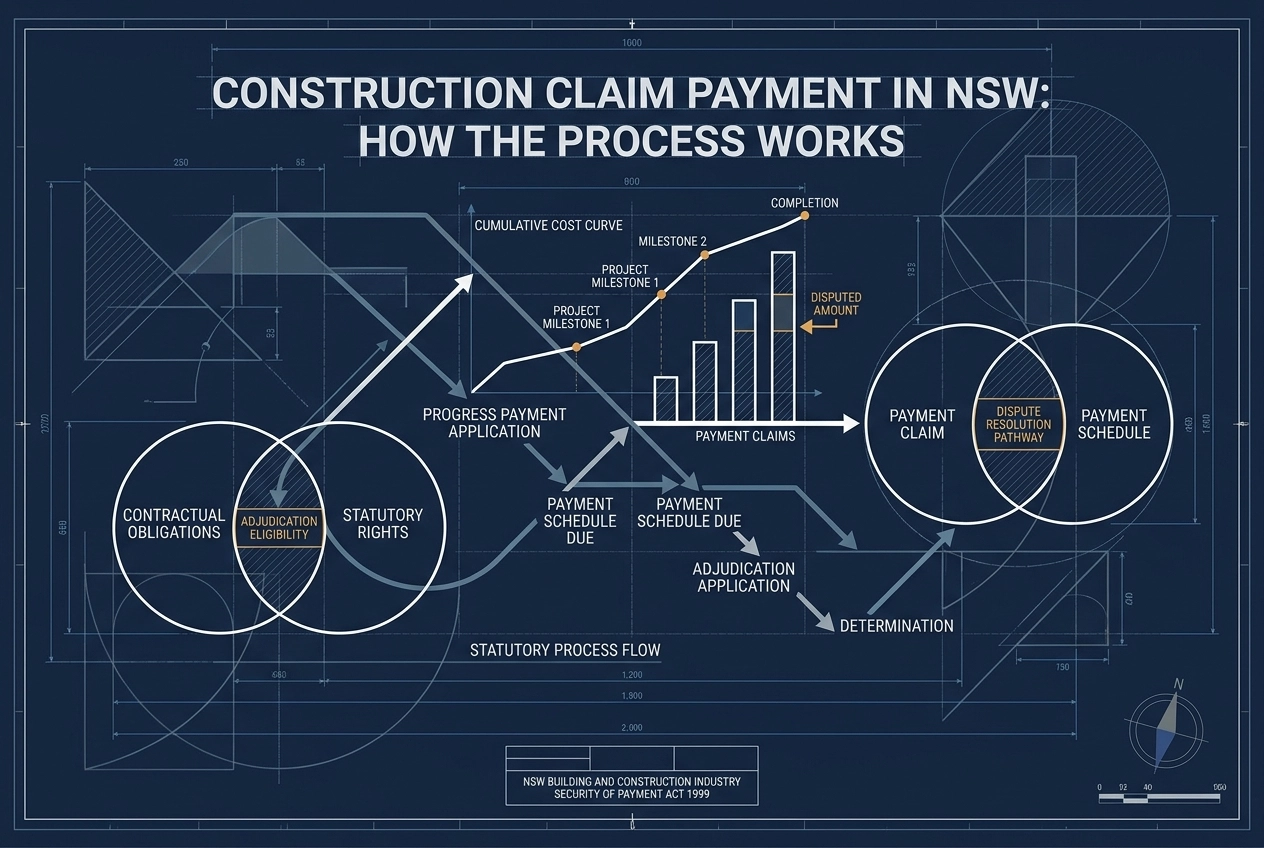
Getting paid for construction work in New South Wales should be straightforward, but disputes and delays can turn a simple invoice into a drawn-out battle. Whether you are a subcontractor chasing overdue progress payments or a head contractor managing a complex project, understanding how claim payment works under the Building and Disputes Tribunals Act and the Security of Payment legislation is essential knowledge for anyone operating in the NSW construction industry.
This guide walks you through the entire claim payment process, from preparing a valid payment claim to navigating adjudication if your claim is disputed. You will learn the critical deadlines you cannot afford to miss, the documentation required to support your claim, and the steps to take when a payment schedule falls short of what you are owed.
By the end of this tutorial, you will have a clear, practical understanding of your rights and obligations under NSW law, giving you the confidence to pursue what you are legitimately owed without unnecessary delays or costly mistakes. Let's break it down step by step.
The Legislative Framework Governing Payment Claims in NSW
The Building and Construction Industry Security of Payment Act 1999 (NSW) establishes a statutory right to progress payments for anyone who has performed construction work or supplied related goods and services under a construction contract. This right exists independently of what the contract itself says, meaning it applies even where payment terms are ambiguous, poorly drafted, or absent altogether. The Act also creates a rapid adjudication process that allows parties to recover disputed amounts without resorting to litigation, which is typically slower, more expensive, and procedurally complex. For principals, developers, and contractors alike, this legislative framework defines the rules of engagement for every payment claim made on a NSW construction project.
The Building and Construction Industry Security of Payment Regulation 2020 (NSW) commenced on 1 September 2020, and introduced a critical change that came into force on 1 March 2021: the removal of the owner-occupier contract exemption. Prior to that date, residential homeowners engaging home builders were largely insulated from the Act's adjudication provisions. Since 1 March 2021, builders can serve valid payment claims on residential owner-occupier clients and, where those claims are disputed, apply for independent adjudication with a determination typically issued within approximately three weeks. This expansion materially increased risk exposure for homeowners, who now face a ten-business-day deadline to issue a payment schedule disputing the claimed amount or become liable for the full sum.
Despite the legislation having operated for over two decades, industry commentary published in 2026 confirms that it remains poorly understood across much of the construction industry. Payment claims are frequently structured around a deliberate strategy of exploiting the other party's lack of preparation rather than the underlying merits of the work performed. For any party involved in a NSW construction project, whether as a government agency, developer, contractor, or homeowner, understanding this legislative framework is the foundational step in managing claim payment risk effectively.
What Is a Construction Payment Claim and How Does It Differ from an Invoice
A progress claim, also referred to as a progress payment, is a formal document submitted periodically by a contractor or subcontractor requesting payment for construction work completed up to a specific point in time. Unlike a standard commercial invoice, which requests payment for fully delivered goods or services at their total cost, a progress claim operates across the entire lifecycle of a project. It is issued at each reference date defined by the construction contract, reflects the cumulative value of work performed to date, and is recalculated with each new submission cycle rather than simply adding a new line item to a running account.
This structural distinction is commercially significant. A contractor engaged on a 12-month infrastructure project may submit 12 separate progress claims, each reassessing the percentage of work completed against the contract sum. Each claim supersedes the previous one, building a documented record of project progress at every payment interval. A standard invoice carries none of this recurrent, percentage-based logic.
Payment claims serve several critical commercial functions beyond simply requesting money. They maintain contractor cash flow throughout long-duration projects, create enforceable statutory deadlines that manage delayed-payment risk, and establish an evidential record that underpins dispute resolution under the Security of Payment Act should payment be withheld or disputed.
Critically, a valid NSW payment claim must include specific statutory endorsement wording to engage the Act's protections. Omitting this wording reduces the claim to a contractual document only, removing the claimant's right to pursue adjudication under the NSW framework entirely. This single procedural requirement represents one of the most consequential differences between a progress claim and an ordinary invoice, and one of the most common sources of costly, avoidable error in practice.
How Payment Claim Amounts Are Calculated Under the Act
Under Section 9 of the Act, the starting point for calculating a progress payment amount is the construction contract itself. Where the contract specifies a valuation methodology, that methodology governs. Common approaches include agreed milestone percentages tied to defined completion stages, scheduled rates applied to measured quantities of work completed, or lump sum breakdowns allocated across discrete work packages. Standard-form contracts used across infrastructure and civil construction typically incorporate one or more of these mechanisms, providing a structured basis for claim assessment that both parties can apply consistently throughout the project.
Where the contract is silent on valuation, the Act's default provisions under Section 10 apply. In these circumstances, the payment amount is assessed on the basis of the value of construction work performed and related goods and services supplied under the contract. The Act directs that this assessment must have regard to the contract price, any other rates or prices set out in the contract, agreed variation adjustments expressed as specific amounts, and the estimated cost of rectifying any defective work identified at the time of assessment. Only materials that have become, or will become, the property of the principal may be included in valuations involving materials and components.
Variations present a particularly important consideration. Only agreed variations, those properly documented and assessed in accordance with the contract's variation provisions, can be reliably included in a valid payment claim under the NSW Security of Payment framework. Undocumented or disputed variations risk exclusion during adjudication, making rigorous variation management essential to protecting commercial entitlements throughout the project.
Procedural compliance is equally critical. The Act permits only one payment claim per reference date, typically monthly. Claims cannot be revised or reissued once served, and a claim submitted before its reference date arises is premature and void under the legislation, forfeiting the claimant's rights for that entire reference period. Understanding how the Security of Payment Act 1999 (NSW) operates in practice is essential for any party seeking to protect its cash flow position.
Critical Procedural Rules Every Party Must Know
Procedural compliance is where many payment claims succeed or fail, regardless of the underlying commercial merits. Understanding these rules is not optional; it is foundational to protecting your rights under the Act.
Statutory endorsement wording is mandatory. A payment claim submitted under the Building and Construction Industry Security of Payment Act 1999 (NSW) must include the prescribed endorsement identifying it as a claim made under the Act. This is not a formality that can be overlooked or corrected after service. A claim that omits the required wording is not a valid payment claim under the Act, and the claimant loses access to the adjudication process and statutory debt recovery mechanisms entirely. Even a technically accurate and well-substantiated claim becomes legally inert without this endorsement. Claimants should confirm the precise wording required under the Building and Construction Industry Security of Payment Regulation 2020 (NSW) before each submission.
One claim per reference date, with no revisions. The Act permits only one payment claim per reference date. Once submitted, that claim cannot be revised, supplemented, or reissued, even if the respondent requests clarification or amendment. This places a strict duty of care on claimants to compile accurate, complete claims before service. Premature claims, submitted before the relevant reference date arrives, are void and carry no legal force. A claimant who submits early cannot re-serve the same document; they must wait for the next available reference date.
The respondent's ten-business-day obligation is absolute. Upon receiving a valid payment claim, a respondent has ten business days to issue a payment schedule formally disputing the amount. Failure to respond within this window renders the full claimed amount immediately recoverable as a statutory debt through the courts, with no further entitlement to raise defences.
The payment schedule is the respondent's complete defence. The reasons contained in the payment schedule constitute the respondent's entire case at adjudication. No new grounds may be introduced at a later stage, making this document as consequential as a formal legal pleading. Respondents should approach its preparation with rigour, specificity, and, where appropriate, independent quantity surveying support to ensure every contested item is properly documented and substantiated.
How to Respond to a Payment Claim: The Respondent's Position
Upon receiving a payment claim, the respondent, whether a principal, developer, or homeowner, must act immediately and methodically. The assessment must cover the actual value of work completed on site at the claim date, the status of any variation instructions (distinguishing approved variations from those still under review), retention amounts applicable under the contract, and any supportable deductions for defective or incomplete work. This is not an administrative formality; it is a substantive commercial and legal exercise that must be completed under strict time pressure.
The payment schedule is the respondent's single opportunity to state their position. In New South Wales, the schedule must be served within ten business days of receiving the payment claim. It must set out the scheduled amount the respondent proposes to pay and, critically, every reason for withholding or reducing any disputed portion. Vague objections or bare references to contract clauses are insufficient; each ground for withholding must be clearly articulated and supported.
The consequences of an incomplete or poorly drafted payment schedule are severe and irreversible. Any reason not included in the schedule cannot be raised at adjudication or in subsequent legal proceedings. Effectively, gaps in the payment schedule are permanent waivers of the respondent's right to dispute those amounts. Responding to requests under the Security of Payment Act requires careful preparation, not a reactive approach drafted under pressure at the last moment.
Failure to serve any payment schedule within the statutory deadline produces an even more damaging outcome. The full claimed amount becomes immediately recoverable as a debt, and the respondent loses the right to challenge it in proceedings. This outcome can arise not from a deliberate decision but simply from administrative delay or underestimating the urgency.
Given these irreversible consequences, engaging an independent quantity surveyor before the payment schedule deadline is a sound and proportionate risk mitigation step. An experienced QS can assess claimed work values against verified site progress, confirm variation entitlements, calculate defensible retention and defect deductions, and ensure every legitimate ground for withholding is identified and properly documented before the schedule is served.
The Adjudication Process: What Happens When a Claim Is Disputed
Where a claimant does not receive the scheduled payment amount, or no payment schedule is served within the required timeframe, the claimant is entitled to apply to an Authorised Nominating Authority (ANA) to have the dispute referred to adjudication under the Act. The ANA nominates a qualified adjudicator to assess the dispute and issue a binding determination. This mechanism exists precisely because the Act recognises that disputes in the construction chain can otherwise stall projects and devastate contractor cash flow while parties await resolution through more formal legal processes.
Following the regulatory expansion that took effect from 1 March 2021, residential homeowners in NSW became subject to the same adjudication framework that has long applied to commercial principals. This is a material change in risk exposure. A builder engaged on a residential project can now apply for adjudication of a disputed payment claim and typically receive a determination within approximately three weeks of lodging the application. Homeowners who previously assumed they were insulated from this process are no longer protected, reinforcing why timely, well-reasoned payment schedules are essential regardless of project type or scale.
The adjudicator's determination is binding on both parties and cannot be challenged on its merits. The only avenue to overturn a determination is to litigate the underlying contractual entitlement through arbitration or court proceedings, a pathway that is substantially more costly and time-consuming than the adjudication process itself. This asymmetry is intentional; the Act prioritises payment flow over procedural perfection.
Critically, the adjudicator works exclusively from the documents placed before them: the payment claim, the payment schedule, the claimant's adjudication application, and the respondent's adjudication response. No new reasons or evidence can be introduced at adjudication that were not included in the original payment schedule. As noted in earlier sections, the payment schedule represents the respondent's entire defence. For a detailed overview of how Victoria's comparable framework operates, including adjudicator timeframes and document requirements, the SOP adjudication guidance published by Victoria's Building and Plumbing Commission provides useful reference context.
Adjudication is deliberately designed as a rapid, interim mechanism to preserve cash flow across the construction chain. It is not intended to deliver final contractual justice. Once a determination is issued, either party retains the right to pursue their full contractual entitlements through arbitration or litigation. The determination resolves the immediate payment dispute; it does not extinguish the broader commercial relationship or the underlying contract rights of either party.
The Role of a Quantity Surveyor in Payment Claim Assessment
An independent quantity surveyor brings professional objectivity to a process that is inherently susceptible to self-interest. When a contractor submits a payment claim, the figures presented reflect the claimant's own assessment of the work completed, which may not align with the value measurable under the contract. An independent QS applies professional quantity surveying methodology to measure and verify the actual value of work executed on site, producing an evidence-based certified amount that is not influenced by the contractor's commercial position or the principal's desire to minimise outgoings.
The assessment process is systematic and multi-layered. The QS conducts on-site inspection and measurement of completed works, reviews the executed contract documentation and agreed rates or bills of quantities, analyses each variation submitted for entitlement and quantum, calculates retention obligations in accordance with the contract, and produces a certified value supported by detailed workings. This documented methodology ensures the assessment can withstand scrutiny. Where a contractor's self-assessed claim contains unsupported variations or overstates the percentage of completion for a particular work package, the independent QS assessment identifies and adjusts those discrepancies against the contractual baseline.
Cost-to-complete analysis adds a further layer of financial assurance. By estimating the value of work remaining to fulfil the full contract scope, the QS can confirm whether the cumulative certified amount is proportionate to overall contract progress. This analysis is particularly valuable for principals and financiers who need assurance that payments released to date do not exceed the earned value relative to the total contract sum.
The independence of the QS is central to the defensibility of the certified value. A contractor assessing their own claim has an obvious financial interest in the outcome. An independent QS holds no commercial relationship with either party, which means the certified figure carries professional credibility. If a payment dispute proceeds to adjudication under the Building and Construction Industry Security of Payment Act 1999 (NSW), a QS-certified assessment with a clear methodology and documented evidence trail provides a substantially stronger evidentiary foundation than an undocumented respondent schedule.
For bank-financed infrastructure and development projects, independent QS certification is not discretionary. Financiers require certified draw-down reports before releasing loan tranches, treating the QS-certified amount as their primary assurance that loan proceeds correspond to verified construction progress. This function protects lenders from scenarios where funds are drawn against incomplete or defective works.
Risks of Over-Certification and Under-Certification
Accurate payment certification sits at the centre of every well-administered construction contract, and errors in either direction carry consequences that extend well beyond a single payment cycle.
Over-certification occurs when the certified amount exceeds the genuine value of work completed at the time of assessment. The immediate commercial consequence is that the principal effectively pre-funds work that has not yet been performed. Should the contractor subsequently default, become insolvent, or abandon the project, the principal's financial leverage is materially diminished. The certified and paid amounts cannot easily be recovered, and the cost of engaging a replacement contractor must often be met from a depleted project contingency. For lenders and financiers, the risk is more direct: over-certified draw-downs erode loan security in proportion to the gap between certified amounts and recoverable completed-work value. If a project fails mid-construction, the financier may find themselves exposed well beyond what can be physically assessed, valued, and reassigned to an incoming contractor.
Under-certification creates an equally serious, if differently directed, set of risks. Where a certifier sets the scheduled payment below the genuine value of completed work, the respondent becomes exposed to adjudication proceedings under the Security of Payment Act. As noted in guidance on the perils of payment certification, certification decisions are placed under close scrutiny when disputes arise, and the certifying party may face claims from multiple directions. Beyond statutory exposure, persistent under-certification damages the principal-contractor relationship and, where the contract imposes a fair assessment obligation, may constitute a breach of contract in its own right.
Project principals and contract administrators who proceed without independent quantity surveyor involvement carry compounded personal and organisational exposure. When certification decisions are later examined in adjudication, arbitration, or expert evidence proceedings, the absence of a documented, professionally supported assessment methodology creates a significant vulnerability. Engaging an independent quantity surveyor establishes a defensible, transparent basis for each scheduled payment amount, substantially reducing the prospect of a successful challenge by either party and protecting the integrity of the certification process throughout the project lifecycle.
How Quantity Surveyors Sydney Supports Payment Claim Assessment
Quantity Surveyors Sydney provides independent progress claim assessment services for principals, developers, project owners, financiers, and contractors across residential, commercial, and infrastructure projects throughout Sydney and NSW. Our involvement gives clients a commercially defensible position at every payment milestone, regardless of project type, contract form, or claim complexity. Whether the contract is a lump-sum arrangement, a design-and-construct agreement, or a cost-reimbursable structure, our assessments are grounded in professional measurement methodology and contract interpretation rather than commercial assumption.
Our assessment process combines on-site measurement of completed work, thorough contract review, detailed variation analysis, and cost-to-complete modelling to produce a certified payment value that is evidentially robust. Each certified figure is supported by documented measurement records, making it suitable for use in adjudication, litigation, or expert determination if a dispute arises later in the project.
We structure our services to operate within the Security of Payment Act's ten-business-day payment schedule window. Clients who engage us on an ongoing basis benefit from a pre-established project understanding that allows us to deliver a substantiated scheduled amount before statutory deadlines expire, rather than scrambling to assemble documentation under pressure.
For bank and financier clients, we prepare draw-down certification reports that satisfy lender due diligence requirements and provide independent assurance that loan proceeds are being released only against verified completed work. These reports reduce over-certification risk and support funding compliance throughout the construction programme.
Engaging Quantity Surveyors Sydney across the full project lifecycle reduces cumulative payment risk, supports early identification of cost overruns, and builds a consistent, independently verified record of certified progress that protects our clients' interests at every stage.
Key Takeaways for Managing Construction Payment Claims
Construction payment claims in NSW operate within a framework that rewards preparation and punishes delay. The consequences of missing critical deadlines are not discretionary; they are statutory and largely irreversible. The ten-business-day window to issue a payment schedule remains the single most important deadline for any respondent, and every ground for disputing the claimed amount must be raised within that schedule. Reasons omitted at this stage cannot be introduced later, including at adjudication.
Independent quantity surveyor assessment provides the most defensible basis for certifying or contesting a claim. Where a matter proceeds to adjudication, a professionally prepared, evidence-based assessment carries significantly more weight than an unsupported position. Both over-certification and under-certification introduce downstream risk, whether to project finances, security arrangements, or contractual relationships.
Early engagement of a quantity surveyor, established before claims are submitted or received, creates the assessment framework, baseline documentation, and contractual reference points needed for consistent, accurate evaluation across every payment cycle. Reactive engagement after a dispute arises is costlier and less effective than structured involvement from project commencement.
Conclusion
Navigating construction claim payments in NSW does not have to be overwhelming. By understanding the Security of Payment legislation, you now know how to prepare a valid payment claim, meet critical deadlines, and respond effectively when a payment schedule falls short of your expectations. You also have a clear roadmap for pursuing adjudication if a dispute arises, protecting your cash flow and your business.
Knowledge is your most powerful tool on any construction project. The law is designed to keep money moving through the industry, and it works best for those who understand how to use it correctly.
Do not leave your payments to chance. Review your current contracts, audit your claim documentation, and share this guide with your team. If you need tailored legal advice, consult a construction law specialist today and take control of what you are rightfully owed.