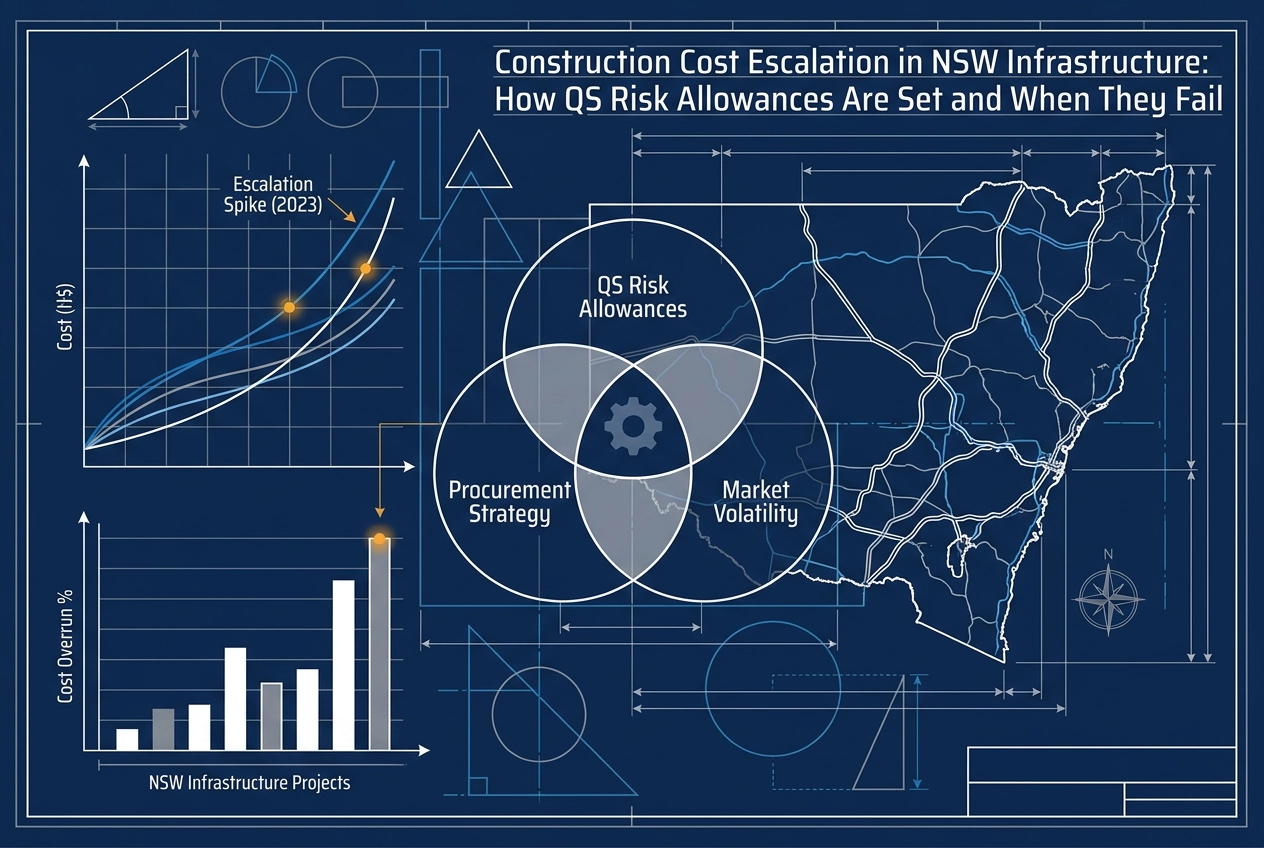
Construction cost escalation has dismantled more carefully prepared infrastructure budgets in NSW than almost any other single risk factor, yet the profession continues to treat it as a market data problem rather than a methodology problem. The distinction matters enormously. When escalation allowances fail, the cause is rarely that practitioners lacked access to price indices. It is that the allowance was set using a method fundamentally misaligned with the project's procurement timeline, contract structure, and sector-specific cost drivers.
This analysis examines how QS escalation allowances are actually constructed on NSW infrastructure projects, where the methodological failures consistently occur, and what rigorous practice looks like in contrast. Readers will work through the critical distinction between escalation and contingency, the procurement timeline problem that renders generic escalation rates unreliable, and the structural reasons why chronic underestimation persists. The analysis also addresses the strategic reserve confusion that compounds risk, the case for first-principles escalation modelling, and how risk transfer across contract models should inform the escalation treatment from the outset. A QS who models escalation realistically, rather than politically, provides materially different advice. This post explains what that difference requires.
Why Escalation Is Not Contingency, and Why the Distinction Matters
Infrastructure NSW's Cost Control Framework (March 2025) formally codifies three distinct cost provisions: contingency, escalation, and strategic reserve. These are not interchangeable labels. Conflating any two of them misrepresents project budget integrity and undermines the transparency that gateway reviews depend on.
Contingency addresses scope uncertainty and estimating risk within the base cost estimate. It is sized against what is unknown about the project as currently defined. Escalation is structurally different: it addresses future changes in input prices across the procurement and construction timeline, a risk that exists entirely outside the base estimate and responds to market forces, not scope definition. Strategic reserve sits above both as a portfolio-level governance instrument, not a project-level buffer. Understanding this three-tier hierarchy is foundational to any credible cost plan on NSW infrastructure work.
When escalation is folded into a general contingency percentage, procurement timeline risk becomes invisible. It cannot be detected in gateway reviews, it cannot be reported against separately, and it cannot be updated when the procurement programme changes. The provision simply disappears into a blended risk number that obscures its own assumptions.
Commonwealth guidance reinforces this separation structurally. Guidance Note 2 on base cost estimation explicitly directs practitioners to the dedicated Guidance Note 4 for escalation methodology. That is not administrative housekeeping; it is a signal that escalation requires a standalone methodology, not a line in the contingency column.
The consequences of conflation are asymmetric and compounding. When escalation is underestimated and embedded within contingency, the apparent contingency available for genuine scope risk is artificially depressed. If both materialise simultaneously, as they frequently do on long-lead programmes in transport, water, and energy where procurement timelines are extended and price volatility is material, the project faces a compounded budget exposure that neither provision was sized to absorb.
Correct treatment of these three provisions is not a formatting convention. It is the precondition for cost control that is analytically honest rather than politically convenient.
How QS Escalation Allowances Are Currently Set on NSW Infrastructure Projects
Understanding the failure starts with recognising which methodology is actually being used, and whether it is appropriate to the project at hand.
In practice, percentage-based approaches dominate the overwhelming majority of NSW infrastructure cost plans, applied without regard to project complexity, cost structure, or programme duration. Other approaches exist along a spectrum from first-principles input-category analysis through to activity-based costing linked directly to procurement event timing, but the simpler percentage method persists because it is administratively convenient and requires minimal supporting analysis.
Percentage-based escalation applies a single rate to the base cost estimate across the assumed project duration. It is also methodologically indefensible on any project with a differentiated cost structure, an extended procurement timeline, or a delivery programme that spans multiple contract award events. A single rate applied to a total cost figure treats a reinforced concrete civil package and a mechanical and electrical services package as carrying identical escalation exposure, which they do not.
The DRFA national guidance note on non-construction costs is explicit: percentage-based estimates must be adjusted based on the complexity and risk of proposed treatments, not simply derived from project value. This requirement is routinely bypassed. Many QS practitioners apply inherited rates from prior projects without reassessing whether those rates are appropriate to the current project's risk profile, cost composition, or programme. The rate travels from one cost plan to the next as convention rather than as a considered forecast.
First-principles escalation modelling is the methodologically sound alternative. It disaggregates the cost plan by input category, separating labour, materials, plant, and contracted services, then applies category-specific escalation rates across a time-phased expenditure profile. It also accounts explicitly for procurement route and contract duration, because when costs are incurred and when contracts are let materially affect the quantum of escalation exposure.
Activity-based costing extends this further by linking escalation exposure directly to the timing of procurement events. A contract awarded in month three of a three-year programme carries a fundamentally different exposure profile to one awarded in month twenty-four. Collapsing both into a single programme-wide percentage obscures that distinction entirely.
The gap between what guidance frameworks require and what NSW project budgets actually contain is a known and persistent deficiency. Most cost plans still embed static, generic percentages applied uniformly to the total estimated cost, with no reference to expenditure phasing, input cost structure, or the procurement strategy that governs when market risk is actually incurred.
The Procurement Timeline Problem: Why Generic Escalation Rates Do Not Transfer Across Projects
RICS professional guidance on procurement strategy establishes that escalation risk allocation varies materially by contract route. Under a traditional lump-sum arrangement, the contractor assumes price risk from the point of award. The client's exposure is confined to the pre-contract window: the period between cost estimate and executed contract. Under a construction management or cost-plus model, that dynamic reverses. The client retains escalation exposure through every trade package procurement event across the full construction programme, because no single fixed price locks in the cost base at any one point.
Applying a uniform escalation percentage across both models misrepresents the client's actual risk profile in a way that cannot be corrected by adjusting the rate. On a design-and-build contract with early contractor engagement and a fixed-price structure, the pre-contract window is where the allowance must be concentrated. On a construction management contract, the exposure is distributed and time-dependent, requiring a phased model aligned to each procurement event. The two problems require different analytical tools, and conflating them produces a cost plan that is wrong by construction.
This is where procurement and contract strategy function as structural cost controls, not just commercial preferences. The procurement route chosen at business case stage determines the shape of the escalation risk retained by the client, and the escalation model must be built to match.
NSW infrastructure programmes compound this problem through their own timeline characteristics. Projects routinely move through multiple gateway stages over several years. A concept-stage cost plan can arrive at a procurement gateway years later with no methodology update, despite a changed market, a revised programme, and often a different delivery model. The number persists because no one has been required to defend the methodology behind it.
Cost forecasting in construction must treat procurement decisions as time-sensitive. Deferring contract award, extending design development, or restructuring programme sequencing each alter the escalation exposure profile in ways a static percentage cannot capture. A six-month programme deferral on a construction management contract may add meaningful cost exposure across several trade packages simultaneously. That consequence should appear in the cost plan as a modelled outcome, not surface later as an unexplained overrun.
Real Cost Escalation vs. General Inflation: Why Sector-Specific Drivers Require Separate Treatment
The procurement timeline problem explains when escalation bites. What explains how much it bites is cost structure: specifically, which input categories dominate the project and how each of those categories moves relative to the broader economy.
The Australian Energy Regulator's escalation methodology framework establishes a foundational distinction that most QS cost plans ignore: labour, materials, and contracted services escalation each operate under structurally different economic drivers. Collapsing all three into a single inflation-indexed rate does not simplify the model; it corrupts it.
Labour escalation in construction is governed by enterprise agreement cycles, regional skills availability, and the competitive intensity of the concurrent project pipeline. None of these track reliably against CPI or the general Wage Price Index. Regulatory cost modelling in the energy sector identifies the Construction WPI as a more appropriate benchmark for labour cost forecasting than headline inflation, precisely because the two series diverge when concentrated programme delivery competes for the same tradespeople across overlapping windows. When a concentrated programme of NSW infrastructure procurement competes for the same tradespeople across overlapping delivery windows, real labour cost growth can significantly outpace any general wage index.
Materials escalation follows a different logic entirely. Structural steel, copper, and concrete are subject to global commodity price cycles, domestic manufacturing capacity, and supply chain disruption, all of which move independently of local inflation conditions. Powerlink Queensland's revenue proposal provides a worked example of applying differentiated indices to labour and materials categories because the two series are not interchangeable. A single blended rate averages across that divergence and conceals the actual exposure in materials-intensive scopes.
Contracted services escalation is perhaps the most volatile of the three. Specialist subcontractor margins respond to demand concentration in ways that neither labour indices nor commodity prices capture. When multiple major NSW transport or utilities programmes enter procurement simultaneously in the same geographic market, services escalation can exceed both labour and materials movement by a material margin.
Market indices and published construction cost data provide useful directional signals, and they are a necessary input to broader infrastructure cost management practice. However, they cannot substitute for project-level cost structure analysis. A labour-intensive civil earthworks programme in regional NSW carries a fundamentally different escalation profile than a materials-intensive mechanical and electrical fit-out in metropolitan Sydney. Applying the same market index to both is not conservative; it is structurally incorrect.
Using CPI as a proxy for construction cost escalation is a methodological error with direct budget consequences. In periods where real construction input costs have risen materially faster than general inflation, a CPI-based escalation allowance systematically underestimates exposure before a single contract is awarded.
When Escalation Allowances Fail: The Structural Causes Behind Chronic Underestimation
Understanding why escalation rates are wrong at the input level is necessary but not sufficient. The deeper problem is why inadequate allowances survive the approval process intact.
Political pressure is the most persistent structural cause. QS advisers operating within agency environments or under gateway approval constraints face implicit incentives to present affordable numbers rather than defensible ones. Escalation, being forward-looking and inherently uncertain, is frequently among the first provisions reduced when a budget requires political acceptance, a pattern that, while not formally documented, is widely recognised in project cost management practice. The reduction is rarely documented as a methodology decision; it presents as a reasonable conservative adjustment. The result is a cost plan that clears the gateway but misrepresents the project's actual exposure.
Methodology complacency compounds this pressure. When a QS applies the same escalation percentage used on the previous three projects without reassessing cost structure, procurement route, or programme duration, the allowance is not a risk-adjusted forecast. It is an inherited assumption dressed as professional advice. This pattern is particularly common on programmes where time pressure on business case development discourages first-principles analysis in favour of precedent rates that are administratively defensible but methodologically inert.
Gateway review processes rarely correct either failure. In NSW, reviewers frequently treat escalation as a fixed-rate line item subject to challenge on quantum rather than a modelled risk position subject to scrutiny on methodology. A reviewer who does not understand procurement timeline dependency cannot identify when an allowance is structurally inadequate, regardless of how the number compares to recent market reports.
Market data misuse reinforces underestimation. Construction cost indices and tender price surveys are valuable inputs, but they describe where costs have been, not where they will be at the point of future procurement events. Using current market data as the primary escalation input conflates historical observation with forward projection, a distinction the previous section addressed in the context of sector-specific drivers. The error is consistent and quantifiable.
The governance consequences are now formalised. The Infrastructure NSW March 2025 Cost Control Framework mandates biannual Cabinet reporting on capital portfolio health for nominated agencies. Projects that embedded inadequate escalation allowances at business case stage will face direct exposure when those allowances are reconciled against actual contract outcomes under this reporting cycle. Escalation overruns are no longer an internal programme management issue; they are a formal governance liability.
Institutional learning is not keeping pace. Post-completion benchmarking is widely cited as a necessary feedback mechanism, yet the absence of systematic data on estimated versus actual escalation across completed NSW projects means the same failure patterns recur without correction. Without that feedback loop, the next business case inherits the same methodology deficiencies as the last.
The Strategic Reserve Distinction: What It Is, What It Is Not, and How Confusion Creates Risk
The failure modes examined in the preceding section share a common downstream consequence: when escalation allowances are exhausted during construction, agencies need somewhere to draw replacement funding. That is where strategic reserve confusion compounds the original error.
The Infrastructure NSW Cost Control Framework (March 2025) explicitly identifies strategic reserve as a third and separate cost provision, distinct from both contingency and escalation. In practice, many project budgets either omit it entirely or treat it as interchangeable with surplus contingency. Neither approach is defensible.
Strategic reserve is a portfolio-level governance instrument, not a project-level buffer. Its purpose is to address unforeseen risks that fall outside both the base estimate risk envelope (which contingency covers) and the procurement timeline price movement (which escalation covers). It is not a mechanism for absorbing poor estimating, and it is not a rounding adjustment on the contingency line.
The conflation problem is structural. Escalation should be sized against a modelled price movement scenario, grounded in input cost forecasts across the procurement programme. Strategic reserve should reflect a deliberate governance judgement about residual risk above that model. When these are merged into a single percentage or labelled interchangeably, the transparency of both is destroyed. Decision-makers cannot assess whether escalation is adequately modelled or whether strategic reserve has been genuinely reserved for unforeseen portfolio risk.
The practical consequence is predictable. Agencies exhaust their escalation allowances during construction, then draw on strategic reserve to absorb cost overruns that were, in principle, foreseeable and quantifiable at the time of the original cost plan. This mirrors the dynamic discussed in how retained client-side risk can behave like a hidden cost-plus exposure inside nominally fixed-price arrangements: the risk was always present; it simply was not assigned to the provision designed to hold it.
Structural clarity across all three provisions is a precondition for meaningful cost control, not an administrative formality. A cost plan that conflates these provisions cannot produce accurate reporting under the biannual Cabinet reporting requirements now embedded in the NSW framework.
A QS who can articulate the precise basis for each provision, and defend the escalation methodology specifically against the procurement timeline and input cost structure, is providing genuinely different advice. Applying a combined percentage and labelling it broadly as "risk" is not a methodology; it is the absence of one.
What Better Practice Looks Like: Procurement-Aligned, First-Principles Escalation Modelling
Defining individual provisions precisely, as the previous section establishes, only delivers value if the escalation allowance itself is built on sound methodology. Precision in labelling a poorly constructed number does not make it defensible.
Disaggregate the cost plan before applying any rates. Category-specific rates, informed by sector forecasts rather than CPI proxies, are the minimum credible starting point, and must be revisited at each stage gate.
Map each category against a time-phased expenditure profile. The escalation allowance for a trade package procured in year one of construction is calculated differently from one procured in year three. This distinction is not a refinement; it is the core logic of the model. A QS who applies a blended rate to the total estimated cost without reference to when each expenditure category is committed is not modelling escalation; they are allocating a contingency buffer under a different label. The contract award and cost baseline establishment process is where this time-phased structure must be locked in and auditable.
Procurement route alignment. The procurement route alignment logic established earlier applies directly here: the escalation model must be built to match the contract model, not applied uniformly across delivery strategies.
Embed scenario analysis in the model structure, not as a post-hoc sensitivity test. A base case, an upside, and a downside escalation scenario, each with explicit assumptions, give decision-makers the information they need to make governance calls at each project gateway. The documented 70 per cent commodity price rises recorded over single 12-month periods in recent years confirm that the downside scenario is not theoretical.
Treat the escalation model as a living estimate. A business case escalation allowance that is not revisited at procurement stage, adjusted for revised programme timelines, and updated against current construction cost data is not cost control. It is a number that has been carried forward because no one was asked to challenge it.
Independent QS advice provides the mechanism to break that pattern. An adviser whose obligation is to the accuracy of the cost plan, rather than the political acceptability of the budget submission, will produce an escalation position that is methodology-grounded, procurement-aligned, and defensible under scrutiny.
Escalation, Governance, and Risk Transfer Across Contract Models
Procurement-aligned modelling, as described in the preceding section, is only as reliable as the governance structure that surrounds it. Even a rigorous first-principles escalation model fails commercially if the contract model creates risk exposures the cost plan has not mapped.
The fundamental problem is misalignment between the procurement strategy and the cost plan. When escalation risk transfer is not explicitly addressed in both documents, a governance blind spot emerges where exposure exists but has no defined owner. On large NSW infrastructure programmes, that unowned risk routinely becomes a budget overrun.
Contract model determines who carries the risk, and when.
The contract-model risk allocation logic established earlier, lump-sum concentrating client exposure pre-award, cost-plus and alliance models distributing it across the delivery programme, has direct governance implications that are often unaddressed in cost plans.
On major NSW infrastructure projects, that pre-contract window can be substantial, often spanning design development, environmental approvals, and a lengthy procurement process. A cost plan that sizes escalation only for the construction period systematically understates client risk. Where the model distributes risk across delivery, the QS adviser cannot treat the escalation allowance as fixed at financial close. The model must remain active, updated against actual market movements and realised contract outcomes as the programme progresses.
Rise-and-fall clauses require careful treatment in the residual allowance.
Some contracts include price adjustment mechanisms that share escalation risk between principal and contractor. Where these provisions exist, the client-side escalation allowance must be sized against the residual risk retained after contractual transfer, not the gross exposure. Failing to account for existing contractual mechanisms leads to double-counting provisions that have already been allocated, inflating the apparent allowance while leaving genuine residual exposure unquantified.
Governance obligations reinforce the need for active management.
The Infrastructure NSW Cost Control Framework's biannual Cabinet reporting requirements for Tier 1, Tier 2, and High-Profile High-Risk projects reflect an institutional recognition that escalation on complex contracts cannot be managed through a single upfront allowance. Active commercial management through delivery is required, not periodic reporting against a static business case figure.
At the programme level, cost forecasting in construction demands that QS advisers track actual escalation outcomes on early contracts and update allowances on later packages accordingly. Where realised escalation deviates from the modelled assumption, that deviation must be incorporated into forward estimates before procurement commitments are made. This discipline requires independent commercial judgement and access to current construction cost data, not a rollover of the original model.
Conclusion: Escalation Modelling as a Test of QS Methodology Rigour
The risk transfer analysis across contract models brings the methodology problem into its sharpest relief: escalation allowances that are not aligned to a specific procurement model, timeline, and cost structure are not professional estimates. They are inherited numbers with professional signatures attached.
Escalation is the provision where QS methodology is most frequently compromised. Institutional pressure to present acceptable budgets, inherited percentage rates applied without reassessment, and the persistent misclassification of escalation as contingency each erode cost plan integrity quietly and early. The financial consequences are not abstract; they are visible in the NSW infrastructure portfolio's history of budget overruns that were, in most cases, quantifiable before procurement commenced.
The Infrastructure NSW March 2025 Cost Control Framework, Commonwealth guidance on base cost estimation, and the AER's escalation methodology framework together define what rigorous practice requires. Knowing those frameworks, however, is not the same as applying them. Compliance with a reporting structure does not correct an escalation model that was built on the wrong methodology in the first place.
The practical obligations are clear:
Disaggregate escalation from contingency in every cost plan, at every stage
Align allowances to the procurement route and programme timeline, not to a prior project's percentage
Apply sector-specific rates to labour, materials, and contracted services separately
Update escalation models at each stage gate as procurement timelines, market conditions, and delivery programmes change
Defend every escalation position on methodology, not convention or precedent
Clients delivering NSW infrastructure projects need a QS adviser whose primary obligation runs to the accuracy of the cost plan. Where that obligation is compromised by budget acceptability pressures, the escalation allowance fails first, and the project budget follows.