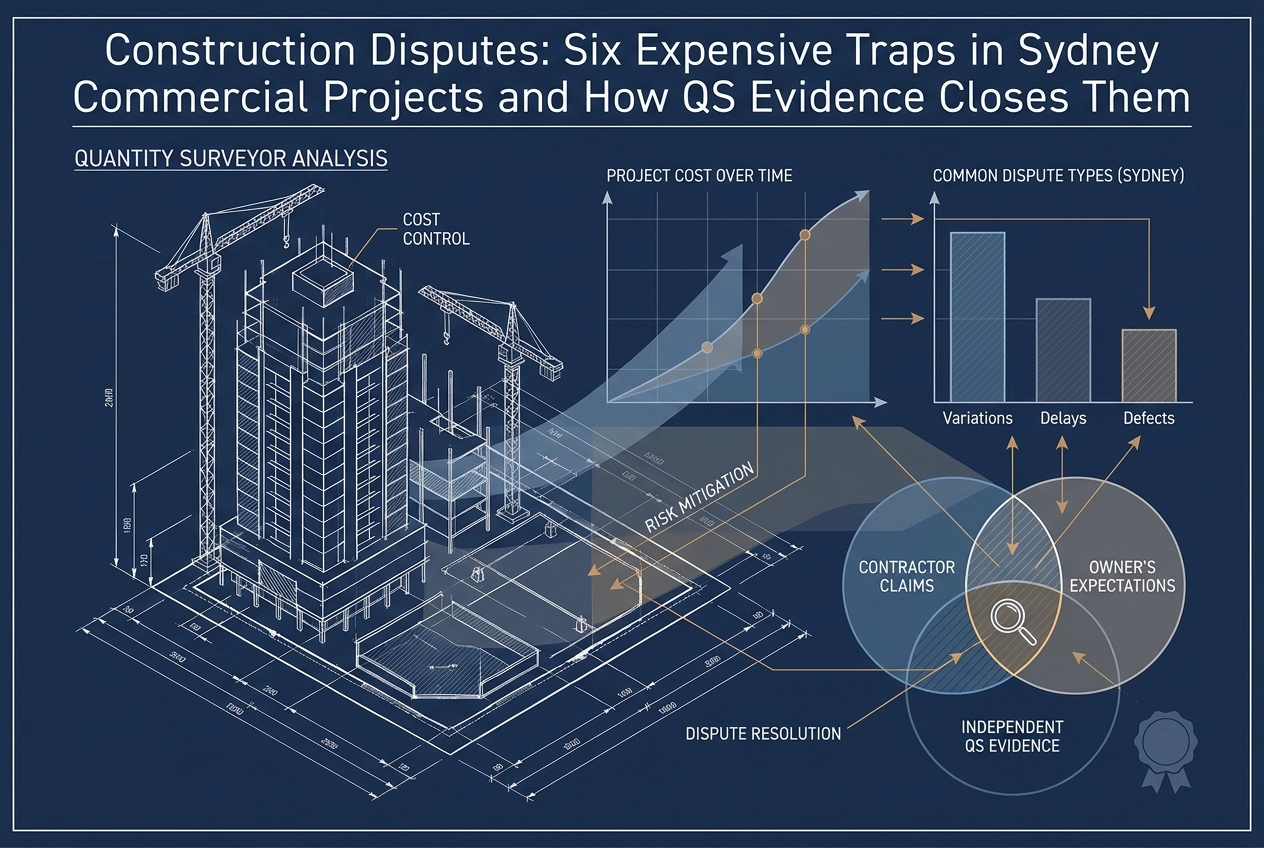
Most construction disputes in Sydney commercial projects do not begin in a courtroom or a mediation room. They begin months earlier, in a poorly worded scope clause, an undocumented variation instruction, or a progress claim that no one bothered to substantiate properly. By the time lawyers are involved, the cost of resolving the dispute has often exceeded what it would have cost to prevent it.
This post takes a different approach to the topic than most. Rather than offering generic guidance on dispute resolution theory, it maps six specific failure modes that consistently trigger construction disputes on Sydney commercial projects. For each trap, it explains what goes wrong, why it escalates, and how independent quantity surveyor evidence closes the gap before positions harden and legal costs compound.
Whether you are a contractor staring down a rejected payment claim, a developer facing a latent condition dispute, or a project manager trying to understand your exposure before engaging counsel, the sections ahead give you a practical framework. The goal is straightforward: understand the pattern, engage the right evidence early, and avoid the expensive alternative.
Why Sydney Commercial Construction Disputes Cost More Than They Should
Most commercial construction disputes in Sydney do not begin with a single catastrophic event. They begin with a missed sign-off, an informal verbal instruction, a progress claim submitted without adequate substantiation, or a scope document that two parties read differently. Each gap is individually manageable. Compounded across months of a live project, they produce disputes that are structurally difficult to resolve because the factual record no longer supports either party's position clearly.
The difference between a manageable disagreement and a costly construction contract dispute often comes down to one factor: whether independent, objective cost evidence exists at the moment the disagreement escalates. Without it, both parties are arguing from self-prepared positions, and the dispute expands to fill the evidentiary vacuum.
The underlying causes are not unpredictable. Across commercial construction disputes in Sydney, six recurring failure modes account for the majority of claims that reach formal resolution: scope ambiguity, unapproved variations, disputed progress claims, defect quantification disagreements, latent-condition claims, and delay costs. Each follows an identifiable pattern of formation and escalation. That predictability matters, because it means the evidence required to close each dispute type can be prepared in advance, before positions harden and legal costs begin accumulating.
Early engagement of an independent quantity surveyor, retained before legal counsel rather than after, establishes the baseline documentation that constrains how far a dispute can grow. The economics of that decision are explored in a later section, but the principle is straightforward: contemporaneous evidence prepared at the point of a transaction is cheaper to produce and more credible in any forum than retrospective reconstruction under legal instruction. Understanding how poor construction management decisions compound dispute risk is the first step toward avoiding that outcome.
The Building and Construction Industry Security of Payment Act 1999 (NSW) adds a further commercial dimension. The Act imposes strict statutory timeframes on payment claims, payment schedules, and adjudication processes. Parties who cannot substantiate their cost position within those windows lose procedural rights that cannot be recovered later. Pre-legal cost documentation is not a precaution under this framework; it is an operational requirement.
What Independent QS Evidence Actually Means in a Dispute Context
Not all cost evidence carries equal weight in a dispute. The critical distinction is between independent QS evidence and advocate-driven costing, where a quantity surveyor assembles figures to support a predetermined position rather than to accurately quantify it. Independent evidence is defined by its methodology: it applies recognised quantity surveying standards, references market-tested cost data, and arrives at conclusions structured to withstand cross-examination, not just to win a negotiation.
In NSW, that distinction has formal legal consequences. Expert witness reports used in construction disputes must comply with the Expert Witness Code of Conduct under the Uniform Civil Procedure Rules 2005. Under those rules, an expert's primary duty runs to the court, not to the party who engaged them. A report that fails to acknowledge the Code is inadmissible unless the court orders otherwise, a threshold established in Tim Barr Pty Ltd v Narui Gold Coast Pty Ltd [2009] NSWSC 49. This is not a procedural formality; it reflects a substantive standard of objectivity that courts actively enforce.
A defensible QS report in a common construction dispute will include four components:
A clearly stated methodology, explaining how quantities were measured and how unit rates were sourced
A breakdown of quantities and rates, giving the decision-maker a transparent audit trail
Identified assumptions, with reasons, so the report's limitations are explicit rather than concealed
Commentary on uncertainty ranges, acknowledging where the cost position could reasonably differ and by how much
That last point is where many reports fail under scrutiny. Courts and adjudicators assess the credibility of cost evidence partly by whether the expert engages honestly with alternative interpretations. A report that presents a single figure without acknowledging legitimate variables signals advocacy, not independence, and loses credibility accordingly.
Quantity Surveyors Sydney prepares expert witness reports and independent cost assessments that meet NSW evidentiary standards. For more on how dispute resolution and expert witness services are applied in Sydney construction matters, our practice supports contractors, developers, and legal teams across adjudication, mediation, and litigation at the appropriate level of rigour for each forum.
Trap 1: Scope Ambiguity and the Cost of Undefined Project Boundaries
Scope ambiguity is the most common entry point into commercial construction disputes, and it almost always originates in the contract documents themselves.
How the trap forms: Drawings, specifications, and schedules of work rarely describe every element with equal precision. Performance-based specifications, design-development obligations, and interface responsibilities between trade packages are particularly vulnerable. Where description is ambiguous, each party reads the document to their own commercial advantage. Neither interpretation is necessarily wrong; both are self-interested. That gap is where disputes begin.
Why it escalates: The core problem is the absence of a documented cost baseline tied to a defined scope. Without one, any disagreement about what was included becomes a factual dispute with no objective reference point. There is no shared starting position from which to measure divergence. Parties move quickly toward formal construction disputes resolution processes not because the amounts are necessarily large, but because neither side can prove the other wrong. Common flashpoints include design development items the contractor treats as extras, interface responsibilities each trade package assumes belongs to another, and specification compliance thresholds the principal reads more strictly than the contractor priced.
What QS intervention looks like: An independent review of contract documents at award stage, before mobilisation, produces a priced scope matrix that identifies ambiguous items, assigns provisional cost allowances, and flags items requiring written resolution. This is not a legal exercise; it is a cost and documentation exercise. It creates the objective baseline that prevents ambiguity from becoming a claim. For context on how scope uncertainty compounds in cost-reimbursable arrangements, Dispute Resolution and the Cost-Plus Contract sets out the additional risks when scope boundaries are inherently fluid.
The AS 4000 dimension: Under AS 4000-based contracts, unresolved scope ambiguity does not stay unresolved. It crystallises as a variation claim mid-project, typically at the point of maximum programme pressure and relationship strain, when the cost of resolution is highest and the appetite for compromise is lowest. Addressing ambiguity at award stage costs a fraction of resolving it in adjudication.
Trap 2: Unapproved Variations and the Approval Trail Problem
Even when scope is clearly defined at contract award, variation disputes routinely emerge the moment site conditions or client requirements shift under programme pressure.
The trap forms when the contractual change management process is bypassed. A superintendent issues a verbal instruction to proceed. A scope change is absorbed to maintain programme. Cost implications are deferred on the assumption they will be agreed later. Each of these shortcuts is understandable in isolation; collectively, they create a documentation gap that is extremely difficult to close retrospectively.
Why the gap becomes a dispute is straightforward: without a documented trail connecting the instruction, an independent cost assessment, and the contractual entitlement, each party reconstructs events differently. The dispute is no longer purely about what the variation cost; it is about whether it was instructed, what scope it covered, and whether agreement was ever reached. That factual ambiguity is expensive to resolve.
The Building and Construction Industry Security of Payment Act 1999 (NSW) provides no shelter from informal variation management. Adjudicators apply strict reference date and supporting statement requirements. A respondent can issue a payment schedule denying a variation claim on the basis of insufficient evidence, and if no contemporaneous cost assessment exists, the claimant has little to counter with. The Act's compressed statutory timeframes, 10 business days for a payment schedule response, amplify the pressure on parties who have not maintained contemporaneous records.
For a worked illustration of how this plays out in practice, the Scenario 2: Unapproved Variation case demonstrates how the absence of a formal variation order can transform a straightforward cost recovery into a contested quantum meruit claim.
QS intervention closes the gap at the point of instruction, not retrospectively. This means:
Formal variation cost assessment prepared independently at the time the change is instructed, using current Sydney commercial market rates
A maintained variation register that links each instruction to its cost assessment, approval status, and contractual basis
Documented authorisation confirming agreement before work proceeds
Variation disputes account for a substantial share of construction contract disputes in Sydney commercial projects. Quantity Surveyors Sydney provides variation management support that converts verbal instructions into auditable contractual records, eliminating the documentation gap before a payment claim is ever filed.
Trap 3: Disputed Progress Claims and the Payment Schedule Standoff
Progress claim disputes follow a different failure pattern from variation disputes. Here, the documentation exists; the problem is that the claimed amounts lack the quantity and rate detail required for a respondent to assess them independently. When the claimant's valuation and the respondent's assessment diverge without a shared evidential basis, the gap rarely closes through negotiation alone.
The statutory stakes under the Building and Construction Industry Security of Payment Act 1999 (NSW) make this trap particularly costly. A respondent who fails to issue a valid payment schedule within the statutory timeframe forfeits the right to dispute the claimed amount in adjudication. That is not a procedural technicality; it is a commercially decisive outcome that flows directly from inadequate contract administration. The NSW Security of Payment adjudication framework processes a significant volume of these disputes annually, and forfeited rights through missed schedule deadlines remain a recurring pattern.
The specific points of disagreement in commercial construction disputes typically cluster around three areas:
Percentage complete assessments, where claimant and respondent apply different completion criteria to the same work
Materials on site valuations, where ownership, security, and incorporation status are disputed
Disputed variations embedded within the claimed amount, which contaminate an otherwise valid claim with contested entitlements
Independent QS intervention addresses each of these directly. At every reference date, an independent assessment produces a payment schedule supported by line-by-line quantity verification, milestone completion evidence, and a documented basis for any deductions. That level of substantiation is what a respondent needs to issue a valid schedule within the statutory window, and what a claimant needs to avoid having their claim rejected as unsubstantiated.
Engaging an independent QS to assess progress claims from the outset removes the subjectivity that drives payment disputes. For a detailed overview of what robust progress claim management involves, the frequently asked questions on progress claims covers the core requirements. A consistent valuation methodology, applied at each reference date, gives both parties an objective reference point and reduces the conditions under which disputes form.
Trap 4: Defect Quantification Disagreements and the Rectification Cost Gap
Where progress claim disputes turn on payment substantiation, defect quantification disputes turn on something more contested: not just what something costs, but what "rectification" actually encompasses.
How the trap forms
When defective work is identified, the contractor typically values rectification at direct replacement cost, the labour and materials required to redo the work itself. The principal's position routinely extends further, incorporating access costs to reach the defect, temporary works, programme disruption, and consequential impacts on other trades or building systems. That gap between the two positions is not a minor rounding difference; in structural, envelope, or fire and life safety defects, it can multiply the baseline rectification cost several times over.
Why it escalates
Without a methodology that separates defect scope, rectification approach, and associated costs into discrete, auditable components, each party's expert tends to absorb assumptions favourable to their instructing client. The result is two reports with irreconcilable totals and no common reference framework. The dispute then shifts from the defect itself to a contest between competing expert methodologies, which is considerably more expensive to resolve.
Common defect categories that generate these disputes in Sydney commercial projects include structural defects in concrete and steel elements, building envelope failures involving waterproofing and cladding systems, fire and life safety system non-compliance, and services installation deficiencies across mechanical, electrical, and hydraulic packages.
What QS intervention looks like
A structured defect rectification cost assessment works from inspection findings or engineer reports to quantify the physical work scope, then prices that scope using current Sydney market labour and material rates. Critically, access costs, temporary works, and consequential cost components are identified and priced separately, so each element of the total can be examined and challenged on its own merits rather than buried in a lump sum.
Quantity Surveyors Sydney prepares defect rectification cost assessments that comply with expert witness standards under the Uniform Civil Procedure Rules 2005 (NSW). For those wanting deeper context on the analytical methods applied, advanced quantity surveying techniques for evaluating and quantifying construction disputes outlines the methodology in detail. Independent cost evidence at this level gives parties a credible basis for negotiated resolution before formal proceedings become necessary.
Trap 5: Latent Condition Claims and the Unforeseen Cost Allocation Fight
Where defect disputes centre on work already done, latent condition claims strike at work that could not have been fully anticipated. Under AS 4000 Clause 25, entitlement arises when physical site conditions differ materially from those an experienced contractor could reasonably have anticipated at tender, having reviewed all available information and inspected the site. The trigger is objective, but that does not make the claim straightforward.
The dispute almost never turns on whether the condition was unforeseen. It turns on three harder questions: what it actually cost to address the physical condition, what programme disruption flowed directly from it, and how responsibility is apportioned between the discovery cost and the consequential effects. Each of those questions requires cost evidence, not geotechnical evidence.
Sydney commercial projects encounter latent conditions with predictable regularity. Contaminated fill requiring unexpected remediation, bearing conditions materially worse than the geotechnical investigation indicated, buried services not shown on utility drawings, and groundwater levels inconsistent with borehole data are the most common triggers. In each case, the geotechnical or environmental report establishes the physical fact. It does not establish the financial impact.
An independent QS assessment closes that gap. It isolates the direct cost of addressing the latent condition as a discrete work package, separately quantifies programme disruption using resource allocation data, and tests the claimed quantum against contemporaneous site records and daily reports. That separation matters: adjudicators and expert determiners are alert to claims that conflate direct remediation costs with general project inefficiency.
AS 4000 Clause 25 also requires the contractor to provide the superintendent with a contemporaneous cost estimate and supporting detail promptly after discovery. Parties who defer that documentation, or who reconstruct it retrospectively, face credibility challenges at adjudication. Early engagement of a QS to prepare that substantiation, and to maintain the cost linkage between condition and impact as work proceeds, is considerably cheaper than rebuilding the evidence chain later.
For further context on how independent cost evidence functions in civil engineering disputes, Dispute Resolution and Expert Witness Services in Civil Engineering outlines the broader framework.
Trap 6: Delay Costs and the Concurrent Cause Complexity
Where latent condition claims turn on physical evidence, delay cost disputes turn on time. The two failure modes share one characteristic: quantum is always contested, and without independent cost evidence, the claimed amount is the first thing discounted.
Delay cost disputes typically crystallise at practical completion. The principal issues a claim for liquidated damages against an overrun programme; the contractor responds with extension of time entitlements and prolongation costs for principal-caused delays covering the same period. Both positions can be contractually arguable. The dispute is rarely about whether delay occurred; it is about who caused which days, and what those days cost.
That question is technically demanding. It requires forensic reconstruction of the programme, identification of the critical path at each relevant period, and a determination of which delay events actually drove completion back. Concurrent delay compounds this significantly. Where principal-caused and contractor-caused events overlap on the critical path, NSW courts and adjudicators have applied different approaches to apportionment, and the absence of published authority from confidential arbitrations means outcomes remain difficult to predict without robust contemporaneous evidence.
Each side may rely on a different baseline programme, a different delay analysis methodology, and a different interpretation of the contract's risk allocation provisions. Without an independent foundation, the competing positions are treated as assertions rather than evidence.
QS intervention in delay disputes works from the contemporaneous record outward. The assessment establishes the prolongation cost rate using actual site cost data, identifies the periods attributable to compensable delay events, and applies verified rates on a period-by-period basis to produce a defensible quantum position. Understanding how labour cost in construction disputes and expert evidence is correctly isolated and attributed is central to that methodology; it is where many delay claims are either substantiated or unravelled under scrutiny.
Without that structure, delay claims are highly vulnerable to discounting. Adjudicators and arbitrators who cannot follow the quantum reasoning from programme record to dollar figure will reduce claims, not resolve them in the claimant's favour.
The Economics of Pre-Legal QS Intervention Versus Litigation Expert Reports
Each of the six traps described in this piece shares a common escalation pathway: documentation gaps that were manageable at formation become expensive to reconstruct under legal instruction. That cost gap between pre-legal preparation and litigation expert work is where the real economics of dispute management sit.
The QS services market in construction disputes has historically centred on expert witness reports prepared after legal counsel is engaged, for use in adjudication, arbitration, or court proceedings. This is the most expensive point at which to introduce cost evidence. Retrospective reconstruction requires a QS to work back through fragmented project records, interpret undocumented decisions, and produce a quantum position that opposing experts will scrutinise for methodology gaps. The process is slow, resource-intensive, and often inconclusive.
Pre-legal QS intervention addresses the same six triggers at the point of formation rather than escalation. A contractor or developer who retains an independent QS from project award, to document scope, assess variations, and certify progress claims, builds a body of contemporaneous evidence as a natural by-product of good commercial management. That evidence is far cheaper to assemble than its retrospective equivalent, and it constrains the scope of any subsequent dispute before positions harden.
The distinction also carries evidentiary weight. Contemporaneous records prepared independently, without knowledge of a future claim, carry greater credibility in adjudication and expert determination than documents assembled in response to a dispute. Adjudicators and expert determiners assess not only what the evidence says but when and why it was created. A variation register maintained throughout construction is a materially stronger document than one reconstructed from emails after a payment dispute crystallises.
Quantity Surveyors Sydney provides both pre-legal commercial management support and formal expert witness services. Clients can engage at the appropriate point in the dispute lifecycle and escalate that engagement if proceedings follow. The decision of when to engage is a commercial one; the cost of engaging too late is a matter of record across Sydney commercial construction disputes.
How QS Evidence Functions Across Different Construction Disputes Resolution Pathways
Whichever pathway a dispute reaches, the evidentiary demands change significantly depending on the forum.
Security of Payment adjudication under the Building and Construction Industry Security of Payment Act 1999 (NSW) is the most frequently used pathway for payment disputes in Sydney commercial projects. Statutory timeframes are compressed: a respondent must issue a payment schedule within 10 business days of receiving a claim, and adjudication itself is typically resolved within weeks. Parties who arrive at that process with organised, contemporaneous cost evidence hold a structural advantage. Those reconstructing their position after the reference date are already behind.
Expert determination is the preferred pathway for defect quantification and latent condition disputes, precisely because the decision-maker is appointed for technical expertise rather than legal authority. In that forum, the quality of the QS evidence is effectively the primary determinant of outcome. A well-structured rectification cost assessment or latent condition quantum, prepared to professional standards and capable of withstanding scrutiny from a technically qualified determiner, carries considerably more weight than a legal submission unsupported by independent costings.
Mediation resolves a substantial proportion of construction contract disputes before they reach adjudication or arbitration. Its effectiveness depends directly on whether parties arrive with substantiated cost positions. When one party presents independently prepared cost evidence and the other relies on unsupported assertions, the negotiating dynamic shifts accordingly. Mediators cannot compel settlement, but they can identify which party's numbers are defensible.
Arbitration and Supreme Court litigation impose the most demanding evidentiary standards, including compliance with the Expert Witness Code of Conduct under the Uniform Civil Procedure Rules 2005 (NSW). At this level, the independence and methodology of the QS preparing the evidence becomes subject to direct challenge.
Across every pathway, one factor remains constant: independent, methodologically sound cost evidence, and the professional credibility of the QS who prepared it, consistently distinguishes successful outcomes from discounted or rejected claims.
Closing the Six Traps Before They Open
The six triggers examined across this piece, scope ambiguity, unapproved variations, disputed progress claims, defect quantification, latent conditions, and delay costs, are not random. They follow a consistent pattern of formation, and they respond to a consistent intervention: independent cost evidence established before positions harden.
The timing of that intervention matters more than most contractors and developers recognise. A QS engaged at contract award, to review scope documentation, establish a variation management framework, and set up a consistent progress claim methodology, creates contemporaneous records that carry genuine evidentiary weight. The same QS engaged after a claim is filed is reconstructing that evidence under adversarial conditions, at considerably greater cost and with reduced credibility.
The commercial case for early engagement is straightforward. Documentation prepared independently at the point of formation is cheaper to produce, harder to challenge, and more likely to resolve a dispute before formal proceedings are necessary. The six triggers covered in this piece are all documentable at project commencement. None require hindsight.
Quantity Surveyors Sydney provides independent QS services across the full dispute lifecycle: pre-contract scope review, variation management, progress claim assessment, defect rectification costing, latent condition quantum, and delay cost analysis. Where disputes proceed to adjudication, expert determination, or litigation, the practice prepares expert witness reports that meet NSW evidentiary standards.
For contractors and developers currently managing a commercial project in Sydney, or facing a claim in progress, the most productive first step is an assessment of the cost evidence already available and the gaps that remain open.
Contact Quantity Surveyors Sydney to arrange an initial review of your current evidence position.
Conclusion
Construction disputes in Sydney commercial projects rarely emerge without warning. The six traps outlined here, scope ambiguity, unapproved variations, payment standoffs, defect disagreements, latent condition fights, and delay cost complexity, all share a common thread: they escalate when contemporaneous cost evidence is absent.
The key takeaways are clear. Independent QS evidence is most powerful when created early. Pre-legal intervention consistently costs less than litigation-stage reconstruction. Properly documented quantum closes disputes faster and on stronger terms.
Waiting until a claim is filed means fighting for ground that should have been secured at contract award. Every commercial project in Sydney currently under contract or in delivery has an evidence position, and that position is either an asset or a liability.
Contact Quantity Surveyors Sydney today to assess your current evidence position and close the gaps before they become expensive disputes.