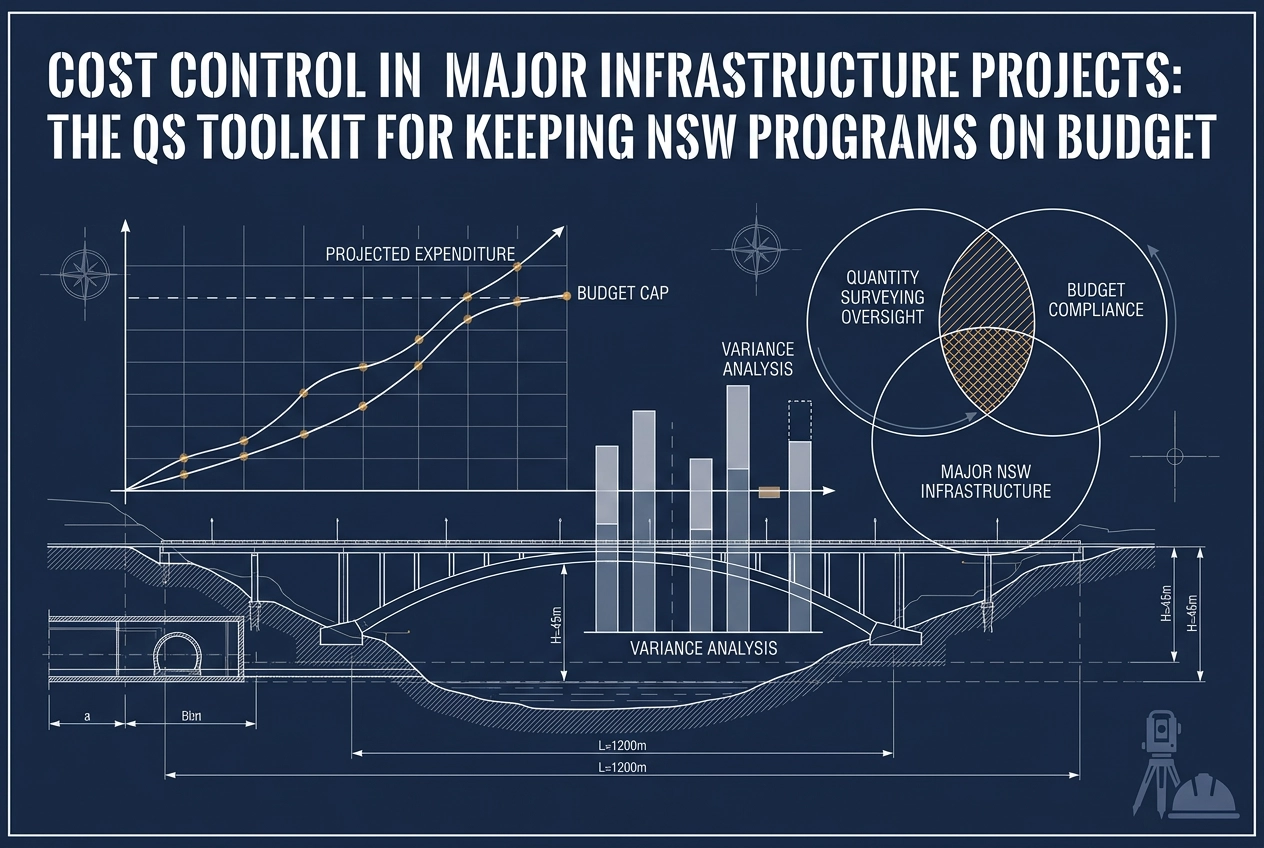
NSW infrastructure programs do not blow their budgets in a single dramatic moment. They bleed out incrementally, through uncontrolled variations, optimistic reforecasting, and cost reporting that arrives too late to change anything. Research confirms that cost overruns on Australian transport infrastructure are systematic rather than episodic, and NSW performs worse than any comparable state. The problem is not bad luck; it is a failure of cost control discipline during delivery execution.
Infrastructure NSW's March 2025 Cost Control Framework has raised the bar, mandating rigorous estimates, transparent contingency management, and biannual Cabinet-level portfolio reporting. Meeting that standard requires more than front-end planning. It demands embedded, independent quantity surveying rigour throughout construction.
This analysis examines the specific tools that make the difference: dynamic cost forecasting, variation registers, earned value reporting, contingency and escalation controls, and disciplined reporting cadences. It explains why internal delivery teams, operating under schedule pressure, structurally cannot sustain the objectivity that independent QS oversight provides, and how a well-integrated QS function applies these mechanisms across a major program to keep expenditure aligned with approved budgets.
Why NSW Infrastructure Cost Overruns Are a Systemic Problem, Not a Series of Shocks
Australian infrastructure cost overruns are not random. The Grattan Institute's analysis of 542 completed and 294 uncompleted road and rail projects valued above $20 million found the pattern is systematic, distorting project selection decisions and misallocating long-term investment across the portfolio. Australian governments spent approximately $28 billion more on transport infrastructure between 2001 and 2015 than initially committed, with 90% of that overrun value concentrated in just 17% of projects.
NSW performs worse than its peer states. The Grattan data shows NSW consistently experiencing higher overrun rates than Victoria and Queensland, with a structurally significant contributor: projects receiving funding commitments during election campaigns averaged 23% higher cost overruns than those committed through standard budget processes. Projects announced prematurely, before formal cost validation, accounted for 74% of total overrun value despite representing only 32% of projects. Political timing, not project complexity, is a primary driver.
The appraisal system compounds this. When early cost growth signals emerge between announcement and contract execution, Australia's project appraisal processes show no consistent evidence of triggering formal reappraisal. Delivery teams inherit inflated risk exposures that were never reassessed, opening construction phases with baselines that no longer reflect reality.
Two compounding failure modes recur across jurisdictions: insufficient early-stage planning, including underdeveloped business cases, optimistic assumptions, and poorly defined scope; and weak delivery-phase governance, including inadequate expenditure tracking, milestone monitoring, and escalation systems. Neither failure alone is fatal; together they are.
With Australian government infrastructure expenditure exceeding 1% of GDP annually since 2009, the fiscal consequences of these failures are portfolio-scale. The accountability pressure this creates is increasingly beyond what internal project teams, operating under schedule constraints, can absorb without structured independent support. For a current assessment of the infrastructure cost management landscape in 2026, the scale of that challenge is sharper than ever.
The practical implication is direct: cost overruns do not present as single events. They accumulate through hundreds of individually minor decisions, each below the threshold that triggers escalation. Real-time construction cost tracking and independent oversight are structural requirements, not discretionary additions.
What Infrastructure NSW's 2025 Cost Control Framework Demands from Delivery Teams
Infrastructure NSW's March 2025 Cost Control Framework responds directly to those systemic failures, establishing binding requirements across all capital projects registered under the Infrastructure Investor Assurance Framework.
The framework's core obligations represent a material step up from conventional project-level tracking. Agencies must now produce biannual Cabinet reports on portfolio health and budget risks, meaning cost data must be aggregated, defensible, and intelligible to non-technical decision-makers on a fixed cycle. That is a fundamentally different task from maintaining a project cost report.
Contingency controls are tightened materially for High-Risk High-Profile (HRHP) projects. Contingency drawdown must now be formally justified and documented against specific risk events. The historical practice of quietly absorbing contingency into cost-to-complete forecasts no longer satisfies the framework's transparency requirements. The framework mandates separate, transparent management of contingency and escalation, two reserves with different purposes and different drawdown triggers, addressed in detail below.
Milestone cost reporting is a mandatory discipline rather than an optional governance step, shifting accountability from periodic gateway reviews to continuous, auditable cost management. Taken together, the framework's requirements align closely with the kind of integrated controls thinking explored in applying system control engineering across infrastructure and development projects, where feedback loops and structured reporting are prerequisites for managing complex program behaviour.
The practical implication is unambiguous. Producing Cabinet-ready, portfolio-level cost reporting while simultaneously managing delivery schedules, contractor claims, and programme risk is beyond the realistic capacity of most internal project teams. The framework does not create merely a compliance obligation; it creates a structural demand for independent QS oversight embedded in the delivery phase from the outset.
Project Cost Forecasting During Delivery: Moving Beyond the Approved Budget
That intelligence begins with delivery-phase forecasting, which is a fundamentally different discipline from front-end estimation.
Early-stage estimates manage scope uncertainty. Delivery-phase forecasting must work with what is actually happening: committed expenditure, contractor performance data, approved and pending variations, and current market conditions for remaining work. The approved budget is a baseline, not a forecast.
The forecast-at-completion (FAC) rests on three inputs working together: the original baseline cost plan, a complete record of approved and pending variations, and a current cost-to-complete (CTC) assessment for every remaining work package. Remove any one and the FAC becomes an opinion rather than a defensible number. For progress claims, cost forecasting, and reporting to function as a genuine control mechanism, all three inputs must be updated on the same cycle.
The most persistent threat to forecast integrity is optimistic bias. Internal delivery teams under schedule pressure consistently present best-case completion scenarios, a pattern well documented across major NSW programs. This is a structural problem, not a competence failure. The same accountability environment that drives schedule performance also discourages surfacing bad cost news early. An independent QS has no such incentive conflict and can challenge completion assumptions formally, with reference to actual productivity rates and comparable program data.
Forecasting cadences must match the purpose they serve. Monthly CTC updates support delivery-level decision-making. Milestone-triggered reforecasts serve program directors reviewing gateway obligations. Portfolio-level aggregation for Cabinet reporting requires additional consolidation, cross-program consistency checks, and translation into financial risk narratives. These are distinct tasks with distinct data requirements, not the same report produced at different intervals.
Burn-rate analysis adds a dimension that variance-at-completion figures alone do not capture. Tracking actual expenditure velocity against the planned spend curve reveals divergence early, particularly when scope changes are still being priced and the variation register has not yet settled. A project spending faster than its planned curve, before variations are formalised, is signalling future cost pressure the current FAC may not yet reflect.
Package-level tracking rolled up to program level enables proportionate scrutiny without overwhelming the reporting function. High-value and high-risk packages warrant intensive monthly review. Stable, well-defined packages can be monitored through exception reporting, flagged only when they breach defined cost or schedule thresholds.
Change Control Registers and Variation Discipline: Where Cost Overruns Actually Accumulate
Accurate cost forecasting depends on a variation record that is current, complete, and commercially interrogated. Without that foundation, even a well-constructed forecast-at-completion is unreliable.
Research into Australian infrastructure cost overruns consistently shows that budget blowouts are not caused by single catastrophic events. They accumulate. A program absorbing hundreds of individually approved variations, each below the threshold triggering senior scrutiny, can drift well beyond its sanction before any single approval looks unreasonable. The problem is aggregate, and only a rigorous change control register captures it in aggregate.
A well-structured register tracks each variation through its full lifecycle: identification, pricing, technical review, commercial assessment, approval authority, and execution confirmation. No cost commitment should enter the program without formal sign-off against a defined budget line. The register is not a record of what has been spent; it is the instrument through which cost commitments are controlled before they are spent.
Escalation thresholds determine who approves what. Variations below a defined value may sit with the project manager. Those exceeding it require client-side QS review, program director endorsement, or, for High-Risk High-Profile projects under Infrastructure NSW's 2025 framework, Cabinet notification. Thresholds must be calibrated to program scale and enforced, not treated as guidelines.
The QS role extends well beyond recording. It involves challenging contractor pricing, validating scope basis, identifying duplications with existing contract provisions, and recognising patterns. A cluster of variations in one work package often signals scope definition failure rather than genuine changed conditions. That distinction matters commercially and should be escalated separately from routine variation processing. Effective contract administration and progress claim management depends on exactly this kind of active scrutiny.
The pending variation register deserves equal discipline. Instructed but not yet valued variations represent uncosted commitments sitting outside the approved budget. A large pending register is a leading indicator of forecast unreliability and where end-of-project surprises are born. Pending variations should be estimated conservatively and carried in the forecast until formally valued and approved.
Change control cadence should be weekly during peak delivery phases. A register updated monthly allows uncosted commitments to accumulate faster than the QS can price and report them, breaking the link between variation discipline and cost forecasting.
Earned Value Reporting: Objective Cost and Schedule Performance for Infrastructure Programs
Earned value methodology (EVM) provides a quantitative, objective basis for measuring whether money being spent is actually buying the progress being claimed. Rather than relying on narrative progress updates from delivery teams, EVM measures physical completion independently and compares it against both planned expenditure and actual cost. On programs where internal reporting is shaped by schedule pressure, this objectivity is not a refinement; it is the entire point.
The framework rests on three metrics: Planned Value (PV), the budgeted cost of work scheduled; Earned Value (EV), the budgeted cost of work actually completed; and Actual Cost (AC), what has genuinely been spent. From these, two indices are derived. The Cost Performance Index (CPI), calculated as EV divided by AC, measures cost efficiency. The Schedule Performance Index (SPI), calculated as EV divided by PV, measures schedule efficiency. A CPI below 1.0 signals cost overrun in progress; an SPI below 1.0 signals schedule slippage. Both function as early-warning instruments, surfacing divergence before it becomes irreversible.
Reliable EVM depends entirely on baseline integrity. A QS implementing an earned value framework must first validate that the Performance Measurement Baseline (PMB) reflects a realistic, scope-complete cost plan. Budgets compressed to secure project approval produce outputs that flatter performance rather than expose it, defeating the methodology's purpose.
The CPI-based Estimate at Completion (EAC), calculated as Budget at Completion divided by CPI, gives project owners a formula-driven forecast independent of the delivery team's own projection. When the two figures diverge materially, the QS is positioned to require reasoned reconciliation rather than accept optimistic reporting.
On multi-contract infrastructure programs, package-level EVM must be aggregated into a coherent program view. This portfolio-level synthesis reflects exactly the consolidated cost and schedule performance data Infrastructure NSW's 2025 framework requires for Cabinet submission. It also reflects the evolving QS role in civil projects, where value-focused analysis increasingly sits alongside traditional quantity and cost measurement.
EVM capability is increasingly expected on major Australian infrastructure programs, and the ability to operationalise it, covering baseline setting, CPI trend analysis, burn-rate integration, and early-warning protocols, is now the meaningful differentiator.
Managing Contingency and Escalation: Two Reserves That Require Different Controls
Earned value analysis identifies what a project is spending and whether that spend is producing commensurate progress. The next layer of scrutiny concerns what reserves remain when performance deviates, and whether those reserves are adequate for the risks still ahead.
Contingency and escalation are routinely conflated in project budgets, but they serve entirely different purposes. Contingency is a risk-response reserve, activated when identified or emerging risks materialise. Escalation is a cost inflation allowance, calibrated to anticipated movement in labour, materials, and plant over the project duration. Treating them as interchangeable obscures both true risk exposure and the adequacy of inflation protection. As established above, the 2025 framework requires each to be separately managed and reported, with contingency drawdown formally justified against identified risk events.
The QS role in contingency management is active, not passive. It involves maintaining a live, cost-loaded risk register, tracking each drawdown transaction against the specific risk realisation that triggered it, and reporting residual contingency adequacy at every milestone. Without itemised drawdown records, contingency misuse is virtually undetectable until the reserve is exhausted.
Escalation management demands a parallel discipline. The QS must maintain index-linked escalation models updated against current market data and flag divergence between assumed rates and observed tender market movements. That discipline was systematically underweighted during the 2021 to 2024 construction cost surge, when actual escalation routinely outpaced the indices embedded in approved budgets. The Department of Infrastructure's 2025 contract with BIS Oxford Economics to update its cost escalation modelling reflects ongoing government recognition that escalation forecasting requires active maintenance, not a set-and-forget allowance.
Reporting contingency adequacy alongside forecast-at-completion figures materially improves financial decision-making. A project that is on budget but has exhausted its contingency carries substantially more exposure than one showing a modest overrun with reserves intact. These are not equivalent positions, and presenting them as such misrepresents project health. For guidance on integrating contingency and escalation management within a broader risk governance framework, risk management and value engineering across the project lifecycle provides a complementary analytical lens.
Independent QS Oversight vs. Internal Teams: Why Delivery Pressure Undermines Cost Discipline
The discipline applied to contingency and escalation reserves is only as reliable as the reporting function that monitors them. That function, when embedded inside the delivery hierarchy, faces a structural problem that no amount of process design fully resolves.
Internal project teams carry a primary accountability to program delivery. Under the compressed schedules and political visibility that characterise major NSW infrastructure, this accountability creates consistent pressure to approve variations quickly, accept optimistic completion forecasts, and defer escalating cost concerns in order to maintain stakeholder confidence. These are not failures of individual competence; they are predictable responses to the incentive environment.
Independence is a prerequisite for credible cost reporting, not merely an organisational preference. A QS function embedded within the delivery hierarchy cannot produce defensible Cabinet-ready reporting if the same team is accountable for the decisions that generated the cost outcomes being reported. The reporting and the decision-making must sit in separate hands.
The framework's biannual Cabinet reporting obligations reinforce this. At a time when 3,596 construction companies entered external administration in the twelve months to June 2025 and NSW faces a projected shortfall of nearly 98,000 skilled construction workers, the sector stress compounding this governance challenge is acute.
An independent QS also brings cross-program benchmarking capability that internal cost managers cannot self-apply. Comparing unit rates, variation frequencies, contingency drawdown patterns, and CPI trends against comparable infrastructure programs provides a commercially grounded challenge function; without it, optimistic forecasts go unchallenged because there is no external reference point.
In contract administration, independence directly affects contractor behaviour. As examined in the role of an independent quantity surveyor in a cost-plus contract, rigorous independent assessment of progress claims, daywork records, and contractor cost reports reduces the commercial incentive to submit inflated applications or front-load payment claims.
The case for independent oversight rests not on internal team incompetence, but on the structural reality that delivery pressure systematically erodes cost discipline in ways that independence counteracts by design.
Construction Cost Reporting Cadences: Frequency, Format, and Audience
Independent QS oversight addresses who produces the reporting. What remains is the question of how that reporting is structured, timed, and calibrated to each audience.
Cost reporting on a major infrastructure program operates across four distinct cadences, each serving a different decision-making function. Weekly variation and expenditure summaries give delivery teams the granular visibility to manage commitments before they compound. Monthly cost reports with forecast-at-completion give project directors the integrated picture needed to govern the program. Milestone health reports give program owners a structured assessment at each decision gate. Portfolio-level submissions give government decision-makers the aggregated financial risk narrative required under Infrastructure NSW's 2025 Cost Control Framework.
Monthly cost report minimum content is not discretionary. A defensible report covers: actual cost to date against budget; approved and pending variations; current forecast-at-completion; contingency drawdown status and residual adequacy; escalation provision against current market indices; CPI and SPI where earned value methodology is active; and a risk summary with cost-loaded exposures. Less than this leaves decision-makers without the data to act.
Cabinet-level reporting demands a different capability again. Project-level variance data must be consolidated into portfolio metrics, technical cost narratives must be translated into financial risk terms, and forecast reliability must be quantified, not described qualitatively. This is QS work, not standard project accounting.
Report timing is as consequential as report content. The NSW Audit Office's 2025 capital projects review identified systemic gaps in cost forecast timeliness across agencies. A cost report delivered after the window for corrective action has closed becomes a historical record, not a management tool. A QS embedded in delivery produces cost intelligence that precedes decisions, not documentation that follows outcomes.
Exception reporting resolves the volume problem at senior levels. Flagging packages or risk items that breach defined thresholds allows program owners and ministers to focus scrutiny proportionately, without reviewing every cost line at each cycle.
Digital platforms support project controls and cost management for civil infrastructure by enabling real-time construction cost tracking across complex multi-package programs. However, baseline validation, variation pricing review, escalation model maintenance, and EVM calculation remain professional judgement functions. The platform surfaces the data; the QS determines whether it is reliable.
Contract Administration and Contractor Incentive Alignment in Cost Control
Rigorous cost reporting creates the information infrastructure for good decisions, but that infrastructure is only as reliable as the commercial discipline applied to the claims and cost data feeding into it. Contractor behaviour is a frequently underweighted driver of cost growth on NSW infrastructure programs, and it operates largely below the threshold that internal forecasting models detect.
Claim inflation, opportunistic variation requests, front-loaded payment applications, and daywork disputes do not appear as discrete budget shocks. They accumulate incrementally, each individually defensible, collectively corrosive. A QS-led contract administration function addresses this directly: systematic assessment of progress claims against independently verified physical completion, valuation of variations against actual scope and market rates, audit of materials-on-site claims, and review of contractor-submitted cost reports all reduce the volume and value of inflated claims reaching approval.
Contractor cost reporting obligations, embedded in contract conditions and actively enforced by the QS rather than passively collected, serve a second function beyond compliance. A contractor whose own reports show declining productivity ratios or margin erosion is signalling elevated claim and variation risk in subsequent periods. That signal, read early, allows the principal's team to increase scrutiny and tighten notice obligation enforcement before disputes crystallise.
Alliance and collaborative contracting models introduce a distinct set of challenges. Open-book cost verification, gainshare and painshare calculations, and indirect cost allocation all require a QS with both the contractual access and the analytical capability to interrogate contractor records rather than accept reported figures. Accepting without scrutiny undermines the commercial intent of the model and transfers risk to the principal through the back door.
Claims prevention consistently delivers better value than claims defence. A QS maintaining current contract administration records can identify compensation event trends, notice obligation failures, and scope ambiguities while resolution is still low-cost and consensual. Once those triggers escalate to formal claims, the commercial and programme costs multiply significantly.
Contract administration is where the cost control framework meets contractor behaviour, and where independent scrutiny most directly protects the project owner's budget position.
Applying the QS Cost Control Toolkit: Cadences, Roles, and Integration Across a Major Program
Contract administration addresses what contractors do; system integration determines whether the QS function can respond to it coherently. The tools examined across this piece only deliver reliable cost control when they operate as a connected chain, not as parallel reporting streams.
As set out in the change control and forecasting sections above, the dependency is sequential: each component feeds the next, and rigour at one link cannot compensate for failure at another.
Timing determines whether that chain can be built properly. Embedding a QS from contract award, rather than introducing one after a cost overrun triggers concern, allows baseline setting, performance measurement baseline establishment, and change control protocol design to precede construction mobilisation. Retrofitting these frameworks during delivery is possible but materially less effective: baselines become contested, protocols are resisted as administrative burden, and early variation patterns go unrecorded.
Operational cadence drives reporting quality. As discussed in the reporting cadences section, weekly discipline generates the data resolution that monthly reporting requires, and a QS operating at monthly cycles lacks the interim data to distinguish event-driven variance from gradual accumulation.
On multi-package programs, team structure must mirror program architecture. Package-level QSs maintain detailed cost control, change administration, and contract-specific forecasting. A lead QS aggregates package forecasts, manages contingency positions across the portfolio, and produces program-level reporting for senior governance. Neither role substitutes for the other.
Integration with the scheduler and risk manager completes the framework. A forecast-at-completion disconnected from the current schedule baseline is an estimate, not a forecast. A contingency drawdown assessment prepared without reference to the current risk register cannot demonstrate adequacy.
Quantity Surveyors Sydney provides independent QS services across the full infrastructure delivery lifecycle, from baseline establishment and change control protocol design through to monthly cost reporting, earned value analysis, and Cabinet-ready portfolio reporting for NSW government and private sector infrastructure programs.
Conclusion: Cost Control as a Continuous Discipline, Not a Gateway Event
The evidence across this post is consistent: NSW infrastructure cost overruns are not discrete events. They accumulate through compounding governance failures during delivery, weak variation discipline, optimistic forecasting, and deferred reporting. Front-end planning deficiencies create the conditions, but it is delivery-phase practice that determines whether cost growth is detected and contained or allowed to compound until it becomes unrecoverable.
Infrastructure NSW's March 2025 Cost Control Framework converts what were previously advisory best practices into formal accountability obligations. For High-Risk High-Profile programs, the 2025 framework's transparency and reporting obligations create a structural demand for independent QS oversight that internal teams under delivery pressure cannot reliably sustain.
As shown above, these components only deliver reliable cost control as a connected system. Independence remains the enabling condition, for the reasons set out earlier.
The practical instruction is direct: engage an independent QS from contract award. Establish the performance measurement baseline and reporting framework before construction mobilises. Maintain the disciplines continuously throughout delivery, not only at scheduled gateway reviews. Cost control that activates only at milestones is not cost control; it is periodic damage assessment.