Most construction budgets do not fail at the tender stage. They fail months earlier, when assumptions go unchallenged, design decisions are made without cost feedback, and project teams mistake an early estimate for a reliable financial baseline. By the time variations start arriving, the damage is already done.
Cost planning in construction is the discipline that closes that gap. When structured correctly by an independent quantity surveyor, it operates as a continuous risk-management framework, not a single number produced at feasibility and filed away. Each stage gate serves a specific commercial purpose: validating viability, disciplining design, satisfying financier requirements, and exposing cost risk before it locks into the contract.
This guide breaks down exactly how that process works. You will learn how a cost plan differs fundamentally from an estimate, where budget blow-outs actually originate, what each planning stage delivers and why it matters commercially, and what Sydney market conditions mean for your timing and contingency strategy. Whether you are a developer, project manager, or financier, understanding this process before you commission a QS will change the quality of the outcome you receive.
A Cost Plan Is Not an Estimate: Understanding the Distinction
An estimate produces a number. A cost plan produces a series of defensible budget benchmarks, each tied to a specific project decision, each structured to withstand scrutiny from a financier, a project board, or a dispute forum. The distinction is not semantic; it is commercial.
A one-off estimate, however carefully prepared, is a point-in-time calculation. It reflects the information available at the moment it was produced and carries no obligation to track what happens next. A structured cost plan, by contrast, is a governed discipline. It moves with the project, updated at each design stage gate, and at each update it answers a specific commercial question: does the current design still fit the approved budget, and if not, what decisions are required to restore alignment?
This is why cost planning as the foundation of the control system is not a one-time deliverable but a continuous cycle of planning, monitoring, reporting, and adjusting. Without that cycle, budget decisions default to reactive management; scope changes accumulate without cost accountability, and the first time the true cost exposure is visible is when a contractor submits a variation.
The professional framework underpinning this discipline is RICS NRM1 (Order of Cost Estimating and Cost Planning). NRM1 formally separates order of cost estimates from structured cost plans, establishes elemental measurement rules, mandates risk allowances at each stage, and defines governance processes for cost plan approval. A qualified QS operating to NRM1 is not producing a spreadsheet; the QS is applying a risk-management framework.
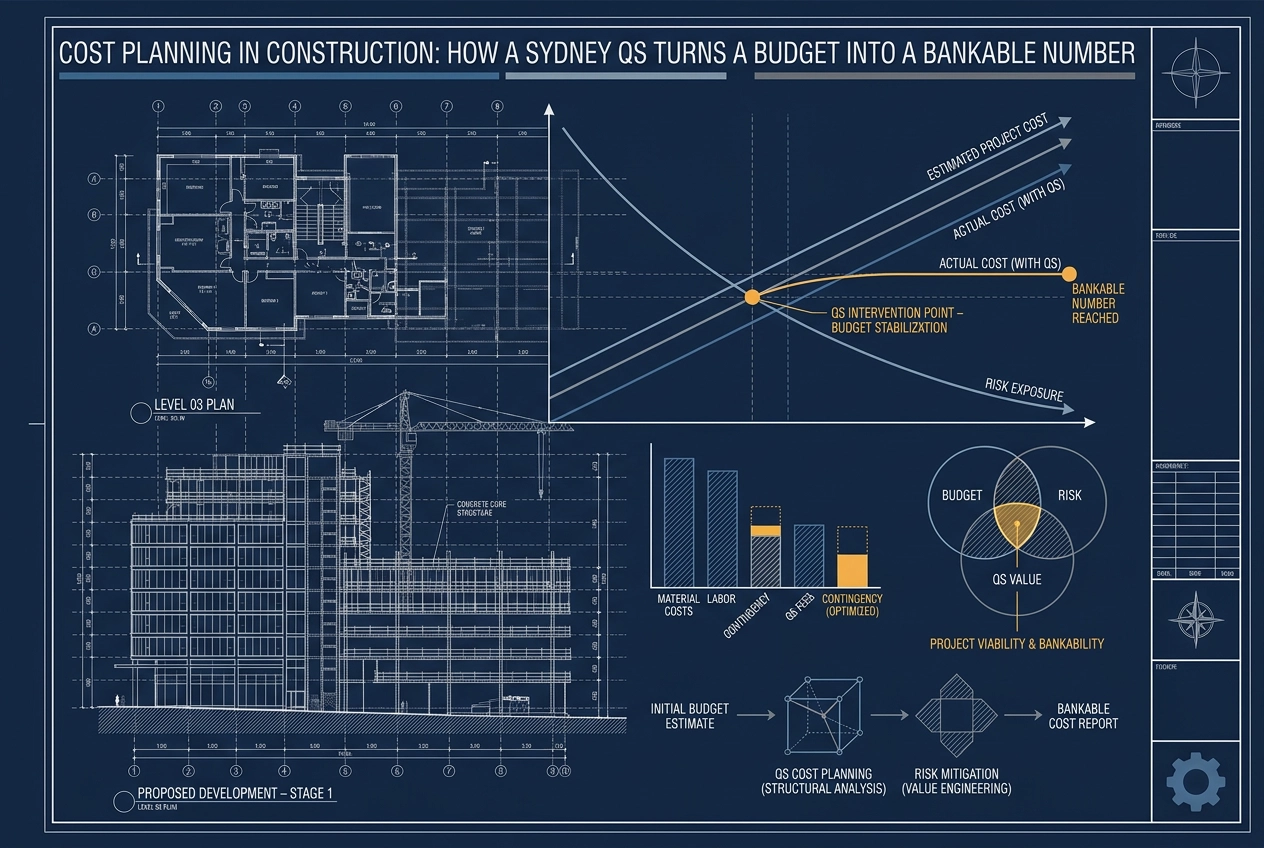
That is the central argument of this article. An independently prepared construction cost plan disciplines design decisions, provides financiers with certifiable cost certainty, and surfaces cost exposure while it can still be managed, before it becomes a variation.
Where Budget Blow-Outs Actually Come From
Understanding where budgets fail is as important as understanding how cost plans work.
Analysis of public sector projects without rigorous early cost management recorded average final account overruns exceeding 20% of the original approved budget, a pattern documented consistently across Australian transport infrastructure. That figure is not exceptional; it is routine where stage-gate discipline is absent.
Four sources account for the majority of construction budget blow-outs:
Late-stage design scope changes, where decisions deferred past scheme stage become variations instead of design revisions
Unquantified site conditions, including geotechnical, contamination, and service conflicts that were foreseeable but never costed
Procurement timing misaligned to market conditions, where tender programmes intersect with peak demand cycles or supply constraints
Contingency frameworks that are too shallow or misapplied, holding a flat percentage against risks that have never been individually identified or sized
Sydney compounds each of these. Trade labour in civil, mechanical, and specialist categories operates under sustained demand from the infrastructure pipeline, constraining subcontractor availability and elevating preliminary costs. Materials pricing remains sensitive to that same pipeline pressure. In competitive tender markets, contractors manage margin and risk allowances dynamically; a cost plan benchmarked to rates from 18 months prior carries embedded exposure that will surface at tender.
The more important pattern is that overruns are rarely the product of a single shock. They accumulate. Individual cost risks, each present at early design stage and each resolvable at low cost then, compound through unreported design drift, unreviewed scope assumptions, and contingency drawn down before construction begins. Understanding where construction management fails commercially confirms that governance gaps at the front end are the consistent precursor.
Pre-construction cost planning exists precisely to intercept these vectors early, when design changes cost revisions, not variations, and procurement decisions still carry flexibility.
The Stages of Cost Planning in Construction and What Each Gate Delivers
Intercepting those risk vectors requires a structured framework, not ad hoc reviews. Construction cost planning is organised around defined project delivery stages, with each gate producing a progressively more detailed cost plan as design information matures and decisions become binding.
The critical distinction is that each gate serves a different commercial purpose, not merely a finer number. The purpose shifts across the lifecycle: early gates validate whether the project concept is financially viable; middle gates discipline design decisions before they lock in cost; later gates inform procurement strategy; and the final gate benchmarks contract award against an independently established pre-tender position. A cost plan that conflates these purposes produces a number without a decision framework.
The RIBA Plan of Work 2020 is the current standard framework for structuring these stages in professional practice, defining eight delivery stages from strategic definition through to use. A QS operating to RICS standards aligns cost management outputs to these stage gates as a baseline expectation, with RICS NRM1 governing the measurement rules and constituent elements at each pre-contract stage.
This alignment matters commercially. Projects that apply rigorous stage-gate cost discipline consistently outperform those that treat cost planning as a single pre-tender exercise, a principle that applies equally to front-end planning, feasibility, and business case development as it does to design and procurement.
The sub-sections that follow examine each gate in turn: what the QS prepares, and the specific commercial decision that gate is designed to support.
Stage 1: Order of Cost Estimate at Feasibility
The first gate in the process is where the commercial case is tested, not the design.
At feasibility, the QS prepares an Order of Cost Estimate (OCE), the formal output defined under the RICS NRM1 framework for pre-contract cost advice. With no resolved design to measure against, the estimate is built from comparable project benchmarks: floor area rates (cost per square metre of gross floor area), functional unit rates (cost per bed, seat, or car space), or elemental benchmarks drawn from analogous completed projects. Each rate is adjusted to the current estimate base date and modified for project-specific variables before application.
The commercial purpose is precise. This gate is not testing whether the design is efficient; it is testing whether the project concept is financially viable before the client commits to architect fees, engineering studies, planning submissions, and the broader consultant spend that follows. An OCE prepared at this stage costs a fraction of the expenditure it can prevent if the economics do not stack up.
A professionally prepared OCE contributes more than a headline figure. The QS identifies the cost drivers most likely to affect viability: site-specific abnormals such as contamination, access constraints, or adverse ground conditions; programme compression costs where delivery timeline is fixed; and procurement model assumptions that carry materially different cost profiles. A preliminary risk allowance is also structured at this stage, typically 15 to 30 per cent of construction cost, reflecting the genuine uncertainty present before design development begins.
The financier dimension is equally direct. Lenders and equity partners reviewing early feasibility submissions expect an independently prepared OCE, not a developer's internal assumption. Independence, under RICS professional standards, signals objective scrutiny and a defensible methodology. For more on how feasibility estimates are structured in practice, see Stage 1: Feasibility, Cost Planning, and Early Estimates.
The gate must answer two questions: is the concept commercially viable, and on what conditions does it remain so?
Stage 2: Elemental Cost Plan at Scheme Design
Once the order of cost estimate confirms viability, scheme design transforms the budget from a single validated number into a structured commercial instrument.
The QS prepares an elemental cost plan aligned to the RICS NRM1 framework, breaking total project cost into defined group elements: substructure, superstructure (frame, upper floors, roof, stairs, external walls), internal finishes, fittings and equipment, services, and external works. Each element is costed separately and expressed as both a lump sum and a rate per square metre of gross floor area.
The commercial value of this format is transparency. A global total conceals which elements are absorbing budget and which are within benchmark. The elemental breakdown exposes exactly where design decisions are generating cost pressure relative to comparable projects. When services are running at 40% above benchmark for the building type, the design team and client can see it immediately, and the QS can identify whether the cause is specification, system complexity, or an unresolved design assumption.
This gate is where value engineering carries its highest leverage. When the structural engineer is still choosing between concrete frame and steel alternatives, the QS can quantify the cost consequence of each option before documentation commits the design. Changes at scheme stage cost time; changes after design development cost money, programme, and often relationships.
The elemental plan also functions as a governance instrument. The QS issues cost checks against the client-approved budget as design progresses. Any elemental movement outside the agreed tolerance, typically plus or minus 10 to 15 per cent, triggers a formal cost report requiring a recorded client decision before design continues. This is cost management operating as a core discipline in engineering project management, not a passive recording function.
The scheme design cost plan also establishes the contingency structure. Risk allowances are sized by element rather than applied as a flat percentage, assigned to design risk, construction risk, or client change risk, and governed by defined conditions for drawdown. That structure carries forward into every subsequent stage.
Stage 3: Detailed Cost Plan and Risk Register at Design Development
By design development, the elemental framework established at scheme stage is fully populated: measured quantities, specified materials, and sub-elemental detail that reflects resolved design decisions. This is no longer a planning instrument oriented toward design guidance. It is a pre-tender benchmark, and the distinction carries commercial weight.
At this level of development, the cost plan must be granular enough to expose what is missing. Unresolved specifications, excluded works, and design ambiguities that survive into the tender package become tenderer assumptions, and tenderer assumptions become post-contract variations. A rigorous design development cost plan forces those gaps into the open while the design team can still resolve them at low cost.
The risk register formalises what the cost plan implies. At this stage, the QS prepares or reviews a quantified risk register that assigns both probability and financial consequence to each identified risk. Contingency is then sized against that register rather than applied as a flat percentage of construction cost. NRM1 Section 3.18 is explicit on this point: risk allowances must be calculated, not assumed.
Two RICS-aligned quantification methods strengthen this process. Sensitivity analysis identifies which cost items carry the greatest influence over the total budget outcome, directing the design team's attention to the risks that matter most. Monte Carlo simulation models the range of probable cost outcomes across combinations of risk events simultaneously, producing a probability distribution rather than a single figure. That distribution gives the client a defensible confidence interval, whether at P50 for internal planning or P80 for a risk-averse lender.
For financiers, this combination is the difference between a number to discount and a case to assess. A detailed cost plan supported by a quantified risk register and Monte Carlo output gives lenders a structured basis for evaluating cost certainty. Understanding key QS engagement points across the Brisbane project lifecycle illustrates how this structured approach applies consistently across major project markets, including the disciplines lenders now expect as standard.
Stage 4: Pre-Tender Estimate and Procurement Cost Strategy
With the design development cost plan and quantified risk register finalised, the project moves into its final pre-contract stage: the pre-tender estimate and procurement cost strategy.
The pre-tender estimate is a final independent cost assessment prepared before tender documents are issued. Unlike earlier stage cost plans, it is structured specifically to allow direct line-by-line comparison with tendered rates and lump sum submissions. Every pricing assumption is documented at trade and sub-element level so that when tenders are returned, variances are immediately traceable rather than buried in aggregate totals.
The commercial purpose is straightforward but critical. An independent pre-tender estimate gives the client a defensible benchmark against which tenderer pricing can be objectively assessed. It identifies whether a submission is credibly priced, anomalously low and therefore carrying concealed risk, or positioned above market without justification. Without this benchmark, contract award decisions rely on relative comparison between tenderers rather than an objective external reference.
At this stage, the QS also advises on procurement strategy. Whether current Sydney market conditions support a fixed-price lump sum, a guaranteed maximum price, or a construction management model depends on contractor appetite, subcontractor availability, and the completeness of design documentation. Contract packaging decisions directly affect competitive tension; splitting or bundling trade packages changes the pool of capable tenderers and the margin behaviour of those who price it.
When tenders are returned, the QS reviews each submission against the pre-tender estimate, flags pricing anomalies, queries ambiguous provisional sum allowances, and prepares a tender report that supports a commercially sound contract award recommendation, as detailed in our overview of the quantity surveyor's role across the civil engineering project lifecycle.
The pre-tender stage is also the last practicable opportunity to adjust risk allocation before contract execution. An experienced QS will identify where standard contract risk positions are misaligned with project-specific exposures, and recommend amendment before those positions become binding.
How an Independent QS Structures Cost Risk Management
Risk allocation does not end at contract execution. The analytical framework underpinning a defensible cost plan operates continuously from feasibility through to tender award.
RICS identifies five risk response strategies, each of which maps to a specific cost planning or procurement decision. Avoidance removes the risk entirely, for example, redesigning a foundation system to eliminate reliance on variable ground conditions. Reduction lowers probability or impact through early investigation or specification tightening. Transfer shifts financial exposure to the party best placed to carry it, typically through fixed-price contracts or geotechnical baselines. Sharing distributes cost outcomes jointly, as seen in guaranteed maximum price structures with shared savings provisions. Retention accepts a quantified risk explicitly and funds it through a controlled contingency allowance. Each strategy produces a distinct cost planning or contract decision, not an abstract classification.
Contingency structuring follows the same discipline. A professional QS does not apply a flat percentage to the base estimate. Contingency is sized against a quantified risk register, differentiated between design risk, construction risk, and client change risk, and released through controlled drawdown as risks are resolved or materialise. A flat reserve invites budget creep; a structured drawdown framework does not.
Monte Carlo simulation converts the risk register into a probability distribution of total project cost. This allows the client to understand the P50 outcome (median cost) against the P80 or P90 confidence level that a risk-averse financier or approving authority will require before committing capital.
Sensitivity analysis identifies the two or three cost items with the greatest influence on total project cost. Resolving those items first concentrates design effort where budget exposure is highest.
The integrity of this entire framework depends on the QS having no commercial exposure to the outcome. A design team carries an incentive to present favourable cost certainty; a contractor pricing for award carries an incentive to compress contingency. An independent QS carries neither, which is what makes the risk quantification credible.
What Financiers Actually Expect From a Construction Cost Plan
That risk framework only delivers its full value when it satisfies the next audience in the approval chain: the financier.
In Sydney development finance, lenders and equity partners typically require an independently prepared cost plan as a condition of loan approval or drawdown. It is not a supporting attachment to a credit submission; it is a primary input to the credit assessment itself, used to verify total development costs and confirm that the capital being committed is protected by a professionally scrutinised budget.
What financiers examine specifically:
A cost plan structured to NRM1 elements, so costs are traceable and benchmarkable
An identified and quantified risk allowance, not a residual percentage applied without justification
A clearly stated basis of estimate: design stage, assumed procurement model, market pricing date, and explicit exclusions
An independent QS certification confirming professional accountability for the figures
The distinction between a financier-grade and a developer-grade cost plan is independence. A cost plan prepared by the project's own design team carries inherent optimism risk. A financier-grade document is prepared by a QS without commercial exposure to the outcome, states its methodology explicitly, treats provisional sums and contingency separately, and includes an executive summary suitable for a credit information memorandum.
The original cost plan structure also governs every downstream reporting obligation. Progress claim assessments, cost-to-complete forecasts, and budget variance reports are all products of the same elemental framework. A poorly structured cost plan at approval stage creates compounding reporting problems throughout construction.
Scrutiny has increased. Following recent construction sector insolvencies and sustained cost inflation in New South Wales, lenders are applying tighter cost certainty requirements before committing capital. An independently certified cost plan, prepared by a practice with sector expertise that matters in the Sydney construction market, directly reduces the credit risk premium a lender applies, which can affect the loan terms offered.
Sydney Construction Market Conditions and Cost Planning Timing
The financier scrutiny described in the previous section does not exist in isolation; it reflects a Sydney construction market that has been structurally stressed for several years, and that stress directly shapes what a cost plan must do to remain reliable.
The 2026 Sydney market presents three compounding pressures. A sustained infrastructure pipeline, driven by state and federal commitments across transport, utilities, and water, continues to absorb a significant share of available contractor and trade capacity. Labour availability in critical categories, including formwork, mechanical services, and electrical, remains constrained in the high-density residential and commercial sectors. Materials cost volatility, while partially stabilised from peak disruption, has not fully resolved, particularly for structural steel, hydraulic components, and long-lead electrical equipment.
Market timing directly affects the reliability of any cost plan. An elemental cost plan benchmarked against rates from 18 months prior carries embedded escalation risk. That risk must be identified explicitly by the QS, with escalation assumptions stated and their basis disclosed. Absorbing stale rates silently into an estimate is a professional failure, not a conservative approach.
Contractor sentiment is a separate variable from elemental rates. In a constrained tender market, subcontractors apply higher margin and risk loadings. A cost plan that models elemental rates accurately but does not account for prevailing contractor sentiment will produce a systematic underestimate at tender return. The gap between the cost plan total and the lowest conforming tender is where budget surprises originate.
A Sydney-based QS with current market exposure provides intelligence that benchmarking databases cannot. Subcontractor capacity by trade, live pricing movements, and procurement lead times affecting programme duration, and therefore preliminaries cost, are known through active market participation, not historical indices.
Commission the cost plan at feasibility. By design development, structural systems, procurement models, and programme assumptions are already fixed. The decisions that most influence cost have been made. Engaging an independent QS earlier preserves the leverage to influence those decisions before they become constraints.
Why QS Independence Changes the Commercial Outcome
Market conditions shape the numbers inside a cost plan. Who prepares the cost plan shapes whether those numbers can be trusted.
An estimate produced by the design team or a contractor-aligned advisor carries an inherent conflict. The architect has a structural incentive to present a budget outcome that keeps the project viable and their commission intact. A contractor-aligned advisor has an interest in securing award. Neither party is independently positioned to report cost overrun findings that might pause or restructure the project. An independent QS has no fee at risk from an unfavourable cost outcome, which is precisely what makes the advice commercially credible.
The governance consequence is direct. When a QS reports to the client rather than through the design team, cost findings reach the decision-maker unfiltered. A design team cannot suppress, qualify, or defer a budget overrun report it did not author. This reporting line creates genuine accountability in the design process. The AIQS Practice Standard for Construction Cost Assessments mandates that quantity surveyors address conflicts of interest as a minimum professional requirement, recognising that independence is foundational to credible cost reporting, not a discretionary quality.
At the variation stage, that independence produces a further commercial benefit. A cost plan certified by an independent QS at element level creates a documented pre-contract baseline. When a contractor submits a variation claim, the original elemental allocation either supports or challenges the claimed scope and value. A design team estimate lacks the same formal certification and elemental rigour, weakening the client's audit trail precisely when it is most needed.
In contract negotiations, a QS acting solely for the client can assess whether risk allocations and pricing structures reflect market reality, without the conflict that arises when the same firm holds ongoing relationships with the contractor or advises multiple parties on the same project.
What to Expect When You Commission a Construction Cost Plan
Commissioning a cost plan is straightforward when you understand what to bring and what you will receive at each stage.
At feasibility, a site description, functional brief, and programme assumptions are sufficient. The QS does not need drawings; benchmarks and comparable project data carry the estimate at this stage. At scheme design, drawn information to elemental level is required so the QS can allocate cost across structure, envelope, services, and finishes. At design development, a full drawing package with specifications is needed to support measured quantities and pre-tender accuracy.
At every stage, the QS delivers a written cost plan stating the basis of estimate, an elemental breakdown, a separately identified risk allowance schedule, documented assumptions and exclusions, and a summary formatted for board or financier presentation. The structure is consistent with RICS NRM1, which is the standard Sydney financiers expect when reviewing pre-construction cost submissions.
Beyond the initial cost plan, the engagement continues. The QS conducts cost checks at each design review, issues formal cost reports when the budget approaches or breaches tolerance, prepares a pre-tender estimate before documents are released, analyses returned tenders against that benchmark, and produces a contract award recommendation with supporting commercial assessment.
On fee versus value: QS cost planning fees across the full pre-construction cycle are modest relative to project exposure. A single undetected cost risk or late-stage design change routinely costs multiples of the entire advisory fee. This is risk-mitigation expenditure with a measurable return, not a consultant overhead.
Quantity Surveyors Sydney provides independent cost planning from feasibility order of cost estimate through pre-tender benchmark, aligned to RICS NRM1 stage gates and structured to satisfy financier requirements in the Sydney market.
Turning a Budget Into a Number You Can Build On
A construction cost plan is not a refined estimate. It is a risk-management discipline that imposes structure on design decisions, governs how budget authority is exercised, and gives financiers the cost certainty they need to commit capital. That distinction carries real commercial consequences at every stage of a project.
Each stage gate in the cost planning process serves a purpose distinct from the one before it: validating viability at feasibility, disciplining design at scheme stage, quantifying risk at design development, and benchmarking procurement at pre-tender. The compounding benefit of completing all stages is a project that arrives at tender with its cost risks understood, provisioned, and independently certified. Projects that skip or compress those gates do not avoid the risk; they absorb it silently until it surfaces as a variation or a budget overrun.
The single most consequential decision a client can make is when to engage. Commissioning an independent QS at feasibility, before design commitments accumulate, preserves maximum leverage over the decisions that drive project cost. By design development, that leverage is substantially reduced.
In the current Sydney market, with contractor capacity constrained across key trade categories and construction costs continuing to move, an independently prepared and regularly updated cost plan is not a best-practice formality. It is a commercial necessity. A cost plan that is not refreshed against live market conditions carries embedded risk that neither the client nor their financier can see.
Quantity Surveyors Sydney provides independent cost planning from feasibility order of cost estimate through pre-tender benchmark, structured to RICS NRM1 standards and tailored to Sydney project and financing conditions. Contact the team to establish a cost plan that supports your project from the first budget conversation to contract award.
Conclusion
A construction cost plan is not a document produced for compliance. It is the financial architecture that holds a project together from first budget conversation to contract award. The key takeaways are clear: early engagement preserves commercial leverage; staged cost planning compresses risk at every design gate; independent QS advice removes the conflicts that distort numbers; and a regularly updated cost plan is what separates a bankable project from one that surprises its stakeholders.
In a Sydney market where costs move and contractor capacity tightens, uncertainty is not something a project can afford to carry quietly. It must be measured, provisioned, and certified.
Commission your cost plan at feasibility, before design decisions narrow your options. Contact Quantity Surveyors Sydney to build the financial foundation your project, and your financier, can rely on.