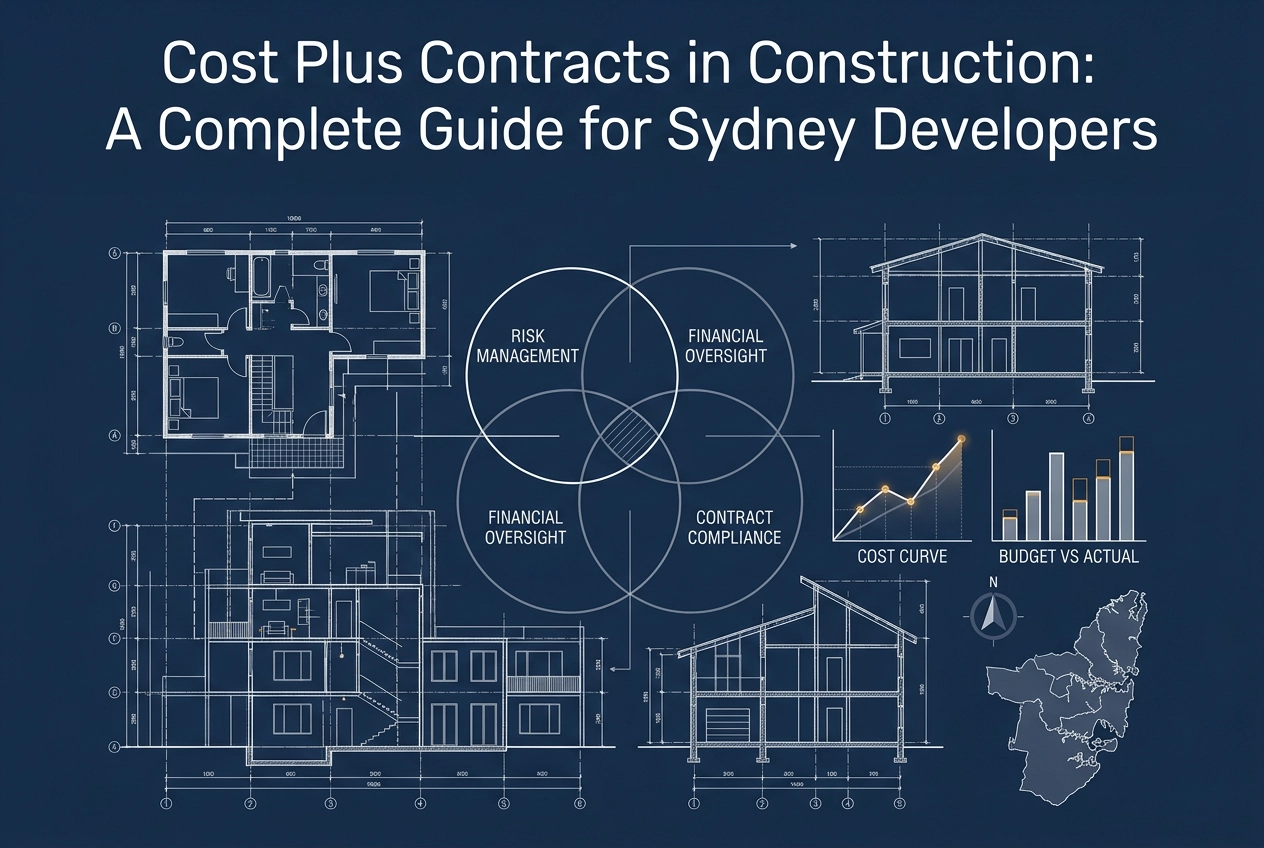
When budgets spiral and project scopes shift mid-build, the contract structure you choose can mean the difference between a profitable development and a financial headache. For Sydney developers navigating complex residential and commercial builds, the cost plus contract has emerged as a compelling alternative to traditional fixed-price agreements, offering flexibility that rigid lump-sum arrangements simply cannot provide.
But flexibility comes with its own set of challenges. Without a clear understanding of how cost plus contracts work, developers can find themselves exposed to budget blowouts, strained builder relationships, and disputes over legitimate expenses. The stakes are particularly high in Sydney's competitive market, where material costs fluctuate and skilled labour remains in high demand.
This guide breaks down everything intermediate developers need to know about cost plus contracts in construction. You will learn how these agreements are structured, where the risks and rewards actually lie, and how to implement the right safeguards to protect your investment. Whether you are evaluating your first cost plus arrangement or refining your approach after previous experience, this analysis will give you the clarity to make informed decisions on your next Sydney project.
What Is a Cost-Plus Contract?
A cost-plus contract is a construction agreement in which the project owner reimburses the contractor for all direct project costs incurred during delivery, plus a defined margin covering the contractor's overhead and profit. Reimbursable costs typically include direct labour, materials, plant and equipment hire, subcontractor invoices, site overheads, preliminaries, and any approved variations or change orders. The contractor is made whole on every verified expenditure item, with the margin applied on top as the agreed commercial return. As Investopedia explains, the structure is straightforward in principle: actual project costs plus a specified profit component, with the owner carrying the financial exposure if costs escalate.
Two principal markup structures govern how that contractor margin is calculated. Under a percentage-of-cost arrangement, the contractor's fee is expressed as a fixed percentage of total actual expenditure, meaning the dollar value of the fee increases proportionally as costs rise. For example, direct costs of $75,000 at a 10% margin produce a contractor fee of $7,500. Under a fixed-fee arrangement, a negotiated lump-sum margin is agreed at the outset and added to reimbursable costs regardless of how total spending moves, providing the owner with greater predictability over the contractor's commercial return. Icertis also identifies incentive-fee and award-fee variants, which are more common in government and major infrastructure procurement contexts.
In Australian practice, cost-plus contracts are also referred to as cost-reimbursable contracts or open-book contracts, the latter term reflecting the contractor's transparency obligation to provide supporting records, invoices, and timesheets for owner verification. The structure is used across residential, commercial, and civil infrastructure sectors, and is particularly prevalent where project scope is insufficiently defined at the time of award to support accurate fixed-price tendering.
Understanding how cost-plus differs from alternative contract forms is essential to evaluating its suitability. Under a lump-sum (fixed-price) contract, the total project cost is agreed in advance and the contractor absorbs any cost overrun from their own margin. Under a guaranteed maximum price (GMP) contract, the owner reimburses costs up to a negotiated ceiling, beyond which the contractor carries the overrun risk, creating a hybrid risk profile. Cost-plus sits at the opposite end of the risk spectrum from lump-sum: the owner carries essentially all cost risk, while the contractor's commercial exposure is limited. This distinction underpins the comparative analysis that follows.
When Is a Cost-Plus Contract the Right Choice?
Cost-plus contracts are most appropriate when the scope of work cannot be reliably defined before construction begins. In infrastructure, remediation, and complex refurbishment projects, attempting to lock in a lump-sum price against an incomplete or evolving design simply transfers scope-definition risk to the contractor, who responds by pricing worst-case assumptions and loading contingency into the tender. This inflates the owner's committed cost before a single element of work is delivered. Where design documentation remains incomplete at contract execution, or where the project brief is subject to ongoing change, a cost-plus structure is the more commercially rational starting point.
Fast-track delivery scenarios present a related challenge. Owners who need to mobilise construction activity before full design documentation is available face a structural problem with fixed-price procurement: there is nothing sufficiently defined to price against. In these circumstances, a cost-plus arrangement, often structured with a Guaranteed Maximum Price once design matures, allows early works to proceed while documentation continues in parallel. This approach is increasingly common across transport, utilities, and energy projects in New South Wales where programme constraints override the preference for full design completion before procurement.
The current material cost environment reinforces this logic. Copper pipes and fittings rose 14.5% in a single quarter to March 2026, and structural steel is forecast to increase a further 10 to 15% through 2026. Electrical equipment has already risen 6.3% year-on-year. Contractors asked to hold firm lump-sum prices across copper-intensive, steel-intensive, or mechanical services scopes must either absorb speculative risk or pad tender submissions heavily. Neither outcome serves the owner well. Where commodity exposure is material and price movement is genuinely unpredictable across the contract duration, cost-reimbursable contract structures more accurately reflect actual project economics than a fixed price inflated by contingency.
Complex remediation, brownfield rehabilitation, and adaptive reuse projects occupy a distinct category. In these projects, existing fabric conceals structural defects, latent hazardous materials, and service conflicts that no pre-contract investigation can fully resolve. The full scope is not merely unclear; it is genuinely unknowable until works are underway. Forcing a fixed price onto these conditions requires contractors to assume worst-case scenarios, creating a contingency premium the owner pays regardless of actual conditions encountered.
The fundamental trade-off is one of risk allocation. Under a lump-sum contract, the contractor carries financial exposure to scope uncertainty and cost escalation. Under a cost-plus arrangement, that financial exposure transfers to the owner. This transfer is appropriate, not problematic, when the owner controls design decisions, occupies the site during construction, or has greater visibility over scope evolution than the contractor does. As contract management frameworks recognise, the objective is to place financial risk with the party best positioned to manage or absorb it, rather than to default to a contract form based on convention alone.
Cost-Plus Contracts in the Current Australian Construction Market
The scale of construction cost escalation in Australia over the past five years has fundamentally altered the commercial calculus behind contract structure decisions. According to current construction cost trend data, the average cost to build a new home in Australia reached $474,939 in 2024-25, representing a 37.5% increase from $345,410 in 2019-20. The ABS CPI for new dwellings rose 4.5% year-on-year to March 2026, while the ABS Producer Price Index for house construction recorded a 4.1% increase over the same period, including a 1.1% rise in the March 2026 quarter alone. This is not a post-pandemic correction playing out. Costs have stabilised at a structurally higher base, and the conditions that drove escalation have not fully unwound.
The insolvency data reinforces why contract structure has moved to the centre of commercial risk discussions. There were 2,361 construction business failures in 2024-25, representing approximately one in four of all business insolvencies across the entire Australian economy. Construction remains the highest-insolvency sector nationally, and the primary contributing factor is well-documented: fixed-price contracts written before the post-2020 cost surge locked builders into delivery obligations at margins that became unviable as material and labour costs escalated. The consequence for project owners is significant. Counterparty insolvency mid-project creates programme disruption, cost overrun, and contractual complexity that no contract form can fully insulate against without active commercial oversight.
Material cost volatility is driving much of the current interest in cost-plus contract structures, particularly for projects with significant mechanical, electrical, and hydraulic content. Electrical equipment prices rose 6.3% year-on-year to March 2026, while copper pipes and fittings surged 14.5% in a single quarter. The Australian construction material price outlook from Altus Group identifies HVAC equipment as a particularly exposed category, with forecast price increases of 12 to 20% through 2026. Annualised input price spikes are running at 12.6% in key material categories globally, reflecting supply chain pressures that continue to flow through to Australian procurement. For any project with a significant equipment procurement component, attempting to fix these costs at tender represents a meaningful commercial risk for whichever party assumes it.
Labour market conditions compound the challenge independently of material pricing. A structural deficit of approximately 500,000 workers in Australian construction is sustaining labour cost premiums across all project types and all contract forms. Trade availability constraints extend programme durations, reduce productivity, and increase supervision costs. These dynamics affect the final cost under a cost-plus arrangement just as they affect a fixed-price builder's margin. Selecting a cost-plus structure does not transfer labour risk away from the owner; it makes that risk visible and directly billable rather than embedded in a lump sum that may ultimately prove unsustainable.
The critical analytical point for any project owner or procurement adviser is that construction inflation has moderated from 2022 peaks but is not reversing. Broad input prices remain 2.5% higher year-on-year to March 2026. In this environment, cost certainty under any contract form, whether fixed-price, cost-plus, or a hybrid structure incorporating rise-and-fall provisions, requires active management through rigorous cost planning, independent cost monitoring, and transparent commercial controls. Passive reliance on contract structure alone, without the underlying quantity surveying and commercial management discipline to validate and control expenditure, leaves project owners exposed regardless of how the contract is drawn.
The Hidden Cost-Plus Risk Inside Fixed-Price Contracts
Many owners executing what they believe to be a fixed-price contract are, in practice, carrying a level of open-ended cost exposure that closely resembles a cost-plus arrangement. This exposure is embedded through three mechanisms that warrant careful scrutiny before contract execution: provisional sums, prime cost items, and variations.
Provisional sums (PS) are allowances included in a fixed-price contract for work that cannot be accurately defined or priced at tender stage. They function as budget placeholders, covering items such as specialist subcontractor installations, complex groundworks, or any scope element where design remains incomplete. Critically, a provisional sum covers both supply and all associated work to be performed, meaning the final instructed cost is entirely open until the instruction is issued. If the actual cost exceeds the allowance, the owner pays the difference. A contract containing significant PS allowances is not meaningfully fixed in those areas; the owner carries the cost risk directly, in the same way they would under a cost-plus arrangement.
Prime cost (PC) items operate differently but create comparable uncertainty. A PC item is a fixed budget allowance for the supply of a specified material or fitting, such as sanitaryware, flooring, lighting, or kitchen tapware, where the owner defers the final selection until after contract execution. Once a selection is made, the contract sum adjusts upward or downward to reflect the actual supply cost. As outlined in Prime Cost Sums in Construction Contracts: Risks, BOQ Examples, and Pricing Strategy, PC adjustments compensate for material price only and do not account for associated changes in handling, storage, installation productivity, or protection requirements, making them one of the more misunderstood pricing mechanisms in standard contract forms.
Variations compound this exposure further. Instructed changes to scope, whether driven by design evolution, owner preferences, or unforeseen site conditions, progressively erode fixed-price certainty. On complex projects, cumulative variation values can represent a substantial proportion of the final contract sum, effectively converting a nominally fixed commitment into something far more fluid.
The combined effect is significant. A contract where provisional sums and PC items represent 20 to 30 percent of the total contract value, layered with an active variation regime, provides far less cost certainty than its headline price suggests. Owners and developers should quantify the undefined proportion of any tender submission before signing, and independently benchmark PS and PC allowances against current market rates. Contractors may include deliberately conservative allowances to present a competitive headline figure, with adjustments to follow. Engaging an independent quantity surveyor to review contract schedules prior to execution is a practical and cost-effective step on any project with material undefined cost exposure.
Risks and Disadvantages of Cost-Plus Contracts
While cost-plus contracts offer genuine flexibility in uncertain project environments, they carry a distinct risk profile that owners must understand before committing to this contract structure. The advantages discussed in earlier sections come at a direct cost: financial exposure, incentive misalignment, administrative burden, and dispute potential that require active, experienced management throughout the project lifecycle.
Owner-Side Cost Exposure
The defining characteristic of cost-plus contracting is that the owner absorbs the majority of financial risk. Without a guaranteed maximum price ceiling, there is no contractual backstop on total expenditure. Final construction costs remain unknown until project completion, and according to industry analysis from Procore, "the total price for a cost-plus contract may ultimately be higher than it would be with other contract types." Where scope creep occurs, site conditions prove more complex than anticipated, or site management is inefficient, a fixed-price contractor would absorb the overrun. Under a cost-plus arrangement, the owner pays it in full. The final account on a poorly scoped cost-plus project can substantially exceed what a competitive fixed-price tender would have returned, even accounting for contingency.
Contractor Incentive Misalignment
Where the contractor's fee is expressed as a percentage of total project costs, the structure creates a direct financial disincentive to control expenditure. As costs rise, the contractor's absolute fee increases proportionally. As noted in cost-plus contract analysis, these arrangements "risk higher costs if unchecked," which is an explicit acknowledgement that active owner-side oversight is not optional but essential. A fixed-fee structure partially addresses this misalignment, but it does not eliminate it entirely. Independent quantity surveyor engagement, or appointment of an owner's representative with commercial management responsibilities, is considered best practice on any cost-plus project of material value.
Documentation, Audit Complexity, and Discrepancy Risk
Cost-plus contracts generate a substantially higher volume of financial records than fixed-price arrangements, including labour timesheets, material invoices, plant hire dockets, subcontractor progress claims, and overhead allocations. Each category requires verification and reconciliation throughout the project lifecycle, not merely at final account. Experienced quantity surveyors frequently identify discrepancies at the progress claim review stage, including preliminary and general items charged to both the direct cost line and the markup percentage, head office overhead recovered via markup and also claimed as a site cost, and subcontractor invoices embedding their own profit margin that is then again marked up by the head contractor. These compounding errors are difficult to unwind retrospectively if audit rights are not exercised in real time.
Dispute Potential and Formal Proceedings
Poorly administered cost-plus contracts are a consistent precursor to formal payment disputes. When records are incomplete, ambiguous, or contested, the parties lack the shared factual foundation needed to resolve disagreements efficiently. In the Australian context, markup legitimacy and cost inclusion disputes frequently escalate to Security of Payment Act adjudication, and in more complex cases, to formal litigation or expert determination. The commercial and reputational consequences of these proceedings are material for both owners and contractors. Well-drafted contracts include a clearly defined schedule of reimbursable and excluded costs, but drafting quality alone is insufficient without disciplined record-keeping and regular independent review across the full project duration.
Record-Keeping Obligations Under a Cost-Plus Contract
Under a cost-plus contract, the contractor's obligation to maintain comprehensive, accurate financial records is not administrative formality. It is the commercial foundation upon which every payment claim rests. The core documentation suite that contractors are typically required to maintain includes tax invoices for all purchased materials and hired plant, signed timesheets for all directly employed labour, delivery dockets confirming physical receipt of materials on site, subcontractor quotes and executed purchase orders establishing the arms-length basis for subcontracted costs, and receipts for all site expenses and allowances including petty cash, travel, and field disbursements. Each category corresponds directly to a reimbursable cost type, and each requires contemporaneous documentary evidence to support assessment and payment.
The principle that governs cost-plus administration is straightforward: a cost-plus arrangement is only as defensible as the records underpinning it. Incomplete invoicing, unsigned timesheets, missing delivery dockets, or undocumented verbal instructions do not simply create administrative inconvenience. They create genuine commercial and legal exposure for both parties. Where costs cannot be substantiated, disputes over allowable versus non-allowable expenditure become difficult to resolve through normal commercial channels and may ultimately require adjudication or formal dispute resolution. This exposure is avoidable with disciplined record management, but only if that discipline is applied from the first day of site activity.
Well-drafted cost-plus contracts address this risk directly by including a provision granting the owner, or their appointed representative, the right to inspect and audit the contractor's cost records during construction and for a defined period following practical completion. Under cost-reimbursement contract frameworks, including those codified in FAR Subpart 16.3, contractors are reimbursed only for allowable incurred costs, a threshold that cannot be assessed without unrestricted access to underlying financial records. Equivalent audit rights provisions are increasingly standard in private sector infrastructure contracts in Australia, particularly on projects of material value where owner-side cost oversight is a commercial necessity.
The practical challenge is that active construction sites generate high-volume, fast-moving cost events that are easily lost, misattributed, or reconstructed retrospectively rather than captured at the point of occurrence. Labour hours, plant movements, material deliveries, and subcontractor instructions accumulate rapidly, and the failure to record costs contemporaneously is one of the most common sources of cost-plus disputes. Retrospective record reconstruction, however well-intentioned, is commercially weaker than contemporaneous documentation and substantially more difficult to defend under independent audit or in adjudication proceedings.
Owners should engage an independent quantity surveyor at contract commencement to establish a cost reporting framework before the first progress claim is submitted. As outlined in cost reimbursement contract guidance, effective cost-reimbursement arrangements establish at award a structured framework covering labour category mapping, cost allocation methodology, and fee treatment. An independent quantity surveyor defines equivalent parameters for private infrastructure contracts: the required format and level of detail for each cost category, the frequency of cost reporting, and the documentation standards that must be met to support progress claim assessment and final account reconciliation. Establishing this framework at commencement, rather than resolving its absence retrospectively, materially reduces the risk of disputed claims and cost overruns.
The Role of an Independent Quantity Surveyor in a Cost-Plus Contract
The independent quantity surveyor occupies a defined and consequential role in any cost-plus arrangement: acting exclusively on behalf of the owner to assess, verify, and certify each progress claim before payment is authorised. This is not an administrative function. It is a forensic one. Every dollar claimed must be traceable to a legitimate, properly documented project cost that falls within the contractually reimbursable categories. The QS examines the contractor's cost records with the owner's commercial interest as the governing standard, establishing that costs were genuinely incurred, correctly allocated to the project, and consistent with the scope of authorised work. Without this independent layer of scrutiny, the open-book structure of a cost-plus contract places the owner in the position of relying entirely on the contractor's self-assessment of what is owed.
Markup Verification
Verifying the contractor's fee requires more than confirming the agreed percentage rate. The QS examines both the rate applied and the cost base to which it is applied. Common issues include applying the margin to head-office overheads, financing charges, or other costs that are contractually ineligible as a markup base, or inflating direct costs before the percentage is calculated. Where the contracted margin is, for example, 15% of verified direct costs, even a modest inflation of the base by $50,000 produces an unwarranted additional fee of $7,500. The QS reconciles the contractor's claimed margin against the agreed rate on each claim cycle, cross-referencing against current market benchmarks for overhead and profit to identify any systematic divergence that warrants formal notification to the owner.
Progress Claim Assessment
Each payment cycle, the contractor submits a claim supported by supplier invoices, delivery dockets, trade timesheets, plant hire records, and subcontractor accounts. The QS reviews every line item against its underlying documentation, applying both a completeness test (is every item supported?) and an eligibility test (is the cost contractually reimbursable?). After line-item review, cumulative certified costs are reconciled against the approved project budget, providing a running measure of cost performance. The QS then issues an independent payment certificate or written assessment that forms the basis of the owner's payment decision, keeping the commercial authorisation separate from the contractor's claim.
Anomaly Detection
The QS brings specific technical training to detecting irregularities that a non-specialist owner would be unlikely to identify. Duplicate invoicing, where the same supplier invoice appears across multiple claims with minor variations in reference numbers or dates, is among the most common. Labour timesheet entries claiming trades on days where site diaries or access records show no corresponding activity represent another category of risk. Plant hire charges for equipment absent from site returns, subcontractor invoices exceeding executed contract rates, and preliminary items charged both as direct line items and embedded within subcontractor accounts are further examples. These anomalies may arise from administrative error rather than deliberate manipulation, but the financial consequence to the owner is identical in either case. The QS investigates, seeks clarification, and withholds certification until the discrepancy is resolved.
Ongoing Cost Reporting
Beyond claim-by-claim verification, the QS provides the owner with regular cost reports presenting committed costs, incurred costs, and forecast outturn in a consolidated format. This ongoing reporting function converts the latent risk of a cost-plus structure into visible, actionable intelligence. When cost trends indicate budget pressure or scope drift, the owner receives timely warning while intervention options, including scope reduction, negotiation, or procurement adjustments, remain available. This is the practical difference between proactive budget management and reactive dispute resolution after the budget has already been exceeded.
Standard Form Contracts for Cost-Plus Arrangements in NSW
Both the residential and commercial construction sectors in NSW operate within distinct standard form contract frameworks, and understanding which framework applies to a given project is a foundational step before any cost-plus arrangement is executed.
Residential Sector: HIA and MBA Standard Forms
For residential construction in NSW, the Housing Industry Association (HIA) and the Master Builders Association (MBA) each publish standard-form cost-plus contracts tailored to the residential sector. These forms include specific provisions governing the definition of reimbursable costs, the applicable markup rate or margin structure, and the owner's rights to inspect and audit cost records. The HIA and MBA forms are widely used across the industry and are generally recognised by NSW Fair Trading as appropriate instruments for residential cost-plus work. However, the printed standard provisions represent a starting point, not a final position; the specific definition of what constitutes a reimbursable cost, and what is excluded, requires careful review before any contract is signed.
Commercial and Civil Sector: AS 4000 and AS 4300
In the commercial, civil, and infrastructure sectors, the relevant instruments are Australian Standards AS 4000 (General Conditions of Contract) and AS 4300 (General Conditions of Contract for Design and Construct). AS 4300 is specifically structured to accommodate reimbursable cost arrangements, making it the standard reference point for commercial and civil projects where a cost-plus or cost-reimbursable model is adopted. These forms provide a more comprehensive framework for large or complex projects, including mechanisms for verifying cost claims, managing variations, and resolving disputes. Project principals and contractors working on transport, utilities, water, or energy infrastructure will typically work from AS 4300 as the base document, with special conditions drafted to address project-specific commercial requirements.
The NSW Home Building Act 1989
For residential projects, the NSW Home Building Act 1989 imposes mandatory requirements that apply regardless of whether the contract is fixed-price or cost-plus. These include prescribed contract form requirements, deposit limits, mandatory progress payment schedules, and statutory disclosure obligations. Non-compliance with the Act can expose builders to licence conditions and owners to uncertainty around their legal protections. These obligations are not displaced by the adoption of a cost-plus structure.
Security of Payment Act 1999 (NSW)
Across both sectors, the Building and Construction Industry Security of Payment Act 1999 (NSW) applies to all construction contracts, including cost-plus arrangements. Contractors hold statutory rights to submit progress payment claims, and owners or principals must respond with a valid payment schedule within the prescribed timeframes. Failure to issue a payment schedule can result in the claimed amount becoming due and payable by operation of law. On cost-plus contracts, where the payment claim amount will vary with actual costs incurred, it is important that claims are accompanied by supporting cost documentation sufficient to constitute a valid claim under the Act.
Regardless of which standard form is used, the cost-plus specific clauses warrant particular scrutiny before execution. The definitions of reimbursable costs and excluded costs, the markup mechanism, and the owner's audit rights are the provisions most likely to generate disputes during delivery. These clauses should always be reviewed by a qualified construction lawyer before the contract is executed.
Dispute Resolution and the Cost-Plus Contract
Cost-plus contracts generate a disproportionate share of construction disputes, and understanding why is essential to managing the risks before they escalate. The most common triggers fall into four distinct categories: disagreements over which costs are legitimately reimbursable under the contract, challenges to the reasonableness of the contractor's markup, allegations of inflated or fabricated cost records, and disputes over the scope and value of variations instructed during construction. The reimbursability question is particularly contentious because cost-plus contracts often lack precise definitions of what constitutes a direct project cost, creating ambiguity that becomes expensive to resolve. Courts have taken a demanding view of contractor obligations in these disputes; in one documented case, a contractor who provided a $35,350 estimate but ultimately billed approximately $67,000 had the entire claim dismissed after the court implied a term that the contractor should have been capable of accurate estimation. The lesson is clear: the absence of rigorous cost management disciplines during delivery does not merely create financial exposure, it can destroy an otherwise legitimate claim.
The Adjudication Pathway Under the Security of Payment Act
Where a payment claim is disputed on a construction project in New South Wales, either party may refer the matter to an authorised nominating authority under the Building and Construction Industry Security of Payment Act 1999 (NSW). This adjudication process is structured for speed and practicality, with determinations typically issued within ten business days of the adjudicator's appointment. That compressed timeframe is a double-edged benefit: it prevents prolonged cash flow disruption, but it also places an immediate premium on well-prepared, evidence-based submissions. Parties who arrive at adjudication without organised documentation, structured cost records, and a clear articulation of their contractual entitlement face a significant and often insurmountable disadvantage. In a cost-plus dispute, where the contested amount may span dozens of payment claims, invoices, and variation instructions, the quality of the evidentiary record presented is frequently determinative.
The Quantity Surveyor as Independent Expert
A quantity surveyor engaged as an independent expert in a cost-plus dispute performs a role that combines technical cost analysis with the objectivity required of an expert witness. The QS can prepare an independent expert report that quantifies legitimate reimbursable costs against the contract terms, assesses whether the markup percentage claimed is commercially reasonable, and identifies specific anomalies, duplications, or overcharges within the contractor's records. This analysis translates complex financial data into findings an adjudicator or judge can act upon with confidence. Critically, a QS who has been monitoring costs throughout the project is not starting from scratch when a dispute arises; the audit trail already exists, the cost data is independently verified, and the owner's position is grounded in contemporaneous evidence rather than retrospective reconstruction.
Prevention Remains the Most Effective Strategy
Poorly maintained cost records substantially weaken a contractor's position in adjudication or litigation. Conversely, an owner supported by an independent QS who has maintained continuous oversight of project costs is considerably better placed to defend against an inflated claim or to prosecute an overcharge allegation. The most effective dispute management strategy in a cost-plus contract is not reactive; it is the appointment of an independent quantity surveyor at project commencement to establish a transparent, auditable cost management framework. When that framework is operating from day one, disputes become less likely because the commercial relationship is grounded in verified data rather than contested recollection. Where a dispute does arise despite those controls, the evidentiary foundation is already in place to support a rapid and cost-effective resolution.
Engaging an Independent Quantity Surveyor for Your Sydney Project
The optimal time to engage an independent quantity surveyor on a cost-plus project is before the contract is executed, not after the first progress claim arrives. Early engagement allows the QS to review draft contract terms, confirm that the definition of reimbursable costs is precise and unambiguous, and establish the cost reporting and progress claim assessment framework from the outset. Attempting to impose commercial oversight retrospectively, once claims are in dispute or costs have already escalated, significantly limits what independent advice can achieve and increases the risk of contested final accounts.
In a cost-plus context, independent QS advisory services typically span the full project lifecycle. At the pre-contract stage, this includes contract review and commercial risk assessment, identifying gaps in reimbursable cost definitions, and establishing a cost plan and budget baseline against which contractor claims will be measured. During construction, the QS assesses and certifies each progress claim, verifies that claimed costs are supported by adequate documentation, and confirms that applied markups align with the agreed contractual rate. Regular cost reporting keeps the owner informed of actual expenditure against budget, with early identification of cost trends that may require commercial intervention. At project completion, the QS conducts a final account review and reconciliation, providing the owner with a fully audited cost record.
Sydney-specific market knowledge is not a supplementary consideration; it is fundamental to accurate claim benchmarking. Understanding prevailing subcontractor trade rates across the Sydney metropolitan area, the labour cost premiums that apply in the current tight market, and the cost implications of NSW regulatory requirements, including council conditions of consent, infrastructure contributions levied under the Environmental Planning and Assessment Act, and Development Application compliance obligations, allows the QS to assess whether contractor claims reflect genuine market costs or incorporate inefficiencies and unjustified charges that an owner without specialist knowledge would not identify.
Quantity Surveyors Sydney provides independent cost management and contract administration services across commercial, infrastructure, and civil projects throughout Sydney and New South Wales, with specific expertise in cost-plus contract oversight, progress claim assessment, and dispute-related quantity surveying. Whether you are reviewing a draft cost-plus contract, managing an active project, or seeking independent verification of a disputed claim, contact the team to discuss your project requirements.
Key Takeaways for Owners and Developers Considering a Cost-Plus Contract
Cost-plus contracts offer a genuine and sometimes necessary solution when project scope cannot be reliably fixed before construction begins. The fundamental trade-off is clear: the owner gains flexibility and the ability to commence delivery without a complete design, but absorbs the financial risk of cost escalation throughout the project. That risk is manageable, but only with active, independent cost oversight in place from the outset.
The current construction market reinforces this point. With input prices rising 2.5% year-on-year to March 2026, structural steel forecast to increase 10 to 15% through the year, and 2,361 construction insolvencies recorded in 2024-25, neither fixed-price nor cost-plus contracts are without material risk. The decisive factor is not which contract form is chosen, but whether risk is understood, allocated deliberately, and managed with the right commercial controls.
Independent quantity surveyor oversight is the most effective protection available to owners under a cost-plus arrangement. Appointing a qualified QS to assess progress claims, verify markup legitimacy, and maintain a current cost-to-complete picture transforms a potentially open-ended financial exposure into a controlled and transparent process.
Owners should also recognise that provisional sums, prime cost items, and variations create equivalent cost-plus exposure within many fixed-price contracts. The same oversight disciplines apply regardless of the contract label.
Before executing a cost-plus contract or approving a progress payment under one, seek independent commercial advice from a qualified quantity surveyor with direct experience in Sydney's construction market.
Conclusion
Cost plus contracts offer Sydney developers a powerful tool when project complexity demands flexibility over certainty. The key takeaways are clear: these agreements work best on projects with evolving scopes, they require rigorous cost tracking and transparency, and selecting a trustworthy builder is as important as the contract terms themselves. Equally, understanding your legal protections under NSW legislation will keep you firmly in control throughout the build.
Armed with this knowledge, you are positioned to make informed decisions rather than reactive ones. Before your next development, review your project scope honestly, consult a construction lawyer, and vet potential builders thoroughly.
The developers who thrive in Sydney's competitive market are not those who avoid risk entirely. They are the ones who understand it, manage it deliberately, and choose the right structures to support their goals. Your next successful build starts with that clarity.