
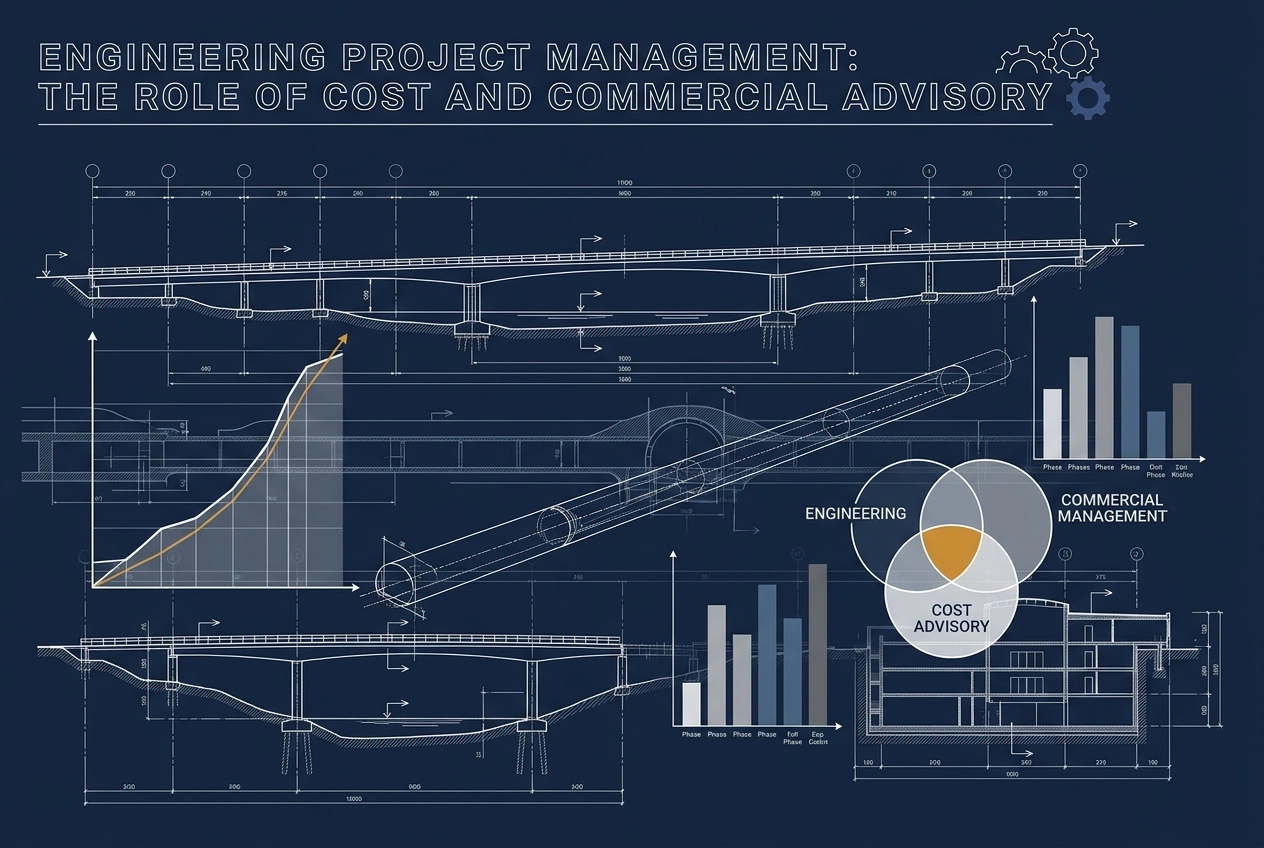
Every major infrastructure failure, budget overrun, or delayed capital project shares a common thread: a breakdown in cost and commercial oversight at critical decision points. In the high-stakes world of engineering project management, technical excellence alone is never enough. The financial and contractual frameworks surrounding a project determine whether it succeeds or collapses under its own complexity.
Cost and commercial advisory functions have evolved far beyond simple budget tracking. Today, they represent a sophisticated discipline that integrates risk quantification, procurement strategy, contract administration, and value engineering into a unified management approach. For organizations delivering complex engineering programs, understanding this integration is not optional; it is foundational.
This analysis examines the precise role that cost and commercial advisory plays within engineering project management, exploring how it shapes decision-making from feasibility through to final account. Readers will gain insight into the methodologies, tools, and governance structures that distinguish high-performing project teams from those that consistently struggle to deliver on scope, schedule, and budget. If you manage, advise on, or invest in engineering projects, what follows is essential reading.
What Engineering Project Management Actually Involves
Engineering project management is the structured coordination of scope, cost, time, quality, and risk across technically complex projects. As detailed in Engineering Project Management: The Essential Guide, it is a specialised discipline that extends well beyond general project management by incorporating deep technical knowledge, domain-specific regulatory compliance, and the coordinated management of large, multi-disciplinary delivery teams. Unlike standard construction projects, engineering schemes frequently involve safety-critical systems, legally binding design standards, and long-horizon delivery programmes that introduce a qualitatively different risk and commercial profile. The discipline requires practitioners to blend engineering literacy with commercial and managerial competence, a combination that neither pure engineering nor generic management functions can fully replicate.
The core disciplines that underpin effective engineering project management include project controls, cost management, commercial management, procurement strategy, contract administration, risk management, and stakeholder engagement. Each discipline is interdependent; a failure in procurement strategy, for instance, will directly compromise cost certainty and programme performance. On major infrastructure schemes, the choice of contract form, whether NEC4, FIDIC, or an alliance-based model, determines how risk is allocated between client and contractor, making contract administration a function of genuine strategic importance rather than a back-office compliance exercise.
Infrastructure sectors including transport, utilities, energy, water, and civil works demand a more rigorous commercial framework than standard construction because of their regulatory complexity, tiered supply chains, multi-year delivery timescales, and the technical uncertainty that characterises early-stage scope definition. Decisions made in the concept and feasibility stages have a disproportionate influence on final outcomes, a principle reinforced by Rice University's graduate engineering management programme, which emphasises the value of structured front-end planning as the primary lever for cost and programme control.
The project lifecycle, spanning concept, feasibility, procurement, construction, commissioning, and close-out, provides the organising framework through which these disciplines are applied. Each stage carries distinct governance requirements, cost confidence thresholds, and risk profiles that must be actively managed rather than passively monitored.
The 2026 operating environment is placing unprecedented strain on this framework. The KPMG Global Construction Survey 2025/2026 identifies material price volatility, labour shortages, technology adoption pressure, and shifting project demand as the four forces currently reshaping construction and engineering project delivery. Supply chain disruption across steel, copper, and concrete continues to erode cost plan certainty, while skilled labour constraints are extending programmes and driving wage inflation. Clients and regulators are simultaneously mandating greater digital delivery capability, adding upfront investment requirements at a time when project budgets are already under pressure.
Why Cost Management Is a Core Pillar of Engineering Project Management
Cost management is not a reporting function performed at the back end of a project. It is a strategic discipline that must be embedded from the moment an investment decision is being contemplated through to final account settlement and project close-out. At each phase of the engineering project lifecycle, cost management shapes the quality of decisions being made: whether a project is commercially viable, whether the scope is fundable within the available budget, whether risks have been priced accurately, and whether the project owner can defend the investment to stakeholders, boards, or government oversight bodies. Treating cost management as a peripheral activity is one of the most reliably costly mistakes a project team can make.
The evidence for this is consistent across the global engineering and construction sector. The KPMG Global Construction Survey 2025/2026 confirms that project cost control and delivery performance remain significant challenges for the industry internationally, with organisations continuing to struggle across all four core cost management processes: planning, estimation, budgeting, and control. Research published by the PM World Journal, drawing on responses from senior project professionals, found that these failures are systemic rather than isolated, reflecting organisational and analytical shortcomings in understanding project complexity rather than simple arithmetic errors. Oxford University research into megaproject performance, led by Professor Bent Flyvbjerg, has further demonstrated that systematic cost underestimation is a structural pattern across infrastructure programmes globally, not an anomaly confined to individual projects.
How Cost Plans Evolve Across the Project Lifecycle
One of the most technically important aspects of cost management is understanding that cost plans are not static documents. They evolve in precision, scope, and commercial significance at each project phase. At concept stage, an order-of-magnitude estimate provides a high-level view of likely project cost, typically carrying an acceptable margin of plus or minus 25 to 30 percent. This is sufficient to inform an initial investment decision or business case but is not adequate for budget approval or procurement. At feasibility, an elemental cost plan breaks the project into defined functional elements, allowing the client to test scope assumptions against budget and assess alternative approaches. Tolerance narrows to approximately plus or minus 15 percent. Through design development, the cost plan is progressively refined as the engineering scope becomes better defined, and by the time a contract sum analysis is prepared at tender stage, the acceptable range of variance has narrowed to approximately plus or minus 5 percent. Each phase requires a different level of commercial input, design interrogation, and risk assessment from the cost manager. Applying the same benchmark rate methodology across all phases, regardless of design maturity, produces misleading cost positions that expose clients to budget shortfalls at the worst possible time.
What Infrastructure Clients and Government Agencies Actually Require
From a client-side perspective, the requirements from cost management go well beyond a number on a page. Government agencies and infrastructure owners need cost certainty that is defensible at gateway review, probabilistic risk-adjusted forecasts that distinguish between P50 and P80 cost outcomes, and budget confidence that supports responsible financial decision-making under public accountability frameworks. Private developers and project financiers require cost plans that support investment committee approval, underpin financing structures, and withstand due diligence scrutiny. For all clients, the value of cost management is its ability to convert technical complexity into commercially legible information that enables decisions to be made with appropriate confidence.
This is precisely why cost management within engineering project management requires a thorough understanding of both the technical scope and the commercial risk profile of a project. Applying unit rates to square metres or linear metres without interrogating the underlying scope assumptions, site conditions, design constraints, procurement environment, or programme risks produces a cost plan that looks credible but lacks analytical integrity. Effective cost management integrates risk assessment, schedule analysis, procurement strategy, and scope definition into a single coherent commercial framework, which is what separates a genuinely useful cost plan from a figure that simply fills a box in a business case template.
The Quantity Surveyor's Role Within Engineering Project Management
The quantity surveying profession has undergone a substantial transformation over the past two decades. Where the discipline was once primarily associated with bills of quantities, measurement, and documentation, the infrastructure QS operating in 2026 functions as a cost planner, procurement advisor, commercial manager, risk analyst, and project controls specialist. RICS describes the modern QS as "the financial linchpin of any construction job," engaged from conception through completion and providing expert input across lifecycle costing, procurement strategy, contract administration, and overall commercial management. This evolution is not simply a matter of broadened scope; it reflects a fundamental repositioning of the discipline within engineering project management structures, where commercial oversight and cost intelligence are recognised as core delivery functions rather than peripheral services.
Mapping the QS Role Across the Project Lifecycle
The value a specialist infrastructure QS delivers is most clearly understood by mapping the role to each stage of the project lifecycle. At concept stage, the QS supports feasibility studies and business case development by providing order-of-magnitude cost estimates, funding gap analysis, and early identification of cost drivers that could affect project viability. During design development, the focus shifts to detailed cost planning, identification of value engineering opportunities, and formulation of the procurement strategy best suited to the project's risk profile and delivery objectives. Through the procurement and construction phases, the QS prepares and manages tender documentation, conducts tender analysis, negotiates contract terms, administers the contract, and assesses progress claims. At project completion, the QS manages the final account process, resolves commercial disputes, and supports close-out reporting. Each of these functions integrates directly with the broader engineering project management framework, ensuring that commercial performance remains aligned with programme and scope objectives throughout.
Transactional vs. Strategic: A Critical Distinction
Not all quantity surveying engagement delivers equivalent value on complex engineering projects. A transactional QS provides measurement, documentation, and cost reporting. A strategic infrastructure QS, by contrast, provides commercial advisory, risk allocation advice, procurement structuring, and cost certainty mechanisms across the full lifecycle. On large-scale transport, energy, water, or civil infrastructure projects, the difference between these two orientations is material. A strategic QS shapes the procurement model to reflect the project's risk environment, advises on contract form and conditions to achieve appropriate risk allocation, and provides the independent commercial oversight that project owners require to make informed investment and delivery decisions. Industry commentary, including practitioner discussions on LinkedIn, confirms that the QS role is "far broader and more strategic than many assume," encompassing cost control, commercial decision-making, procurement, and risk management functions that align directly with engineering project management responsibilities. Academic research further supports this, with published analysis on ResearchGate exploring the QS role in mega project bidding and contractual management, confirming the discipline's integration into high-stakes project management contexts.
Role Convergence and the Commercial Case for Early Engagement
Across the industry in 2026, the convergence of quantity surveying and engineering project management is increasingly formalised. Firms including Altus Group and RPS Group explicitly position QS and cost management services within project and programme management frameworks, reflecting the strategic elevation of the discipline beyond its traditional boundaries. The UNOPS classification of a Lead Quantity Surveyor under the job category of "Engineer" on international civil infrastructure programmes provides further evidence that, at the organisational level, the QS and engineering project management functions are increasingly treated as integrated rather than separate. This convergence has a practical consequence for project owners and contractors: the earlier a specialist infrastructure QS is engaged, the greater the commercial benefit. Front-end cost input at concept and feasibility stage allows project teams to test assumptions, identify affordability constraints, and refine delivery strategies before design decisions lock in cost trajectories that are difficult and expensive to reverse. Reactive cost engagement, introduced after design development is substantially complete, limits the QS to reporting on decisions already made rather than informing the decisions that matter most.
Front-End Planning and Feasibility: Where Cost Certainty Begins
The most consequential cost management decisions on any engineering project are made before a single design line is drawn. At concept, feasibility, and business case stage, the fundamental parameters of a project are established: what will be built, how it will be procured, how risk will be allocated, and what level of investment is genuinely warranted. These decisions carry a compounding influence on every cost position that follows. Research into construction cost estimating practice confirms that order-of-magnitude estimates at concept stage carry an accuracy range of approximately ±25%, narrowing to ±10–15% at elemental cost plan stage and ±5% at tender. The wide early-stage band is not a failure of the process; it reflects genuine uncertainty that must be explicitly quantified, managed, and disclosed to decision-makers rather than suppressed by optimistic single-point estimates.
A rigorous feasibility study and business case cost assessment, prepared by a specialist infrastructure quantity surveyor, encompasses several interdependent components. Order-of-magnitude cost estimates are developed using parametric or benchmark-based methodologies calibrated to project type, scale, location, and market conditions. Cost sensitivity analysis stress-tests the estimate against variations in scope, procurement model, market conditions, and programme duration, identifying which assumptions exert the greatest influence on project viability. Risk-adjusted cost modelling produces a probability-weighted cost range, typically expressed as P50 and P90 positions, rather than a single deterministic figure that obscures the true range of outcomes. Escalation allowances are applied across the anticipated construction programme, a critical discipline given the material price volatility that has characterised the NSW construction market in recent years. Lifecycle cost considerations ensure that decisions optimising capital expenditure do not create disproportionate long-term asset management liabilities.
The consequences of poorly scoped or optimistically costed feasibility studies are well documented. Australian governments overspent by approximately A$34 billion, representing 21% above initial estimates, on transport projects completed between 2001 and 2015. For projects exceeding A$1 billion, the position was materially worse: nearly half exceeded their initial budgets by an average of 30%. A 2024 global systematic review catalogued 99 cost overrun factors across 10 categories, with inaccurate initial estimates and weak early-stage planning consistently identified as root causes rather than incidental contributors. Optimism bias, the systematic tendency to understate costs and overstate benefits in project business cases, is a well-recognised feature of infrastructure approvals; independent cost advice at feasibility stage provides a direct structural counter to this bias.
In the NSW context, the Infrastructure NSW forward pipeline of transport, utilities, water, and civil infrastructure projects operates within a formal gateway review framework. Cost estimates must demonstrate sufficient rigour to support Stage 1 and Stage 2 gateway approvals, Treasury submissions, and parliamentary budget appropriations. These processes require credible probability-weighted cost ranges, documented risk registers, and defensible assumptions, not aspirational figures prepared to fit a predetermined funding envelope. The NSW Government Capital Business Case Guidelines set explicit standards for the quality and format of cost estimates submitted at each approval stage, and the professional standing of the estimating adviser is a relevant consideration for agencies and their oversight bodies.
Engaging a specialist infrastructure quantity surveyor at feasibility stage is not an additional project cost; it is a risk management measure with a quantifiable return. For a programme where independent review has historically demonstrated the potential to identify material budget exposure before funding commitments are locked in, the advisory fee is immaterial relative to the cost of proceeding on a deficient cost basis. Early QS engagement ensures that investment decisions are grounded in realistic, independently prepared cost intelligence, that procurement model selection is informed by an understanding of cost and risk implications, and that project budgets entering design carry sufficient rigour to withstand scrutiny at every subsequent gateway.
Procurement Strategy and Tender Management in Engineering Projects
Procurement strategy is one of the most consequential decisions in engineering project management. The contract type selected, the delivery model adopted, and the risk allocation framework embedded in project documents collectively determine commercial exposure across the entire project lifecycle. A well-structured procurement strategy aligns the interests of the owner and contractor, creates appropriate incentives for performance, and establishes the commercial architecture within which every subsequent decision is made. Getting it wrong at this stage produces consequences that no amount of contract administration skill can fully reverse.
NSW Public Infrastructure Procurement Models
The Government Procurement Guidelines published by Infrastructure NSW define the delivery models available to NSW public sector agencies, each suited to different project profiles. GC21, the standard NSW government conditions of contract, is appropriate for well-defined works where scope can be clearly specified and risk can be precisely allocated between the parties. Early Contractor Involvement (ECI) is applied on complex or high-risk projects where contractor input during design development is needed to improve constructability and establish a defensible target cost before committing to a delivery price. Design and construct transfers design responsibility to the contractor and suits projects with clear performance outcomes where design flexibility is acceptable to the owner. The managing contractor model is appropriate for large, complex programs requiring coordination of multiple trade packages under a cost-reimbursable or guaranteed maximum price structure. Alliance contracting, a collaborative pain/gain sharing model, is reserved for projects where risk is genuinely unquantifiable or where adversarial contracting would produce materially worse outcomes than a shared-risk arrangement.
The Infrastructure QS in Procurement
The infrastructure quantity surveyor plays a central role across the full procurement cycle. This includes preparing tender documentation such as bills of quantities, pricing schedules, and scope descriptions with the specificity required to generate comparable, reliable contractor responses. It also involves conducting rigorous tender analysis and contractor evaluation, assessing not only pricing but methodology, risk pricing behaviour, and commercial exposure. Critically, the QS advises on contract structure and risk allocation to achieve competitive, value-for-money outcomes rather than simply the lowest headline price. This advisory function requires current market knowledge, familiarity with delivery model mechanics, and an understanding of how contract conditions translate into real commercial outcomes.
Procuring in a Volatile 2026 Market
The current procurement environment places exceptional demands on procurement strategy. With construction cost escalation estimated at between 4 and 6 percent across the Australian market, and over 660 major public infrastructure projects generating sustained demand against constrained contractor capacity, fixed-price contract structures that transfer unmanageable escalation risk to contractors are commercially counterproductive. They produce inflated contingency pricing, reduced competition, and heightened claims activity during delivery. Procurement strategies in 2026 must incorporate appropriate price adjustment mechanisms, including rise-and-fall provisions linked to relevant materials indices, realistic market testing through pre-tender engagement, and risk-sharing provisions calibrated to actual market conditions rather than theoretical ideals.
Tender Quality and Downstream Commercial Performance
The quality of tender management has a direct and measurable effect on construction-phase commercial performance. Ambiguous scope descriptions, incomplete documentation, and inadequate risk allocation at tender stage are among the most consistent upstream causes of disputes, variations, and cost overruns during delivery. When contractors are asked to price uncertainty, they either inflate contingencies, exclude risk, or accept liability they cannot genuinely carry, each outcome damaging to project performance. Rigorous tender documentation, clear scope definition, and well-structured risk allocation are not administrative details; they are the foundation on which project commercial performance is built. An experienced infrastructure QS, applying current market knowledge and procurement expertise, is best placed to ensure that foundation is sound.
Contract Administration and Commercial Management During Construction
Contract administration is the active management of contractual rights and obligations from project award through to final account close-out. On complex infrastructure projects, this function extends well beyond certifying monthly progress payments. It encompasses the systematic assessment of progress claims against verified site progress and contract entitlements, the evaluation and negotiation of variations, the analysis of extension of time claims against programme records and contractual causation tests, and the disciplined management of final account settlement. Each of these activities carries direct financial consequences for both principals and contractors, and the quality of contract administration discipline maintained throughout construction will largely determine whether a project closes within its approved budget or escalates into a protracted commercial dispute.
Commercial Management: Protecting Project Value Throughout Delivery
The commercial management function sits alongside contract administration and operates at a broader financial oversight level. During construction, this means continuously monitoring actual expenditure against the approved cost plan, maintaining updated cost forecasts and cash flow projections that reflect current project conditions, and identifying emerging cost risks before they crystallise into formal claims. Commercial performance reporting to project stakeholders requires more than a monthly cost report; it requires a coherent narrative about budget status, forecast final outturn, the financial exposure embedded in open variations and unresolved claims, and the actions being taken to address cost pressures. Disciplined commercial management ensures that the funding authority and project governance structures remain informed and that corrective action can be taken while options still exist.
NSW Security of Payment Act Obligations
In New South Wales, the Building and Construction Industry Security of Payment Act 1999 creates a statutory payment framework that operates alongside the construction contract itself. Progress claims, payment schedule responses, and adjudication are not exceptional events; they are routine features of infrastructure project delivery in this jurisdiction. A respondent who fails to issue a compliant payment schedule within the statutory timeframe can become liable for the full amount of the claim, regardless of its merits under the contract. This makes robust contract administration discipline an essential risk management function for both principals and contractors. Payment schedules must be prepared with rigour, supported by contemporaneous site records, and issued within the prescribed timeframes. Treating SOPA obligations as an administrative afterthought represents a material financial risk on any significant infrastructure project.
Project Controls as a Commercial Management Tool
Effective construction-phase commercial management depends on integrated project controls. Earned value analysis provides the analytical framework for measuring cost and schedule performance simultaneously, using metrics such as the Cost Performance Index and Schedule Performance Index to generate cost-to-complete forecasts grounded in actual delivery data rather than subjective assessment. As the PMI's construction-specific guidance notes, applying earned value management in construction requires adaptation to physical progress measurement methodologies specific to the built environment. Alongside earned value analysis, a well-maintained change management register provides a single source of truth for all scope changes, tracking financial status, approval stage, and programme implications. Risk drawdown reporting, which tracks the consumption of contingency and risk allowances against identified risk events as they occur, completes the picture by giving the project team real-time visibility of remaining cost exposure.
The overriding principle across all of these activities is that proactive commercial management during construction, rather than reactive dispute resolution after practical completion, is the most effective mechanism for protecting project budgets and maintaining productive contractor relationships. Disputes that might have been resolved through timely negotiation during construction become significantly more costly and adversarial once the project has demobilised and contractual positions have hardened. Infrastructure projects of any scale benefit from a dedicated commercial management resource that maintains consistent discipline across all of these functions from the first day on site to the last certificate issued.
Risk Management and Value Engineering Across the Project Lifecycle
Effective risk management in engineering project management has moved well beyond the maintenance of qualitative risk registers. While a risk register is a necessary starting point, it only identifies and categorises uncertainty. The more rigorous discipline involves translating that uncertainty into quantified, defensible budget allowances. Monte Carlo simulation (MCS) has become the established standard for this purpose, generating thousands of probabilistic cost outcomes by sampling uncertain inputs across a project's cost model. Rather than assigning a flat contingency percentage based on experience or convention, MCS produces a statistical distribution of total project cost, enabling budget decisions to be anchored to defined confidence levels, typically P50, P80, or P90. Empirical analysis of construction projects using 10,000 simulation iterations consistently shows that mean project costs exceed base estimates, and that P90 allowances commonly require a margin of six to seven percent above the deterministic figure. For project owners and funding bodies seeking defensible contingency modelling grounded in quantitative risk analysis, this distinction between probabilistic and arbitrary contingency reserves is commercially critical. Risk drawdown frameworks extend this further by treating contingency not as a static lump sum but as a dynamic budget reserve tracked against identified risk events as they materialise or are retired through the project lifecycle.
Risk Allocation and Its Commercial Consequences
The distribution of risk between client and contractor is one of the most consequential decisions made at procurement stage. Under lump-sum contract forms, contractors carry the majority of cost and quantity risk, which typically results in elevated tender pricing as contractors apply a premium to uncertainty they cannot fully quantify or control. Under target-cost and cost-reimbursable arrangements, a greater proportion of risk is retained by the client, which can produce more competitive base pricing but demands stronger client-side commercial oversight. Shared risk mechanisms, such as the pain/gain share provisions under NEC4, offer a middle path that aligns incentives while distributing exposure proportionately. Misallocating risk, particularly by contractually transferring risks the contractor cannot manage, reliably inflates tender prices, increases the likelihood of disputed claims during construction, and undermines the commercial relationship between parties.
Value Engineering as a Structured Process
Value engineering is frequently misunderstood as a cost-reduction exercise. In infrastructure project management, it is more precisely defined as a structured, multi-disciplinary process of examining project functions, design alternatives, and procurement options to achieve required outcomes at optimised whole-life cost without compromising quality, safety, or programme. Following the SAVE International job plan, value engineering proceeds through information gathering, functional analysis, creative development, evaluation, and formal presentation of recommendations. It is most effectively applied during early design stages, when design flexibility is highest and decisions carry the greatest long-term cost impact. The critical distinction is between value engineering, which maintains function at lower cost, and scope reduction, which removes function to save money. Conflating the two undermines project value and damages stakeholder confidence.
2026 Market Conditions and the Case for Active Risk Management
Current market conditions make both disciplines more important than at any recent point in the infrastructure cycle. Persistent material price volatility across steel, concrete, and specialist packages, combined with supply chain fragility and skilled labour shortages, means that optimising contingency cost allocation in a volatile procurement environment requires active, ongoing monitoring rather than a single assessment at project sanction. Labour cost escalation continues to affect preliminaries and build-up rates across the Australian construction market, and geopolitical uncertainty has extended lead times for critical imported materials. Static contingency reserves set at project approval are increasingly unable to reflect the dynamic risk profile of a project moving through design, procurement, and construction in this environment.
The infrastructure quantity surveyor is the most appropriately positioned professional to lead both functions. Combining technical cost knowledge with current procurement market awareness and commercial acumen, the infrastructure QS can facilitate value engineering workshops, model risk quantitatively using MCS, connect risk register findings directly to contingency recommendations, and present outputs in a form that withstands scrutiny at gateway approvals, board reviews, and funder due diligence assessments.
Technology Trends Reshaping Engineering Project Management in 2026
BIM Integration: The New Baseline for Infrastructure Cost Management
Building Information Modelling has transitioned from an emerging capability to a baseline professional expectation in engineering project delivery. Federated BIM models, which consolidate architectural, structural, mechanical, and civil data into a single coordinated environment, now serve as the primary platform for quantity take-off, cost planning, and construction programme development on major infrastructure projects. A QS professional working from a federated model can extract verified quantities with a level of precision and speed that manual measurement cannot match, reducing the risk of scope gaps and improving cost plan reliability at each design gate. Clash detection embedded within BIM workflows identifies design conflicts before they reach site, directly reducing the rework costs that historically represent one of the most significant sources of budget overrun on complex civil and building projects. For government agencies and infrastructure owners procuring services in 2026, a QS practice that cannot operate effectively within a BIM environment carries measurable commercial disadvantage, particularly on transport, water, and energy projects where federated model delivery is increasingly specified as a contract requirement.
AI-Powered Cost Prediction: Augmenting Commercial Judgement
Artificial intelligence tools are reshaping how infrastructure cost estimates are developed, benchmarked, and stress-tested. AI-assisted estimating platforms analyse historical project datasets to identify cost risk patterns, flag estimating assumptions that fall outside expected ranges, and benchmark proposed budgets against comparable infrastructure projects with similar scope, procurement model, and delivery complexity. These capabilities improve early-stage estimate accuracy and provide project owners with a more rigorous basis for investment decisions and business case development. However, the commercial value of AI tools is realised only when they operate within the interpretive framework of an experienced infrastructure QS. AI platforms process structured data; they do not assess contractor market conditions, evaluate procurement risk, or apply the contractual and commercial judgement required to translate a cost estimate into a defensible funding position. The technology augments professional practice; it does not replace it.
Digital Twins and Lifecycle Cost Intelligence
Digital twins extend the value of data-rich project environments beyond the construction phase. By integrating real-time sensor data, construction progress records, and asset condition information into a dynamic model of the built asset, digital twins enable project managers and asset owners to track cost performance against programme, forecast maintenance expenditure, and assess lifecycle cost implications of construction decisions as they are made. For infrastructure owners managing long-lived assets across transport, utilities, and water sectors, the ability to connect construction-phase cost data directly to asset management planning represents a material improvement over traditional handover documentation. This lifecycle intelligence supports more accurate whole-of-life cost assessments and strengthens the commercial case for value engineering decisions made during delivery.
Blockchain Smart Contracts: Emerging Procurement Technology
Blockchain-based smart contracts represent one of the more significant structural changes emerging in construction procurement. By encoding payment obligations and milestone triggers into immutable digital records, smart contracts offer the potential for automated progress payment processing, transparent subcontractor payment flows, and an auditable chain of contract documentation that reduces disputes over payment entitlement and contract compliance. For principals, the appeal lies in supply chain transparency and reduced administration overhead. For head contractors and subcontractors, the implications are more complex. Automated payment triggers require contract terms to be defined with a precision that many traditional construction contracts do not achieve, and the commercial management of variations, claims, and disputed milestones within a blockchain framework raises unresolved questions that the profession is actively working through. Adoption remains emergent rather than mainstream in 2026, and clients considering smart contract procurement models should seek specialist commercial and contractual advice before committing to this approach.
Technology Capability Combined with Commercial Expertise
The central message for infrastructure owners, project managers, and procurement teams is that technology adoption in engineering project management creates both efficiency gains and new categories of commercial risk. Firms that implement advanced digital tools without the contractual expertise to manage the obligations those tools create, or that rely on AI cost outputs without the professional judgement to interrogate them, are not reducing risk; they are transferring it to areas where they have less visibility. The value of a specialist infrastructure quantity surveying practice in this environment lies in combining genuine technological capability with deep commercial and contractual expertise. Proficiency in BIM environments, AI estimating tools, and digital project controls must sit alongside a thorough understanding of procurement strategy, risk allocation, contract administration, and claims management to deliver the cost certainty and project outcomes that clients require.
Engineering Project Management in the NSW Infrastructure Context
New South Wales operates one of the most ambitious and diverse infrastructure pipelines in Australia. Delivered through Infrastructure NSW, Transport for NSW, and a range of sector agencies, the active programme spans metro rail expansions, major road upgrades, water treatment facilities, renewable energy infrastructure, health precincts, and education assets. Projects confirmed in the published pipeline carry individual contract values from $50 million upward, with the national Infrastructure Partnerships Australia pipeline identifying over $110 billion in projects across Australia and New Zealand that are suitable candidates for private finance, with NSW contributing significantly to that figure. The commercial management demands generated by this pipeline are substantial: project teams must coordinate simultaneous procurement across multiple contract types, maintain concurrent cost planning and cost control obligations across overlapping programme cycles, and manage cash flow across hundreds of subcontract packages at any given time.
The NSW procurement environment is distinguished by its deliberate diversity of delivery models. Infrastructure NSW publishes procurement strategies for every listed project, with approaches ranging from Early Contractor Involvement and alliance contracting through to Design and Construct, Incentivised Target Cost, and Public Private Partnerships. Each model carries distinct commercial management obligations. Under GC21, the NSW Government's standard conditions for non-lump-sum public works, the contract's collaborative ethos demands a different operating posture from QS professionals than a conventional adversarial lump-sum environment; relationship management obligations, early warning requirements, and cooperative dispute resolution are embedded contractual expectations rather than aspirational behaviours. Alliance contracting takes this further, removing competitive tendering for variations and replacing it with open-book cost verification, Target Outturn Cost governance, and pain/gain sharing arrangements that require advisors with specific alliance commercial competence. Professionals unfamiliar with these frameworks cannot simply transfer general QS practice into these models without material gaps in their advisory capability.
The Building and Construction Industry Security of Payment Act 1999 (NSW) underpins cash flow management across every project in the state's pipeline. Its statutory payment claim and payment schedule mechanism means that principals and head contractors who fail to issue conforming payment schedules within legislated timeframes become liable for the full claimed amount, regardless of the underlying contractual merits. On large infrastructure programmes, this is not a periodic legal exposure; it is a continuous operational requirement. Robust progress claim assessment, properly reasoned payment schedules, and defensible contemporaneous records are the practical tools that protect both project owners and contractors from adverse adjudication outcomes. Commercial advisors who understand SOPA's operational mechanics, not just its legislative structure, provide materially better protection than those who treat payment administration as a clerical function.
The broader regulatory environment reinforces the case for jurisdictional competence. The NSW Building Commission, the NSW Government Procurement Policy Framework's probity and prequalification requirements, and Transport for NSW's Digital Engineering Framework each impose compliance obligations on project teams and their advisors. Navigating these frameworks requires familiarity with NSW-specific documentation standards, reporting obligations, and regulatory expectations that are not replicated in other jurisdictions. An infrastructure quantity surveyor with direct experience in the Sydney construction market brings current cost intelligence on labour, materials, and plant rates; practical knowledge of how procurement models operate under live programme conditions; and the regulatory literacy to support compliant project delivery from concept through to close-out. That combination of contextual knowledge and technical capability represents a differentiator that generalist project management advisors, regardless of their process rigour, are genuinely unable to replicate.
Selecting the Right Cost and Commercial Advisor for Engineering Projects
Selecting the right cost and commercial advisor is one of the most consequential decisions a project owner makes on any complex engineering project. The criteria extend well beyond professional accreditation and fee rates. Demonstrated infrastructure sector experience, lifecycle advisory capability across the full spectrum from concept through close-out, familiarity with the procurement models commonly used on public and private infrastructure projects, genuine independence from contractor and developer interests, and the capacity to produce defensible, well-documented cost advice are the five qualities that distinguish a capable advisor from a capable measurer. On transport, utilities, energy, water, and civil infrastructure projects, where commercial complexity is layered, procurement risk is material, and regulatory accountability is real, these criteria are not preferences; they are prerequisites.
Generalist Practice Versus Specialist Infrastructure Advisory
The distinction between a generalist quantity surveying practice and a specialist infrastructure cost and commercial advisory firm is a meaningful one, and it matters most on precisely the projects where the stakes are highest. A generalist practice typically provides measurement, bills of quantities, and construction cost reporting. A specialist infrastructure advisory firm brings procurement strategy development, contract model selection, risk quantification, commercial management during construction, and project controls capability alongside cost planning. On projects governed by NSW Government procurement policy, Gateway Review requirements, or Infrastructure Australia business case frameworks, the deliverables required from a cost advisor go well beyond standard quantity surveying outputs. Clients who engage a generalist firm at the wrong stage often find themselves without the commercial depth and institutional knowledge that complex infrastructure delivery demands.
The Case for Early Engagement
Bringing a cost and commercial advisor into the project team at concept or feasibility stage rather than at tender documentation stage fundamentally changes the trajectory of a project. Early engagement enables realistic cost planning before design commitments are made, supports investment decision-making with credible budget positions, shapes procurement strategy while options remain open, and establishes the commercial framework against which design development and scope change can be assessed. Advisors engaged only at tender stage are responding to decisions already locked in; advisors engaged at feasibility stage are shaping those decisions. The difference in project outcomes is substantial.
Independence as a Precondition for Cost Certainty
Independent cost advice is not simply a professional standard; it is a structural requirement for project owners, government agencies, and financiers who need credible, unconflicted information. Cost advice influenced by contractor relationships, design ambitions, or development optimism introduces systematic bias into investment decisions, budget approvals, and contract negotiations. True independence means the advisor's only obligation is to the accuracy of the advice, not to the commercial interests of delivery partners or the reputational interests of design teams.
Quantity Surveyors Sydney operates as a specialist infrastructure cost and commercial advisory practice, providing independent cost planning, procurement advisory, contract administration, commercial management, and project controls support across transport, utilities, energy, water, and civil infrastructure projects throughout NSW. Clients working through the full project lifecycle benefit from consistent, technically rigorous, and commercially grounded advisory that supports sound decisions at every stage.
Delivering Cost Certainty Across the Engineering Project Lifecycle
The evidence presented throughout this analysis leads to a clear and consistent conclusion: effective engineering project management requires specialist cost and commercial advisory that is integrated from feasibility through to final account. Reactive engagement, whether triggered by budget pressure, procurement failure, or emerging disputes, consistently produces worse outcomes than disciplined, early advisory embedded at project inception. The principles are well established. Engage independent cost advice at feasibility, not after tender award. Invest in rigorous front-end cost assessment and progressive estimate refinement as design develops. Select procurement models calibrated to actual market conditions rather than default templates. Maintain proactive contract administration throughout construction. Leverage technology purposefully, without allowing digital tools to displace the commercial and contractual judgment that underpins cost certainty.
The 2026 environment presents genuine challenges. Material price volatility, labour constraints, and accelerating technology disruption are reshaping infrastructure project delivery across New South Wales and nationally. These pressures are manageable, but only with the right advisory support, disciplined project controls, and a procurement strategy designed for current market realities rather than pre-pandemic assumptions.
Project owners, government agencies, developers, and contractors seeking independent infrastructure cost and commercial advisory in NSW are encouraged to contact Quantity Surveyors Sydney to discuss their specific project requirements and how specialist support can be structured across the full project lifecycle.