
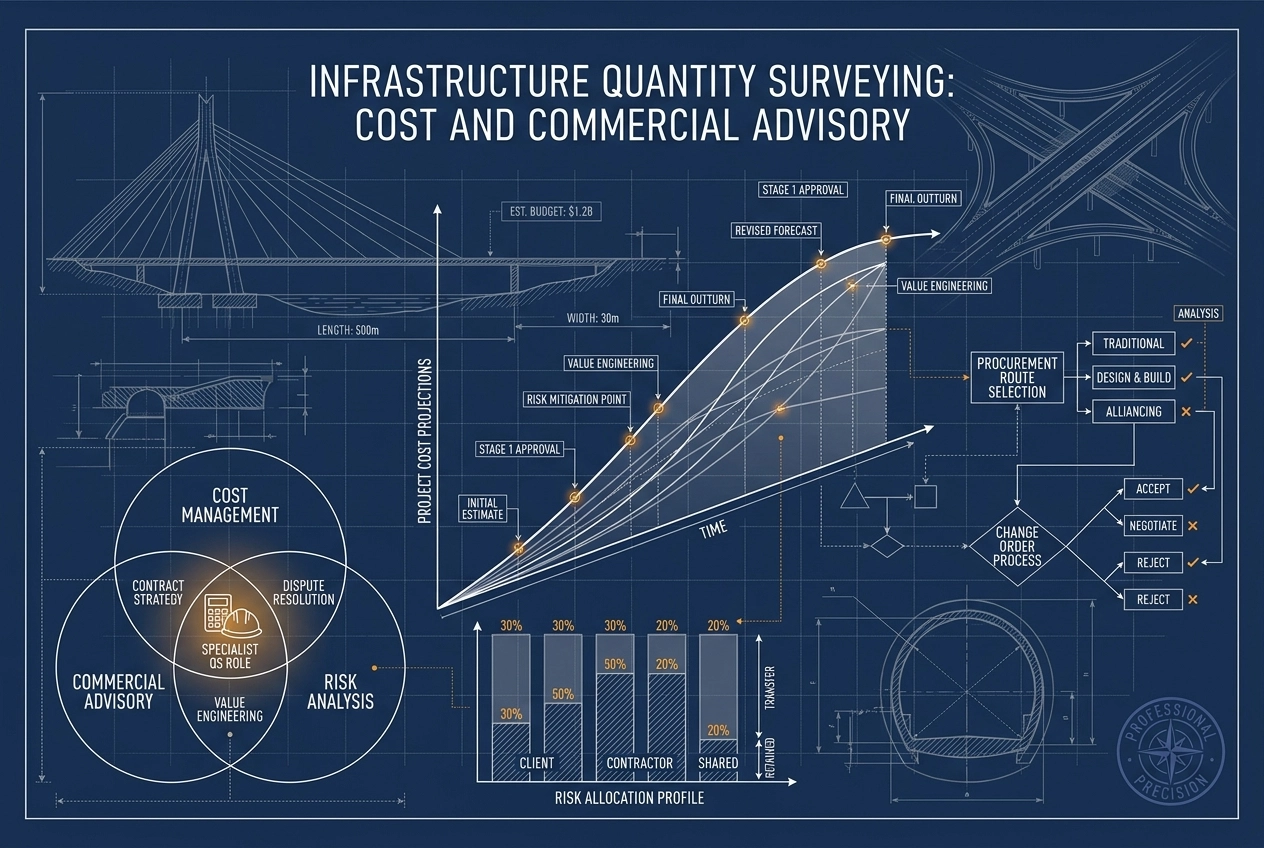
The cost of getting infrastructure wrong is staggering. Billions in budget overruns, delayed projects, and compromised public assets have become almost routine across major capital programs worldwide. Yet the discipline that sits at the heart of preventing these failures, infrastructure quantity surveying, remains widely misunderstood or underutilised by many project stakeholders.
This analysis takes a rigorous look at the evolving role of quantity surveyors within complex infrastructure environments, from early-stage cost planning and procurement strategy through to commercial risk management and final account resolution. Whether you are working across transport networks, utilities, water systems, or large-scale civil engineering schemes, the commercial advisory function is no longer a peripheral service; it is a strategic necessity.
Readers of this piece will gain a deeper understanding of how sophisticated cost management frameworks are applied across the infrastructure lifecycle, how quantity surveyors add measurable value beyond mere number-crunching, and what best practice looks like in an era of increasing project complexity, contractual risk, and financial scrutiny. This is a discipline demanding precision, foresight, and commercial intelligence in equal measure.
The Infrastructure Cost Management Landscape in 2026
The infrastructure cost management environment entering 2026 is defined by pressures that are structural in nature, not cyclical, and infrastructure clients need to plan accordingly. RLB Oceania has confirmed that construction cost escalation remains elevated, driven by persistent labour shortages, ongoing tariff exposure, and compounding supply-chain disruption. These are not temporary market corrections that will self-resolve. Australian building material costs have surged by 38.3% since 2020, with some Queensland infrastructure programmes absorbing escalation rates of up to 9% in 2026 alone. For infrastructure owners and government agencies managing multi-year programme budgets, this level of sustained escalation demands rigorous, independent cost planning from the earliest stages of project development, not as a refinement exercise at tender.
The NSW Government's infrastructure investment pipeline remains substantial, spanning transport, health, education, utilities, and energy sectors under the Infrastructure NSW forward programme. Each sector carries its own procurement complexity, risk profile, and cost escalation exposure, and no single contingency allowance or standard benchmarking approach adequately covers the full spread. According to Infrastructure Australia's construction workforce analysis, Australia's five-year construction pipeline from 2024-25 to 2028-29 represents $1.14 trillion in total activity, with a projected workforce shortage of 300,000 workers at peak demand in mid-2027. That capacity constraint has direct cost implications for every project competing for contractor and trade resources within that window.
The 2026 market is operating in a state of selective activity, and client tolerance for cost drift has tightened considerably. Compressed public budgets mean that cost overruns which might have been absorbed in prior cycles now trigger programme-level consequences. JLL's 2026 midyear construction perspective characterises the current cost position as an "elevated baseline, open ceiling," with final-cost indices running approximately 5% year-over-year globally and materials price growth carrying a meaningful probability of reaching 8% in the second half of 2026.
Emerging investment in energy infrastructure, grid reinforcement, and data centre construction is expanding the demand for specialist quantity surveying advisory services well beyond the traditional transport and water sectors. These asset classes carry distinct procurement profiles, technology-intensive cost structures, and escalation exposures that require dedicated advisory capability. The convergence of compressed public budgets, elevated escalation risk, and complex procurement environments confirms that infrastructure cost management can no longer function as a back-end discipline. It must be embedded at concept stage, structuring investment decisions, informing procurement strategy, and maintaining budget integrity throughout the full project lifecycle.
How Infrastructure QS Differs from Building Quantity Surveying
Infrastructure quantity surveying and building quantity surveying share foundational cost management principles, but they diverge sharply in practice. Practitioners who move between disciplines without specialist grounding risk material gaps in scope coverage, risk identification, and contractual compliance. Understanding these differences is essential for clients selecting advisory support on complex infrastructure programmes.
Measurement Conventions and Civil Methodologies
Infrastructure cost management operates under measurement conventions that building-focused practitioners do not routinely apply. Where building QS practice relies on the New Rules of Measurement (NRM) or POMI, with elemental breakdowns covering walls, roofs, finishes, and fittings, infrastructure work typically applies the Civil Engineering Standard Method of Measurement (CESMM4) or bespoke project-specific methodologies mandated by the client or regulator. Measurement emphasis falls on linear quantities such as road lengths and pipeline runs, volumetric earthworks calculations including cut-and-fill balancing, and underground utility network quantification. A building-focused practitioner placed on civil infrastructure work may misquantify earthworks volumes or miss utility network scope items entirely, while an infrastructure QS on building work may underestimate the cost of complex interior finishes and detailed mechanical and electrical systems. As explored in this analysis of infrastructure versus building quantity surveying expertise, these are not minor gaps; they carry real financial consequences for clients and programmes.
Procurement Models and Risk Allocation
Procurement models in infrastructure diverge significantly from the conventional lump-sum design-bid-build approach common in building work. Alliance contracting requires the QS to model pain and gain mechanisms and target-cost regimes rather than fixed-price schedules. Public-private partnerships demand whole-life costing capability, concession structure analysis, and output-specification pricing across the full asset lifecycle. Managing contractor and early contractor involvement (ECI) arrangements make cost planning iterative and collaborative, with the QS advising on risk transfer at each design gateway rather than pricing a completed document set. Design-and-construct procurement introduces scope gaps between the employer's requirements and the contractor's design solution, creating financial exposure that must be quantified and allocated before contracts are executed. Each of these models carries distinct cost management and risk allocation implications that require specialist procurement advisory experience, not generic QS competency.
Contract Frameworks: Rates, Provisions, and Payment Regimes
Infrastructure contracts introduce financial mechanisms that are largely absent from building lump-sum forms. AS 4000 and GC21, the standard general conditions widely used across NSW government infrastructure programmes, employ schedule-of-rates structures where work is priced as measured quantities multiplied by unit rates, with final accounts based on re-measurement rather than fixed sums. The NEC3 and NEC4 suite introduces a target-cost mechanism with compensation events; the QS must manage the compensation event register dynamically and produce updated forecasts of final outturn cost throughout delivery. Rise-and-fall provisions, which are embedded in many multi-year infrastructure contracts to address commodity price volatility, require the QS to track published indices covering steel, fuel, bitumen, and labour, then apply contractual adjustment formulae to certified payment amounts. Milestone payment regimes replace the percentage-completion progress claims familiar from building work, requiring reconciliation of programme achievement against contractual milestones before certification can proceed. Command of these provisions is a specialist skill that clients should confirm when engaging cost management support on infrastructure programmes.
Risk Profiles Specific to Infrastructure
Infrastructure projects carry a materially different risk register from building projects, and those risks must be identified, quantified, and contractually allocated at the procurement stage rather than absorbed into contingency reserves. Geotechnical uncertainty is a primary driver: subsurface conditions including rock hardness, groundwater levels, and ground contamination make earthworks costs highly variable, and geotechnical cost modelling at feasibility stage is a core infrastructure QS competency. Utility conflicts, where existing buried services must be located, protected, or diverted, generate significant variation claims on corridor infrastructure when allowances are inadequate. Traffic management costs escalate with programme duration on projects within or adjacent to live road networks, and must be modelled against the construction programme, not estimated as a fixed preliminary item. Environmental approval conditions, fauna relocation requirements, revegetation obligations, and noise restriction periods all carry direct cost implications that an experienced infrastructure QS will identify and price at tender. Community interface costs, covering stakeholder notifications, complaints management, and altered working hours, are real project costs that belong in a properly structured preliminaries build-up.
Programme Integration and Staging Complexity
Major infrastructure programmes are delivered in stages and packages, with interdependencies between work fronts that determine when costs are incurred, when milestone payments are triggered, and when escalation exposure materialises. Cost planning on these projects must integrate with the construction programme at a granular level, not simply produce a static estimate at a single design gateway. Cashflow forecasting must be updated continuously as programme logic changes, incorporating extended preliminaries, extended equipment hire, and additional traffic management costs that compound when schedules are delayed. Earned Value Management, which compares budgeted cost of work scheduled against actual cost and physical progress, is standard on large infrastructure programmes and provides the client with objective early warning of cost and schedule divergence. This level of programme-integrated cost control is a defining feature of specialist infrastructure cost management and is not routinely applied on building projects of equivalent value.
Infrastructure Sub-Sectors Requiring Specialist Cost Advisory
Transport Infrastructure
Transport infrastructure consistently accounts for the largest share of public capital investment in New South Wales, encompassing roads, highways, bridges, rail corridors, light rail, interchange structures, and active transport networks. Effective cost management across these asset classes demands practitioners with direct experience in linear construction pricing, where quantities are measured along horizontal alignments rather than within building footprints, and where earthworks, pavement, drainage, and structures interact in ways that standard building measurement practice does not address. Staged delivery models are standard across major transport programmes, requiring the cost plan to accommodate interface risks between packages, contractor mobilisation and demobilisation costs, and escalation exposure across multi-year programmes. QS practitioners without this specialist background routinely underestimate provisional sums for geotechnical variables, traffic management, and utility relocations, all of which are material cost drivers on transport projects. Infrastructure quantity surveying services covering roads, bridges, and related civil assets confirm that precision in linear construction measurement is a recognised differentiator in specialist QS practice.
Water and Wastewater Infrastructure
Water and wastewater infrastructure introduces cost planning complexity that originates not in civil construction but in process engineering. Treatment plants, pump stations, pipelines, reservoirs, and stormwater systems all involve significant plant and equipment procurement, where lead times, vendor-specific pricing, and integration with civil and structural works create cost uncertainty that standard elemental cost plans do not adequately capture. Long asset lifecycle considerations are equally important; lifecycle cost modelling for water assets regularly extends across 30 to 50 years, and the cost plan must reflect not only capital expenditure but maintenance intervals, energy consumption, and replacement allowances for critical mechanical and electrical plant. The interface between process design and civil construction is a frequent source of scope gap risk, and the specialist infrastructure QS role includes identifying and pricing these interfaces explicitly in the cost plan.
Energy and Utilities Infrastructure
Energy and utilities infrastructure is the fastest-growing sub-sector for specialist cost advisory services in Australia in 2025 and 2026, driven by the national energy transition and accelerating private investment in data centres, grid reinforcement, and renewable generation. Transmission lines, substations, battery storage facilities, and gas network upgrades each present distinct procurement and pricing challenges, including high-voltage equipment supply chains, regulatory land access requirements, and the need to sequence civil and electrical works around live network constraints. Data centre investment has grown to the point where it is now treated as a discrete advisory specialisation, as cost management and quantity surveying practices recognise by listing data centres as a standalone sector alongside energy and renewables. The cost advisory function on energy infrastructure projects must account for tariff exposure on imported equipment, supply chain constraints on transformers and switchgear, and the commercial risk that arises when technology specifications evolve faster than the procurement programme.
Civil, Public Realm, and Social Infrastructure
Civil and public realm infrastructure, including sports facilities, civic precincts, public open space, drainage systems, and contaminated land remediation, presents a different set of cost planning demands centred on staging complexity, government client governance requirements, and community impact considerations that carry direct cost implications. Remediation projects in particular require probabilistic cost modelling rather than deterministic estimates, given the inherent uncertainty in contamination extents until intrusive investigation is complete. Health, education, and government building infrastructure delivered under formal capital programmes requires QS practitioners who understand functional brief alignment, medical or educational equipment procurement schedules, and the specific cost reporting thresholds embedded in government gateway approval processes. Independent cost certification at each gateway stage is a standard requirement on NSW Government infrastructure programmes, and the cost plan must be structured to satisfy those approval requirements while remaining a practical project management tool throughout construction and commissioning.
Front-End Planning, Feasibility, and Business Case Development
The most consequential cost decisions on any infrastructure project are made before a single contract is awarded. Research spanning more than $120 billion of capital projects, compiled by the Construction Industry Institute, confirms that structured front-end planning delivers measurably better cost performance, more predictable estimates, reduced project changes, and improved operational outcomes. The concept is straightforward: the further upstream a cost decision is made, the lower the cost of making it correctly and the higher the cost of getting it wrong. For infrastructure clients, this means that investment in rigorous concept-stage cost planning is not overhead; it is the most effective form of capital risk management available.
The Scope of Infrastructure Feasibility Cost Work
Infrastructure feasibility studies demand substantially more than a construction estimate. A credible feasibility cost plan must address capital cost across all project elements, whole-of-life operating and maintenance costs, risk-adjusted cost ranges that reflect scope uncertainty at the relevant stage, escalation allowances calibrated to sector-specific labour and materials markets, and indirect costs including design, approvals, land, and commissioning. This breadth requires a quantity surveyor with structured cost modelling capability and access to sector-specific benchmarking data, not generalised building cost indices. The distinction matters because feasibility cost estimates prepared without infrastructure benchmarks frequently misstate the true cost base, creating budget parameters that cannot survive detailed design without material revision.
Gateway Requirements and Business Case Standards
Business case development for government-funded infrastructure in New South Wales operates within a defined framework. Cost plans submitted at Strategic, Preliminary, and Detailed Business Case stages must satisfy NSW Treasury and Infrastructure NSW gateway requirements, with clearly documented assumptions, exclusions, confidence levels, and contingency rationale presented in a format that surveyors technical and non-technical reviewers can both interrogate. Omissions at this stage, whether undisclosed exclusions or unsupported contingency percentages, create gateway risk that can delay project approvals or require costly rework of the entire cost submission.
Probabilistic Cost Assessment and Independent Review
Order-of-magnitude estimates and probabilistic cost assessments at the P50 and P90 confidence levels are increasingly required at early gateway stages to support investment decisions. The P50 estimate represents the cost level with a fifty percent probability of being achieved; the P90 represents a higher-confidence figure used to inform funding envelope decisions and contingency allocation. A specialist infrastructure quantity surveyor must be capable of constructing, documenting, and defending these models before technically literate client audiences including treasury analysts, infrastructure agency advisors, and project financiers. Where cost estimates are prepared by a proponent rather than independently, front-end planning methodology best practice supports independent peer review to confirm that figures are methodologically sound, appropriately risk-adjusted, and reflective of current market conditions. This assurance function is increasingly requested by government agencies and private financiers as a condition of advancing projects through gateway stages, recognising that proponent-prepared estimates carry inherent optimism bias that independent review is specifically designed to identify and correct.
Procurement Strategy and Tender Management on Infrastructure Projects
Procurement strategy selection is one of the most consequential and frequently underestimated cost risk decisions in infrastructure project delivery. The choice between lump-sum, schedule of rates, early contractor involvement (ECI), managing contractor, alliance, public-private partnership (PPP), or hybrid models determines not only how risk is allocated between client and contractor, but also how the market will respond at tender, what margins contractors will apply, and how disputes are likely to arise during construction. Despite this, many infrastructure clients default to familiar models or replicate procurement structures from previous projects without rigorous analysis of whether those models remain appropriate given current scope definition, risk profile, and market conditions. Independent quantity surveying advice at the procurement strategy stage provides an evidence-based framework for model selection, drawing on knowledge of contractor appetite, current market dynamics, and the cost implications of transferring risk inappropriately. Research on megaproject procurement, including a systematic literature review published in the ASCE Journal of Management in Engineering, confirms that procurement strategy is a primary determinant of cost and schedule outcomes on complex infrastructure works, and that significant efficiency gains remain unrealised where strategy selection is poorly informed.
Pre-Tender Cost Intelligence and Measurement
Pre-tender cost estimates, bills of quantities, and schedule of rates documentation for infrastructure works require a level of sector-specific measurement expertise that differs fundamentally from building quantity surveying practice. Infrastructure measurement involves earthworks volumes, pavement layer quantities, drainage structures, utility diversions, geotechnical contingencies, and construction methodology assumptions that demand familiarity with how contractors price these elements in the current market. An estimate prepared without current labour cost data, without awareness of prevailing supply chain constraints, or without a realistic view of on-cost structures will not serve as a reliable basis for budget-setting or tender evaluation. In the 2026 construction environment, where cost escalation remains structurally elevated due to persistent labour shortages and ongoing supply chain exposure, pre-tender cost intelligence derived from live market benchmarks is a prerequisite for informed client decision-making. EPC procurement strategies being adopted across industrial and civil sectors in 2026 reflect a market actively treating pre-tender preparation quality as a direct mechanism for controlling project costs.
Tender Analysis and Commercial Risk Assessment
Tender analysis provided by an independent quantity surveyor extends well beyond verifying arithmetic accuracy. A rigorous commercial review of tender submissions examines pricing coverage against the full scope of works, identifies abnormal rates that may signal qualification risk or future claims, detects front-loaded payment schedules that transfer cashflow risk to the client, and flags unbalanced bids where rates for provisional or remeasured items expose the client to cost overrun if quantities vary. These are not theoretical risks; they represent patterns observed consistently across infrastructure tender returns and are a principal source of post-award commercial disputes. Tender documentation review adds a further layer of protection, with the QS examining conditions of contract, special conditions, and risk allocation clauses to identify provisions likely to generate pricing uplift or future cost exposure. Onerous latent conditions clauses, poorly drafted delay damages regimes, and ambiguous scope boundaries all attract margin loading from experienced contractors and create grounds for variation claims during delivery.
Optimising Package Sizing and Market Tension
In a market characterised by selective contractor participation and elevated margins, procurement strategy advice that addresses package sizing, contract risk allocation, and tender process design is a direct mechanism for achieving competitive pricing. Oversized contract packages can reduce the field of capable tenderers; poorly allocated risk can cause contractors to decline to tender or to price conservatively to cover uncertainty. Structuring packages to align with the capacity and risk appetite of the available contractor market, while maintaining sufficient scope to attract genuine interest, requires a detailed understanding of current industry capacity. This is the practical connection between front-end commercial advisory and cost-effective project outcomes, and it is where independent quantity surveying input translates directly into measurable value for the client.
Contract Administration and Commercial Management Through Delivery
Effective contract administration on infrastructure projects is not a passive compliance function. It is an active, commercially focused discipline that determines whether the client's financial position is protected throughout the delivery phase. From the date of contract award, the quantity surveyor must establish and maintain a rigorous commercial record: a live register of contractual notices, a tracked variation log with entitlement assessments, a rolling forecast of the final outturn cost, and a documented audit trail that supports every certification and commercial determination made during the project. Research confirms that inadequate contract administration at the construction stage is directly linked to substandard project performance, reinforcing that best practices for contract administration in large projects are performance-critical obligations, not administrative formalities. On major civil infrastructure contracts, where the financial exposure between a well-administered and poorly administered project can run to tens of millions of dollars, this discipline is foundational.
Progress claim assessment and payment certification represent the operational core of the QS's role during delivery. Each assessment requires an independent, defensible determination of work physically completed, materials reasonably on site, and milestone achievements verified against the contract terms, whether the applicable form is AS 4000, AS 11000, NEC4, or a project-specific agreement. In New South Wales, the assessment process operates within the framework of the Building and Construction Industry Security of Payment Act, which imposes strict statutory timeframes on payment schedules and adjudication rights. The QS must understand both the contractual and statutory dimensions of each assessment, and must document the basis of every determination to withstand scrutiny if a payment dispute proceeds to adjudication or formal dispute resolution.
Variation assessment demands a structured, entitlement-first approach. Before any pricing is considered, the QS must establish whether a contractual entitlement exists under the relevant clause, whether the variation was instructed in accordance with the required procedure, and whether the claimed scope falls within or outside the original contract works. Pricing then follows a defined hierarchy: contract rates where directly applicable, adjusted rates where the character or conditions of the work have materially changed, and reasonable cost on a demonstrated basis where no applicable rate exists. Latent conditions, a significant and frequently disputed source of additional cost on civil infrastructure, require particularly careful assessment against the contractual definition and the geotechnical information provided at tender.
Project controls integration allows the infrastructure client to maintain continuous visibility over budget and schedule performance. Cost reporting, earned value analysis, and cash flow forecasting, when embedded within the QS's commercial management function, transform individual payment assessments into a live picture of project financial health. Earned value metrics, including cost performance index and schedule performance index, provide early warning of cost overrun trajectories before they become unrecoverable. According to data cited by the Construction Financial Management Association, poor contract administration contributes to average project delays of 23 percent, while 47 percent of construction disputes originate in contract-related failures. These figures illustrate precisely why early intervention, enabled by integrated project controls, is more effective than reactive dispute management. The WorldCC similarly identifies proactive commercial management as a structural differentiator between projects that achieve cost certainty and those that do not.
Commercial close-out is the final phase where the cumulative quality of contract administration is tested. Final account negotiation requires a fully reconciled variation account, documented entitlement positions, and a clear record of all certified payments. Retention release, tied to practical completion and the expiry of the defects liability period, must be managed against the contractual conditions and any outstanding defect rectification obligations. Unresolved claims, whether for extensions of time, prolongation costs, or disputed variations, require experienced QS involvement to achieve a settlement that is commercially fair, legally defensible, and clearly documented. Disputes that reach adjudication or formal proceedings at close-out almost invariably reflect deficiencies in commercial record-keeping during delivery, not simply at the end. Engaging specialist infrastructure quantity surveying support from contract award through to final account closure is the most reliable mechanism for ensuring that the client's commercial position is protected at every stage.
Risk Management and Value Engineering in Infrastructure Cost Planning
Robust risk management and disciplined value engineering are not supplementary activities on infrastructure projects; they are core cost management disciplines that directly determine whether a project achieves its approved budget and delivers its intended outcomes.
Risk Quantification and Contingency Setting
Structured risk quantification gives infrastructure clients a defensible, evidence-based understanding of their realistic cost exposure. Deterministic methods, which apply fixed percentage contingencies to a base estimate, are straightforward but frequently inadequate for complex infrastructure projects where cost uncertainty is asymmetric. Analysis of Swedish transport infrastructure projects spanning 2004 to 2022 found that while decision-to-build estimates are close to final costs on average, the distribution of cost changes is highly skewed with a long right tail, meaning a small proportion of projects incur very large overruns. This asymmetry is precisely what probabilistic Monte Carlo simulation is designed to capture. By modelling risk events as probability distributions rather than point values, Monte Carlo methods produce outputs at P50, P80, and P90 confidence levels, allowing clients to set tiered contingency allowances appropriate to their approval context. A P50 estimate may satisfy an internal project team, while a government gateway review or project finance committee will typically require a P80 or P90 position to demonstrate credible cost governance.
Risk Allocation Strategy in Procurement Documentation
Risk allocation is one of the highest-consequence cost decisions embedded in procurement documentation, and it deserves the same rigour applied to cost estimating. The foundational principle is that risks should be borne by the party best positioned to assess, manage, and price them. In practice, procurement strategies that push risk to contractors without genuine capacity to control those risks produce predictable outcomes: contractors price the uncertainty heavily, inflate preliminaries, or carry the risk silently until a dispute crystallises. Both outcomes increase total project cost. Standard-form contracts including AS 4000, NEC4, and FIDIC each provide different mechanisms for risk sharing, and selecting the appropriate form, then drafting the accompanying special conditions carefully, determines how risk is actually allocated rather than how it appears to be allocated on paper. Specialist infrastructure cost advisory input at the procurement documentation stage, before contract conditions are finalised, materially reduces the probability of cost disputes during delivery.
Value Engineering at Design Development Milestones
Value engineering workshops, conducted at structured intervals through concept, schematic, and detailed design phases, provide a formal mechanism for interrogating whether the proposed design solution delivers the required project function at the most efficient cost. The discipline is frequently mischaracterised as indiscriminate cost-cutting; it is not. Queensland's Department of Transport and Main Roads defines value as the balance between function, performance, and benefits relative to cost, risk, and consequences, a framing that encompasses lifecycle optimisation, risk reduction, and sustainability outcomes alongside capital cost. With building material costs having risen approximately 37.7% since 2020, formal VE processes have become a front-line cost management obligation rather than an optional advisory service. Effective VE workshops require multidisciplinary participation from design, engineering, construction, and commercial teams, with outputs that are properly documented, assessed against functional requirements, and carried through into revised cost plans.
Escalation Allowances and Whole-of-Life Cost Analysis
Cost escalation in 2026 requires explicit, category-specific treatment in the infrastructure cost plan. A single blended escalation percentage applied to the total estimate is no longer adequate given the divergent price trajectories of labour, structural steel, concrete, mechanical and electrical components, and civil materials. Escalation allowances should be derived from current tender price index forecasts, applied to the relevant cost categories, and reviewed formally at each design gate and procurement milestone as procurement timing and market conditions evolve.
Whole-of-life cost analysis adds the final dimension to sound infrastructure investment decisions. Capital cost is a single point in a project's economic life; operational expenditure, maintenance obligations, and end-of-life replacement costs frequently dwarf the initial construction outlay over a 30 to 50-year asset life. Net present value analysis, drawing on established frameworks such as the ISO 15686 series for service life planning, provides infrastructure clients and their funders with a complete economic picture, ensuring that procurement and design decisions are made on the basis of total value rather than lowest initial outlay.
Why Independent Cost Advisory Matters on Infrastructure Projects
The foundational value of independent cost advisory on infrastructure projects rests on a single, non-negotiable principle: an independent quantity surveyor has no financial interest in the outcome of any assessment they provide. This distinction separates genuinely independent cost advice from assessments produced by contractor-employed estimators, developer-appointed cost managers, or in-house commercial teams whose conclusions, however professionally prepared, carry an inherent conflict of interest. When a contractor's quantity surveyor assesses a variation claim, or a developer's cost manager certifies a progress payment, the commercial context of that assessment cannot be fully separated from the relationship that produced it. Independent cost advisory removes that conflict entirely, providing clients, funders, and oversight bodies with an unencumbered professional opinion grounded in market evidence and contractual analysis rather than commercial positioning.
For government agencies and statutory bodies, independent cost scrutiny is increasingly a formal procurement requirement rather than a discretionary best practice. Treasury gateway processes, audit office frameworks, and probity compliance obligations at both Commonwealth and state levels require demonstrable independent cost assurance before major infrastructure investment decisions are approved. Independent quantity surveyor certification provides the evidentiary basis that satisfies these requirements, supporting robust documentation for budget submissions, project approvals, and post-completion audits. In an environment where public infrastructure spending faces heightened scrutiny and accountability, the ability to demonstrate that cost estimates and commercial assessments were subject to genuinely independent review is a governance requirement that clients cannot afford to overlook.
In infrastructure disputes, the credibility of expert cost evidence is directly affected by the independence of the practitioner providing it. Claims involving prolongation costs, latent conditions, scope disputes, and delay and disruption frequently turn on contested quantification of financial impact. Arbitrators, adjudicators, and courts consistently give greater weight to expert cost opinions produced by independent practitioners with no connection to either party than to assessments prepared by party-aligned consultants. Research published by HKA in its annual Harmon Report consistently identifies disputed variations and cost claims as among the primary drivers of construction conflict, underscoring the practical importance of independent expert cost analysis in resolving or avoiding costly disputes.
Private sector infrastructure clients, including project finance lenders, concession operators, and equity investors, rely on independent cost assurance as a core component of investment due diligence and ongoing lender reporting. Project finance structures routinely require independent technical adviser certification of cost estimates, drawdown claims, and completion milestones as a condition of funding. The integrity of that certification depends entirely on the adviser's independence from the project proponent.
Finally, peer review services extend the independence principle to the validation of a proponent's own cost work. An independent assessment of a feasibility study, class estimate, or variation claim provides clients with a verified basis for decision-making, identifying errors, omissions, or optimism bias before commitments are made. Given that infrastructure projects globally have a well-documented tendency to exceed initial cost estimates, independent peer review at key decision points represents one of the most cost-effective risk controls available to any infrastructure client.
Digital Cost Management and BIM on Infrastructure Projects
BIM-enabled quantity take-offs have fundamentally changed how the infrastructure quantity surveyor approaches measurement and cost plan production. Rather than working from two-dimensional drawings and applying manual measurement techniques, the QS can now extract quantities directly from three-dimensional design models, drawing on geometric and spatial data embedded in the model itself. This approach reduces the risk of measurement error that accumulates across large, complex infrastructure schemes, accelerates the production of cost plans at each design milestone, and critically, enables the rapid assessment of cost implications when design changes are proposed. On a major road or rail project where scope adjustments are frequent through detailed design, the ability to rerun quantities against a revised model within hours rather than days provides the client with a materially faster decision-making cycle. The global 5D BIM market, which integrates geometry, programme, and cost into a unified digital environment, was valued at USD 3.7 billion in 2025 and is projected to grow at a compound annual rate of 13.6 percent through to 2032, reflecting sustained investment in this capability across infrastructure and construction markets.
Integrated digital cost management platforms have displaced manual spreadsheet-based processes on larger infrastructure programmes, and the operational difference is significant. Real-time budget monitoring, automated cost reporting, and structured audit trails replace the version-controlled spreadsheet environment that previously made financial reporting slow and susceptible to human error. For contract administration purposes, a verifiable audit trail is not simply a convenience; it is a governance requirement on publicly funded infrastructure, where expenditure accountability is subject to scrutiny by project owners, auditors, and funding bodies. These platforms also support better integration with project management information systems, allowing cost data to sit alongside programme, risk, and document management information rather than existing in isolation.
AI-assisted cost forecasting tools are entering practical use on infrastructure programmes, analysing large project datasets to identify cost patterns, flag anomalies against budget benchmarks, and support escalation modelling across labour, materials, and energy inputs. Academic research published in 2025 has examined the integration of large language models with BIM-derived quantity data to automate elements of cost estimation, signalling that this capability is advancing beyond prototype. However, professional QS judgement remains indispensable. AI tools do not understand project-specific risk context, local market conditions, or the commercial dynamics of a particular procurement environment. They produce outputs that require experienced interpretation, not outputs that replace experience.
Data-driven benchmarking adds a further layer of cost confidence, allowing the QS to test estimates against a curated database of comparable infrastructure project outcomes. Drawing on established cost indices and internal project data, benchmarking exposes estimates that sit outside expected ranges and provides clients with market-calibrated assurance before investment decisions are committed. This is particularly valuable at the business case stage, where order-of-magnitude estimates carry significant weight in funding approvals.
Digital competency is now a baseline expectation on infrastructure projects rather than a point of differentiation. Clients procuring QS services should directly assess whether the practice they are engaging has the technological capability to integrate with project information systems, deliver digital-format cost reporting, and operate within a BIM-enabled project environment. Practices that cannot demonstrate this capability present an operational risk on programmes where digital delivery standards are contractually mandated.
Dispute Resolution and Expert Witness Services in Infrastructure
Infrastructure contracts generate a disproportionate share of construction industry disputes, and the reasons are structural rather than incidental. Extended delivery periods expose projects to design evolution, changed ground conditions, supply chain disruption, and shifting client requirements. Multi-party contracting structures create layered obligations that are difficult to trace when something goes wrong. The financial stakes are high, the contract forms are complex, and the documentary record is vast. Common dispute categories in infrastructure include claims for delay and disruption costs, latent conditions, scope and variation disputes, acceleration directions, suspension costs, loss of productivity, and termination. Each of these involves a detailed analysis of cost entitlement that requires specialist expertise to quantify accurately and present credibly.
The QS as Quantum Expert Witness
A quantity surveyor appointed as quantum expert witness in infrastructure proceedings carries an overriding duty to the court or tribunal, not to the instructing party. This principle, embedded in the Uniform Civil Procedure Rules and equivalent state procedural frameworks, requires the expert to provide independent, objective opinion evidence, regardless of who is paying for it. The expert's report must quantify the cost consequences of the contested event using recognised methodologies, supported by the project's documentary record, including bills of quantities, progress claims, variation registers, RFIs, site diaries, and subcontractor accounts. The report must be reasoned, transparent in its assumptions, and capable of withstanding cross-examination by opposing counsel and challenge from a competing expert.
Expert cost evidence may be required across multiple forums. Adjudication under the Building and Construction Industry Security of Payment Act operates on compressed timescales, typically requiring a fully substantiated quantum submission within weeks. Arbitration and expert determination proceedings allow more time but demand a higher standard of forensic rigour. Mediation benefits from early, well-prepared quantum analysis that gives both parties a credible basis for commercial negotiation. Supreme and District Court litigation requires expert reports that comply strictly with court rules governing form, content, and expert conduct.
Competencies Required and the Value of Early Engagement
Preparing quantum expert evidence for infrastructure disputes requires more than cost measurement skill. The QS must have command of the relevant contract form, whether AS4000, GC21, NEC, or FIDIC, and must understand how each allocates risk and entitlement. Familiarity with delay and disruption cost methodologies, including time impact analysis and prolongation cost assessment, is essential, as is the capacity to engage constructively with delay analysts, programmers, and technical engineering experts whose evidence will intersect with the quantum analysis.
Early engagement of an independent QS before formal proceedings commence frequently produces the best outcomes for all parties. Pre-dispute advisory, which includes reviewing notice compliance, identifying records gaps, testing the strength of a claim or defence, and exploring settlement options, often enables commercial resolution without the cost, time, and relationship damage of formal dispute processes. The most effective disputes strategy in infrastructure is one that begins well before positions harden.
Conclusion: Achieving Cost Certainty on Infrastructure Projects
Independent infrastructure QS advisory, embedded from concept stage through to commercial close-out, remains the most effective mechanism for achieving cost certainty and managing the commercial risks inherent in complex infrastructure delivery. In an environment where cost escalation is confirmed to remain structurally elevated through 2026, where procurement decisions carry lasting financial consequences, and where contract disputes are a predictable feature of long-duration projects, the value of genuinely independent advice is not marginal; it is foundational.
Clients seeking infrastructure cost management, procurement advisory, contract administration, or expert witness support in New South Wales should engage a QS practice with demonstrated sector-specific experience, methodological rigour, and independence from contractor and developer interests.
Quantity Surveyors Sydney provides specialist infrastructure cost and commercial advisory services across transport, energy, water, civil, and public sector projects throughout Sydney and New South Wales. Prospective clients are invited to discuss their specific project requirements, including cost planning, feasibility assessment, procurement strategy, contract administration, project controls, or expert witness needs, to determine how independent QS advisory can support their objectives.