
Construction projects fail for many reasons, but fragmented management systems rank among the most preventable. When quality, safety, and environmental processes operate in silos, the result is duplicated effort, compliance gaps, and costly rework that erodes both timelines and profit margins.
This is precisely where integrated management systems have transformed how leading construction firms operate. By unifying multiple management frameworks under a single, cohesive structure, these systems eliminate redundancy and create a consistent operational backbone across even the most complex projects.
But what does the evidence actually say about their effectiveness? This analysis cuts through the noise to examine documented outcomes from real-world construction implementations. You will find a clear breakdown of what integrated management systems deliver in practice, which organizational conditions support successful adoption, and where common implementation pitfalls tend to emerge. Whether you are evaluating adoption for your own firm or benchmarking your current approach, the research-backed insights presented here will give you a sharper, more grounded perspective on one of the industry's most consequential operational decisions.
What Is an Integrated Management System in Construction?
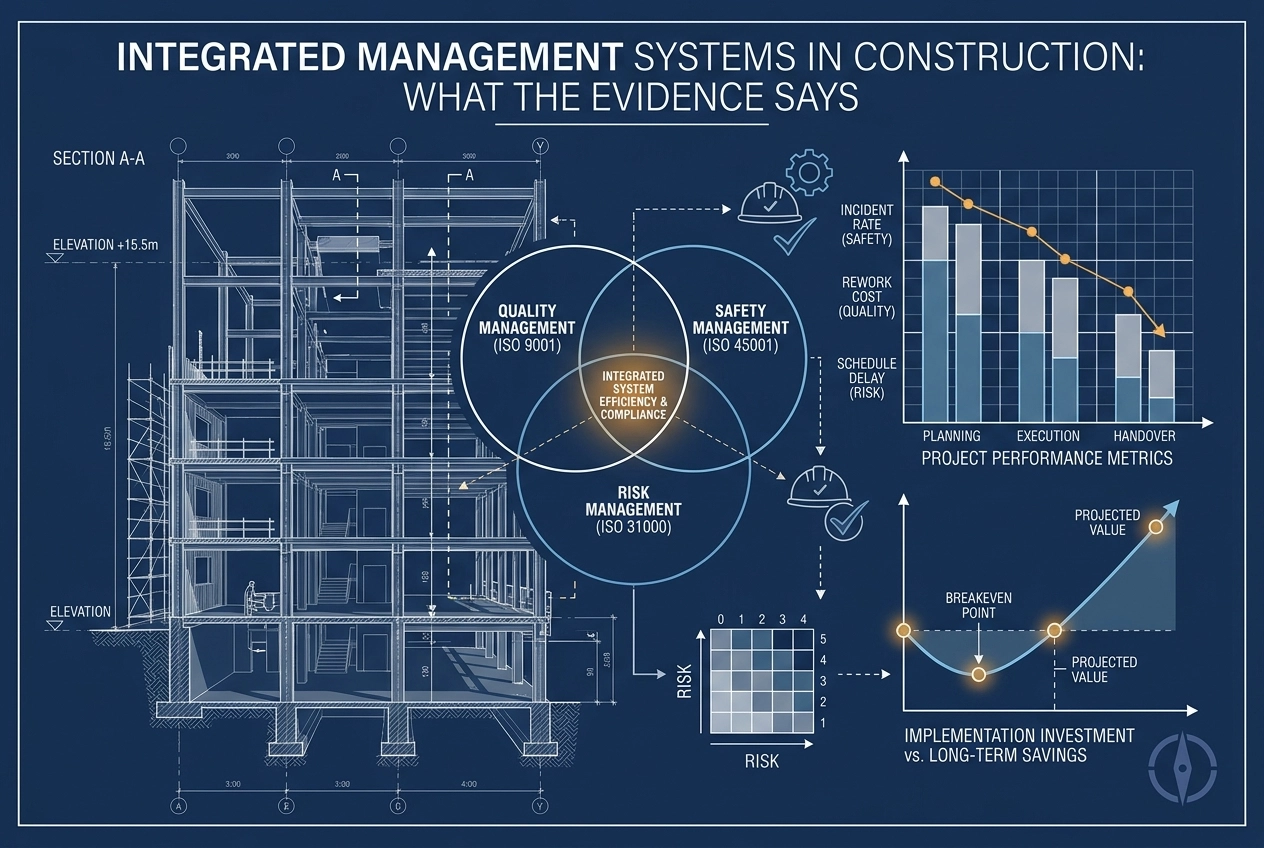
An Integrated Management System (IMS) is a unified operational framework that combines quality management, risk management, and safety management into a single, coordinated governance structure. Rather than maintaining separate compliance functions that operate in isolation, an IMS consolidates these disciplines under one operating system, ensuring that decisions made in one domain are visible to, and consistent with, all others. This integrated approach directly addresses what peer-reviewed research identifies as the fundamental weakness of traditional construction management: fragmented strategies that "cannot offer total optimisation" across project outcomes. For infrastructure projects, where cost overruns, safety incidents, and quality failures routinely intersect, the case for a unified framework is both practical and commercially compelling.
IMS Is Not Just ISO Certification
A common misconception is that holding individual ISO certifications, such as ISO 9001 for quality, ISO 45001 for health and safety, or ISO 14001 for environmental management, constitutes an integrated management system. It does not. Most organisations that manage these certifications separately end up with quality, safety, and risk functions each running distinct procedures, conducting separate audits, and producing conflicting documentation. The result is duplicated effort, inconsistent risk assessments, and administrative overhead that adds cost without adding value. The integration of these systems is what generates optimisation across project lifecycle stages. Shared processes, unified improvement loops, and consolidated audit programmes are only achievable when the systems are structurally connected, not merely coexisting within the same organisation.
The Three Core Pillars
Research published in the Journal of Infrastructure Intelligence and Resilience confirms statistically significant relationships between each IMS pillar and sustainable construction outcomes, validated through structural equation modelling across 119 construction professionals. Quality management, which encompasses output standards, process control, and defect prevention, demonstrated the strongest influence on project outcomes (beta = 0.643, p less than 0.001). Risk management, covering identification, quantification, allocation, and ongoing monitoring of project risks, recorded a beta of 0.530 (p less than 0.001). Safety management, addressing WHS compliance, incident prevention, and workforce protection, contributed a beta of 0.439 (p less than 0.001). Each pillar is significant independently; together, they form a governance architecture that produces outcomes no single function can achieve alone.
IMS Versus a Project Management Plan
It is equally important to distinguish an IMS from a Project Management Plan (PMP) or Construction Management Plan (CMP). A PMP or CMP is a delivery document. It specifies how a particular project will be executed, by whom, and within what programme and methodology. An IMS operates at a fundamentally different level. It is a strategic governance framework that applies across the full project lifecycle and across an organisation's operations, establishing the standards, processes, and accountability structures within which delivery documents are produced and executed. Academic frameworks for IMS in construction consistently position it as an organisational-level system, not a project-specific instrument.
For infrastructure owners, government agencies, and project financiers, this distinction matters considerably. A contractor producing a compliant CMP is meeting a project requirement. A contractor operating under a mature IMS is demonstrating systemic capability, which represents a materially different level of assurance for cost certainty, risk management, and regulatory compliance throughout procurement, construction, and project close-out.
The Evidence Base: What Peer-Reviewed Research Tells Us
The strongest evidence supporting integrated management systems in construction comes not from industry guidance documents or practitioner opinion, but from peer-reviewed quantitative research published in the Journal of Infrastructure Intelligence and Resilience. A 2025 structural equation modelling study by Waqar, Nisar, Muddassir, and Benjeddou surveyed 119 construction professionals and applied one of the most rigorous multivariate statistical methods available for testing causal relationships between management system components and project outcomes. Internal consistency across all measurement instruments was confirmed through Cronbach's Alpha scores ranging from 0.72 to 0.95, comfortably exceeding the conventional 0.70 threshold for acceptable reliability. The Fornell-Larcker criterion was applied to verify discriminant validity, confirming that each construct measured a genuinely distinct management domain rather than overlapping variables. This methodological rigour means the findings carry material weight for infrastructure owners, government procurement teams, and project financiers conducting due diligence on management system frameworks.
The study's headline findings are three standardised regression coefficients, each statistically significant at the p<0.001 level. Quality management produced a beta coefficient of 0.643, the strongest individual predictor of sustainable construction outcomes in the model. Risk management returned a beta of 0.530, and safety management produced a beta of 0.439. Because these are coefficients within a structural equation model rather than simple correlations, each value represents the unique contribution of that management domain to sustainable outcomes after statistically controlling for the other two variables. Quality management's beta of 0.643 is notably high by social science research standards, indicating it explains a substantial portion of variance in sustainable outcomes independently. Risk management's coefficient confirms it operates as a primary driver in its own right, not merely a supporting function. Safety management's independent effect of 0.439 persists even when quality and risk performance are held constant, demonstrating that safety governance delivers measurable value beyond its interaction with the other two domains.
The practical significance of these coefficients becomes clear when set against the scale of the construction sector's environmental footprint. The same study reports that construction consumes over 3 billion tonnes of raw materials annually and accounts for 40% of global CO2 emissions. At that scale, the argument for integrated approaches moves well beyond best-practice aspiration and becomes a commercial and regulatory imperative. Infrastructure owners operating under sustainability reporting obligations, government clients subject to net-zero procurement commitments, and project financiers applying environmental screening criteria all face tangible consequences if management systems remain fragmented and uncoordinated.
The distinction between evidence-based validation and advisory preference is one that matters considerably in infrastructure investment decisions. When a beta coefficient and a p-value below 0.001 sit behind a management framework recommendation, that recommendation carries a different burden of proof than a guidance document or a professional opinion. For government agencies developing business cases, for financiers structuring project debt, and for infrastructure owners allocating contingency and risk reserves, the difference between "we recommend this approach" and "peer-reviewed causal modelling confirms this approach improves outcomes" is significant. It is worth acknowledging the study's own noted limitation; the sample of 119 professionals, while sufficient for structural equation modelling, is cross-sectional and self-reported, and the authors themselves call for future validation using objective project performance data across broader geographic contexts. That caveat does not diminish the findings; it simply defines the current frontier of the evidence base and points toward where future research should extend it.
The Quantity Surveyor's Role Across Each IMS Pillar
The Quality Management Pillar: Cost Planning as Scope Discipline
The connection between quantity surveying and quality management is more direct than it might initially appear. When a quantity surveyor prepares a detailed cost plan or bill of quantities at the front end of a project, the primary output is not simply a cost figure; it is a structured decomposition of scope. Every element, specification, and methodology must be defined with sufficient precision to be measured and priced. This process forces scope clarity before procurement begins, eliminating the ambiguity that routinely causes substitution of inferior materials, disputed interpretations, and costly rework during construction. Tender analysis compounds this benefit by examining contractor submissions against a common, well-defined scope baseline, identifying where prices diverge due to specification misreads or deliberate omissions rather than genuine commercial competition. Commercially sound contract terms developed through this process lock in quality obligations, ensuring that the specification a client approved at design stage is the specification the contractor is contractually bound to deliver. In this way, the QS function serves as the first and most effective quality control mechanism, operating before a single item of plant arrives on site.
The Risk Management Pillar: Quantified Exposure and Procurement Strategy
Risk management within an IMS framework depends on more than identifying risks in a register; it requires those risks to be quantified in commercial terms so that project owners can make informed decisions about contingency, procurement structure, and contract strategy. This is where the quantity surveyor's contribution to the risk pillar is most analytically rigorous. Risk-adjusted cost estimates, prepared using probabilistic modelling or structured sensitivity analysis, translate qualitative risk assessments into funding-relevant figures that a project board or financier can act upon. Contingency allocation supported by a quantified risk register, with each identified exposure assigned a likelihood and cost range, provides a defensible basis for budget approval rather than a reliance on historical percentage allowances. Equally important is procurement strategy advice: the choice between lump sum, schedule of rates, cost-reimbursable, or guaranteed maximum price contracting is fundamentally a decision about risk allocation, and the QS is the professional best positioned to advise which model assigns each risk category to the party best placed to price and manage it. Ongoing commercial risk monitoring through contract administration then tracks whether those risk assumptions remain valid as the project progresses, flagging emerging exposures before they crystallise into claims or disputes. Research confirms that risk management carries a statistically significant positive impact on sustainable construction outcomes (β=0.53, p<0.001), and the QS is the practitioner who gives that pillar its commercial substance.
The Safety Management Pillar: Contract Integrity and Commercial Incentives
The relationship between quantity surveying and safety management operates through a mechanism that is frequently overlooked: commercial pressure on contractors is one of the most consistent drivers of unsafe site behaviour. When progress claims are assessed fairly, variations are processed promptly, and contract administration is conducted with transparency and rigour, contractors maintain the cash flow required to resource projects properly, maintain equipment, and comply with safety obligations without financial compromise. Conversely, disputed assessments, delayed payments, or unresolved variations create financial distress that incentivises corner-cutting, including on safety-critical activities. Security of payment legislation across Australian jurisdictions exists precisely because payment disputes were recognised as a structural risk to site safety and project integrity. The quantity surveyor's role in maintaining contract integrity, through independent progress claim assessment, disciplined variations management, and impartial contract administration, is therefore a direct contribution to the safety pillar of any IMS framework.
The QS as the Commercial Spine of an Integrated Framework
What distinguishes an effective IMS from a collection of parallel compliance systems is integration: each pillar informing and reinforcing the others through shared data, unified governance, and coordinated decision-making. The quantity surveyor provides the commercial connective tissue that makes this integration functional in practice. Cost certainty supports quality by eliminating the budget pressure that drives specification compromise. Quantified risk exposure informs procurement decisions that determine how safety and quality obligations are contractually allocated. Contract administration maintains the integrity of those obligations throughout delivery. Without a commercially competent QS function embedded across all three pillars, an IMS risks becoming a documentation exercise rather than an operational governance framework.
The Modern QS Advisory Role in 2026
According to RICS, the contemporary quantity surveyor operates as a multi-disciplinary commercial advisor across the full project lifecycle, a description that aligns precisely with what IMS frameworks demand. The profession has moved well beyond traditional measurement and billing. In 2026, quantity surveyors operating within integrated project environments are simultaneously functioning as data analysts, leveraging 5D BIM and cloud-based cost management platforms; as risk managers, preparing quantified risk registers and advising on contingency strategy; as commercial advisors, supporting investment decisions and business case development; and as procurement strategists, structuring tender processes and contract frameworks that allocate risk intelligently. Academic research from the University of South Australia confirms that risk management and sustainable advisory capability are now core expectations of the profession rather than specialist extensions of it. This evolution positions the quantity surveyor not as a supporting function within an IMS, but as its commercial foundation.
IMS and the Australian Regulatory Environment
The Australian regulatory environment has evolved significantly since 2020, and the cumulative effect of recent legislative reform creates both a compliance imperative and a structural argument for integrated management systems across the construction sector. Understanding how IMS maps to local statutory obligations is no longer an academic exercise; it is a practical necessity for contractors, developers, project managers, and infrastructure advisors operating in NSW.
The Design and Building Practitioners Act 2020 and Supply Chain Accountability
The Design and Building Practitioners Act 2020 (NSW) introduced a statutory duty of care on any person who carries out construction work, extending accountability well beyond the principal contractor to encompass designers, engineers, and subcontractors throughout the supply chain. This represents a material shift from prior common law arrangements, because the duty is now statutory, non-delegable in practice, and enforceable regardless of contractual structures that might otherwise dilute responsibility. For practitioners operating under an IMS, the quality management pillar, encompassing documented procedures, non-conformance registers, inspection and test plans, and corrective action workflows, provides precisely the audit trail required to demonstrate that the duty of care has been actively and consistently discharged. Without this governance architecture, firms face the difficult position of asserting compliance without the documentary evidence to support it under regulatory scrutiny.
The NSW Building Commission and Demonstrable Compliance
The NSW Building Commission operates as the central oversight body for building quality in the state, with powers to audit, inspect, and investigate compliance across the project lifecycle. Contractors and developers must now be prepared to demonstrate robust quality and risk management processes on demand, not merely at project close-out. An IMS provides the operational infrastructure that makes this demonstration both possible and defensible: documented management plans, version-controlled design registers, site audit programs, and traceable approval workflows are not bureaucratic overhead but evidence of a systematic compliance posture. Project managers and contract administrators who can present an IMS framework during a Building Commission audit are materially better positioned than those relying on ad hoc documentation assembled retrospectively.
SafeWork NSW, the WHS Act, and Integrated Safety Management
SafeWork NSW administers and enforces the Work Health and Safety Act 2011 and the updated Work Health and Safety Regulation 2025, which imposes specific obligations on every Person Conducting a Business or Undertaking (PCBU) involved in construction. For principal contractors managing complex or high-risk work, these obligations include Construction Work Plans, Safe Work Method Statements (SWMS), hazard identification programs, and incident reporting systems. The safety management pillar of an IMS maps directly to this regulatory framework, providing the documented structure through which PCBU obligations are operationalised and evidenced. Critically, as confirmed by a landmark 2020 NSW prosecution that resulted in combined fines of $750,000 across three PCBUs following a workplace fatality, WHS duties are shared across the supply chain and WHS fines are uninsurable in NSW. This financial and legal exposure reinforces why a systematic, IMS-embedded approach to safety management is a commercial necessity, not merely a regulatory formality.
Government Procurement, Infrastructure Investment, and IMS Governance
As Australian public infrastructure investment continues to grow, government clients are increasingly requiring demonstrated compliance frameworks in tender submissions and contract management plans. The Master Builders Association NSW explicitly references NSW Government Procurement Guidelines as a framework under which safety, quality, and environmental management systems, including IMS, require formal accreditation for contractors. This procurement architecture means that firms without an integrated, accredited management system face a structural disadvantage in competitive tender processes for government-funded infrastructure work, across transport, water, energy, and civil sectors. IMS provides the governance framework to meet these obligations systematically rather than assembling compliance evidence project by project.
A Significant Guidance Gap for Australian Practitioners
Despite the convergence of these regulatory pressures, there is a striking absence of published guidance that explicitly connects IMS to the post-2020 NSW regulatory environment in a construction or quantity surveying context. Practitioners navigating the DBP Act, Building Commission oversight, and WHS Regulation 2025 simultaneously are doing so without a coherent framework that integrates all three compliance obligations into a unified operating model. This gap represents a genuine risk for firms that manage each obligation in isolation, and a clear opportunity for practices prepared to address it directly and authoritatively.
IMS in Infrastructure Procurement and Front-End Project Planning
The case for integrated management systems in infrastructure is strongest not at the construction phase, but considerably earlier. When IMS principles are embedded during feasibility assessment, business case development, and procurement strategy formulation, they shape the commercial and technical architecture of a project before contractual commitments are made. Retrofitting integrated quality, risk, and safety frameworks during construction, when contractor scopes are locked in and variation mechanisms are already active, produces friction rather than alignment. Front-end embedding allows project owners and their advisors to establish governance parameters that flow through every subsequent phase, from contractor engagement through commissioning and close-out.
Procurement Strategy as the Gateway to IMS Objectives
Procurement strategy decisions are among the most consequential choices made on any infrastructure project, and they directly determine whether IMS objectives are achievable in delivery. The selection of a contract model, whether Alliance, Design and Construct, Early Contractor Involvement, Managing Contractor, or traditional lump sum, carries implications for how quality, risk, and safety obligations are allocated between principal and contractor. An Alliance contract, for example, creates a shared risk and reward structure that is inherently compatible with integrated management objectives, as all parties operate under unified governance. A traditional lump sum arrangement, by contrast, can create adversarial risk allocation that undermines collaborative management unless IMS requirements are explicitly embedded in tender documentation and contract conditions from the outset. Tender evaluation criteria that weight quality and safety management plan quality, past performance on similar infrastructure programs, and WHS pre-qualification standing send a clear signal to the market that IMS alignment is a selection threshold, not an afterthought.
Early Cost Planning and Value Engineering Within an IMS Framework
Early cost planning and structured value engineering are the mechanisms through which IMS parameters are commercially anchored before contractor engagement. At feasibility and business case stage, elemental cost planning establishes quality benchmarks and scope definitions that function as the cost baseline against which risk and safety trade-offs are assessed. Value engineering workshops conducted at this stage, informed by whole-of-life cost modelling and risk-adjusted estimates, allow project teams to resolve quality, risk, and safety conflicts before they become contractual disputes. Research applying IMS-aligned procurement redesign found that process clarity improved from 78% to 94% and stakeholder satisfaction from 84% to 94% following structured integration of sourcing strategy with quality and compliance frameworks, per IMS procurement process research. These improvements mirror the outcomes achievable in infrastructure when cost planning is treated as an integrated governance activity rather than a standalone estimating function.
Sector Relevance Across Long-Duration Infrastructure Programs
The front-end commercial decisions made on transport corridors, water treatment facilities, energy transmission assets, and utility networks set the trajectory for project lifecycles that routinely span five to fifteen years. A rail corridor program, a desalination plant expansion, or a renewable energy transmission project each carries investment decisions made at concept stage that cannot be efficiently unwound once procurement commences. The digitalization of integrated management systems, supported by a systematic review of 69 peer-reviewed studies across energy, oil and gas, and civil sectors, demonstrates that digital IMS implementations produce measurable operational performance improvements including 30 to 40 percent reductions in audit preparation time. For infrastructure owners and government agencies managing multi-year programs, this efficiency translates directly into reduced contract administration burden and more effective project controls.
The QS Role in IMS-Aligned Infrastructure Procurement
The quantity surveyor's contribution to IMS-aligned procurement spans the full project lifecycle. At concept and feasibility stage, the QS develops business case cost estimates that reflect risk-adjusted ranges and quality assumptions aligned with IMS parameters. Through procurement strategy and tender documentation preparation, the QS embeds IMS requirements into pricing schedules, contract conditions, and evaluation frameworks. During tender analysis, the QS assesses contractor submissions not only for commercial competitiveness but for the robustness of their quality, risk, and safety management methodologies. Through contract administration, the QS maintains the integrity of those parameters against scope changes, progress claims, and variation events. This end-to-end advisory role positions the infrastructure quantity surveyor as a central figure in IMS governance, supporting clients from investment decision through to commissioning with consistent commercial discipline.
Technology Enablers: BIM, AI, and Cloud Platforms in IMS Delivery
The digital transformation of construction project delivery has moved well beyond experimentation. The global BIM market, valued at $7.92 billion in 2024 and projected to reach $21 billion by 2034, reflects a technology that has crossed the threshold from competitive advantage to baseline delivery expectation. For infrastructure owners, government agencies, and project teams operating in 2026, BIM integration is no longer a point of differentiation; it is a procurement and governance standard. More than 70% of large-scale commercial and public infrastructure projects in the United States now incorporate BIM-based design workflows, with cloud-based BIM deployment exceeding 60% penetration among major metropolitan construction firms. In the Australian infrastructure context, the trajectory is consistent: clients and delivery teams who do not embed BIM within their project governance frameworks are increasingly operating below the prevailing standard of care.
The significance of BIM for integrated management systems specifically lies in the evolution toward 5D capability. Where early BIM adoption centred on 3D spatial modelling, modern platforms incorporate time (4D) and cost (5D) dimensions, creating a single data environment in which quality, safety, risk, programme, and commercial data coexist and interact in real time. This architecture maps directly to the core requirement of an IMS: a unified operational framework where each management pillar informs and constrains the others. A 5D BIM model does not merely visualise construction sequence; it enables cost plan updates to flow from programme changes, flags scope variations against quality benchmarks, and provides an auditable record that supports both regulatory compliance and contract administration. For quantity surveyors and project controls specialists, 5D BIM is the technical infrastructure through which IMS principles become operationally executable rather than procedurally aspirational.
Artificial intelligence is accelerating this integration further. AI adoption in construction is projected to exceed $2.3 billion in 2026 at a compound annual growth rate of approximately 30%, driven by capability advances in cost prediction, risk analytics, automated scheduling, and compliance monitoring. AI systems processing historical project data can identify cost overrun patterns, flag emerging programme risk, and support predictive safety monitoring through IoT-integrated site devices. These functions directly reinforce IMS decision-making, embedding data-driven assurance into quality, safety, and risk processes that were previously reliant on periodic manual review.
Cloud-based collaboration platforms complete the operational picture. Real-time data sharing across geographically distributed project teams, instant access to current cost plans and live risk registers, and integrated audit trails that satisfy regulatory documentation requirements are now achievable within standard platform infrastructure. The broader construction management software market, growing from $9.3 billion toward a projected $23.9 billion by 2031, reflects the sector-wide digital transformation that is raising baseline expectations for project governance. For infrastructure projects requiring demonstrable cost certainty, risk transparency, and procurement compliance, the convergence of BIM, AI, and cloud platforms is not a future capability. It is the present operating environment, and effective IMS delivery depends on deploying these tools with the same rigour applied to contractual and commercial frameworks.
ISO 9001, ISO 45001, and ISO 14001: How IMS Maps to International Standards
Most IMS frameworks are built on three international standards, each addressing a distinct organisational priority. ISO 9001:2015 governs quality management systems, requiring organisations to establish customer-focused processes, measurable quality objectives, and documented evidence of conformance. ISO 45001:2018 addresses occupational health and safety management, introducing requirements for hazard identification, worker consultation, and systematic OH&S risk control. ISO 14001:2015 covers environmental management, requiring organisations to identify environmental aspects and impacts, set measurable environmental objectives, and demonstrate continual improvement. What makes integration structurally viable is the Harmonised Structure introduced through Annex SL, which provides an identical 10-clause framework across all three standards. The result is that context analysis, management review, internal audit, corrective action, and document control need only be implemented once to satisfy the shared requirements of all three, significantly reducing duplication, administrative overhead, and audit fatigue.
Mapping QS Services to ISO 9001
Cost planning, tender documentation, and bills of quantities align directly with ISO 9001's Clause 8 operational requirements. These services establish clear, measurable performance standards before construction commences, defining scope with sufficient precision that conformance can be assessed against an objective commercial baseline. A well-prepared bill of quantities does not simply enumerate work items; it creates the documented framework against which quality of delivery is measured, contractual obligations are verified, and departures from specification are identified and priced. Tender documentation developed with rigorous commercial controls supports the kind of evidence-based decision-making that ISO 9001's process approach demands. For infrastructure project managers and owners operating under an IMS, quantity surveying outputs at the pre-construction stage provide exactly the structured, auditable commercial record that quality management conformance requires.
Mapping QS Services to ISO 45001
The connection between contractor commercial health and site safety performance is well-established in construction industry research. When contractors face unresolved progress claims, disputed variations, or cash flow pressure from delayed assessments, the financial stress that follows is a recognised precursor to cost-cutting behaviour that compromises safety standards. Contract administration, timely progress claim assessment, and structured variations management directly support ISO 45001 objectives by maintaining the commercial conditions under which contractors can resource work properly, maintain compliant site practices, and sustain the workforce participation that Clause 5.4 of ISO 45001 requires. A quantity surveyor functioning as commercial manager on an infrastructure project is, in this context, contributing to the financial environment that makes safe delivery achievable.
Mapping QS Services to ISO 14001
Feasibility studies, value engineering, and procurement strategy are the points in the project lifecycle where environmental cost parameters can be most effectively integrated. At the feasibility stage, whole-of-life cost modelling can incorporate embodied carbon assessments alongside capital and operational cost projections, allowing environmental performance to be evaluated as a financial variable rather than a separate compliance exercise. Value engineering exercises that include sustainable specification options, material substitution analysis, and supply chain environmental criteria directly support ISO 14001's Clause 6.1.2 requirements by quantifying the cost implications of environmental aspect management. Integrated management systems certification guidance confirms that environmental objectives under ISO 14001 must be measurable, and procurement strategies that price environmental criteria into tender evaluation directly satisfy that requirement.
IMS Without Formal Certification
It is worth clarifying that ISO certification is not a prerequisite for implementing an effective IMS. Organisations can adopt integrated quality, safety, and environmental management frameworks aligned with ISO principles without pursuing third-party certification, making the approach accessible to a broader range of project participants including contractors, project owners, and delivery teams operating on individual projects rather than at an organisational level. The practical requirement is genuine integration through shared workflows, common registers, and unified reporting. As IMS implementation guidance notes, a combined document manual without shared operational processes represents paper integration only. For infrastructure projects, embedding IMS-aligned commercial controls through quantity surveying services provides a practical entry point that delivers the substantive benefits of integration without the administrative commitment that formal certification demands.
Practical Considerations and Barriers to IMS Adoption
Adopting an integrated management system is not a frictionless process, and organisations that approach IMS implementation without accounting for its practical demands often underestimate the upfront investment required. Effective integration of quality, risk, and safety management frameworks requires deliberate process design, structured documentation architecture, staff training across multiple disciplines, and technology infrastructure capable of supporting unified data environments. For smaller contracting organisations and single-project delivery teams, these requirements can represent a genuine resourcing challenge. The system design phase alone, prior to any certification activity, demands cross-functional input from quality, safety, commercial, and project management disciplines simultaneously. This is not an argument against adoption; it is an argument for phased implementation strategies that build IMS capability incrementally rather than attempting full integration in a single programme.
The cultural dimension of IMS adoption presents a separate and sometimes more persistent barrier. Construction project teams are frequently assembled for defined contract durations, drawing professionals from different organisations, disciplines, and regulatory backgrounds. Quality managers, safety officers, and commercial teams have historically operated in parallel rather than in concert, each maintaining separate registers, risk assessments, and reporting frameworks. This silo structure is not simply a matter of poor practice; it reflects the short-term contractual relationships and fragmented governance models that have characterised project delivery for decades. Effective IMS requires sustained cross-functional collaboration, shared ownership of process outcomes, and a unified management culture that rotating project personnel find structurally difficult to maintain. Organisations that address this through deliberate governance design at project inception, rather than attempting cultural change mid-delivery, achieve meaningfully better integration outcomes.
Two market forces are sharpening the commercial logic of IMS adoption in ways that make delay increasingly difficult to justify. The global modular construction market, currently valued at approximately $91 billion and projected to reach $120.4 billion by 2027, is accelerating demand for IMS-aligned procurement precisely because modular and off-site delivery methods compress the traditional construction sequence. Quality, risk, and safety governance must be embedded before manufacturing commences, removing the opportunity for on-site remediation that conventional delivery allows. Separately, construction costs in the United States remain approximately 42% above pre-pandemic levels, and Australian market conditions reflect comparable inflationary pressures. In this elevated-cost environment, the financial consequences of poor quality, unmanaged risk, and safety incidents are materially higher than they were five years ago. Rework, regulatory non-compliance, and incident response costs compound rapidly against a high base rate.
The measurable benefits of integrated management systems include reduced duplication across auditing and compliance processes, consolidated documentation frameworks, and streamlined project administration, each of which generates direct cost savings once the system is operational. The peer-reviewed evidence reinforces this framing: structural equation modelling across 119 construction professionals demonstrated statistically significant positive relationships between IMS components and sustainable construction outcomes, with quality management registering a standardised coefficient of 0.643, risk management at 0.530, and safety management at 0.439, all at p less than 0.001. These are not marginal associations. They represent strong, validated evidence that IMS investment generates measurable returns in project performance, not merely compliance assurance. The barrier to adoption is real, but in a high-cost, high-accountability delivery environment, the cost of not adopting an integrated approach is increasingly difficult to absorb.
IMS Documentation and Its Role in Dispute Resolution
One of the less-discussed but commercially significant functions of an integrated management system is the evidentiary protection it provides when construction disputes arise. Integrated quality, risk, and safety records, maintained consistently throughout the project lifecycle, create a contemporaneous audit trail that is difficult to replicate after the fact. Whether a dispute proceeds to adjudication under security of payment legislation, formal arbitration, or litigation, the strength of a party's position is often determined not by what happened on site, but by what was recorded at the time it happened. An IMS framework, by design, generates precisely the kind of structured, timestamped, cross-referenced documentation that adjudicators, arbitrators, and expert witnesses require to assess causation, apportion liability, and quantify damages with confidence.
Well-maintained IMS records carry particular weight at the expert evidence stage of a dispute. Risk registers document when risks were identified, how they were assessed, and what mitigation actions were approved. Quality inspection reports establish whether work was checked, accepted, or flagged for non-conformance. Safety management plans demonstrate regulatory compliance and site governance. Contract administration correspondence records instruction sequences, variation approvals, and the timeline of commercial decisions. Taken together, these documents provide the factual substrate from which expert opinions on quantum and liability are constructed. Where records are incomplete, inconsistent, or absent, expert witnesses are forced to rely on reconstruction, which is a weaker evidentiary basis and one that is more vulnerable to challenge during cross-examination.
The quantity surveyor with commercial management experience across an IMS framework is particularly well-positioned to provide expert evidence in disputes involving cost impacts, contract compliance failures, and risk allocation disagreements. A QS expert witness can assess whether claimed costs are reasonable and directly tied to the event in question, whether risk was allocated and managed consistently with contract provisions, and whether management system failures contributed to cost overruns or project delays. This cross-disciplinary perspective, combining cost expertise with familiarity across quality, risk, and safety governance, adds analytical depth that narrow technical evidence alone cannot provide.
The relevance of IMS documentation extends specifically to payment disputes, variation claims, and defect rectification proceedings. In each of these claim categories, establishing causation and quantifying impact requires tracing a clear line from an event or decision through to a measurable cost consequence. Without integrated management records, that line is difficult to establish and easy to dispute. The absence of contemporaneous documentation frequently makes it harder to demonstrate scope change authorisation, identify the origin of a defect, or verify the basis on which a progress claim was certified.
Robust IMS documentation functions, in practical terms, as a form of dispute risk mitigation. Organisations that implement and sustain integrated management frameworks reduce their exposure to unmeritorious claims by maintaining clear, consistent records of every significant decision, approval, and compliance activity across the project. The investment in IMS infrastructure is, in part, an investment in commercial protection.
Building the Case for IMS in Your Next Infrastructure Project
The convergence is clear. Peer-reviewed structural equation modelling, Australian regulatory reform, and accelerating digital transformation collectively point in one direction: integrated management systems represent the appropriate governance framework for complex infrastructure and construction projects in 2026 and beyond. The evidence is not anecdotal. Validated effect sizes across quality, risk, and safety management confirm that IMS delivers measurably improved outcomes, and the regulatory environment across work health and safety, environmental compliance, and procurement governance continues to reinforce integration as the expected standard rather than an optional enhancement.
Quantity surveyors are the commercial backbone that makes IMS operationally functional. From front-end feasibility and cost planning through procurement strategy, contract administration, and commercial management, a specialist QS practice provides the structured, documented, and cost-disciplined inputs that each IMS pillar requires to operate effectively. Without that commercial infrastructure, IMS risks becoming a compliance exercise rather than a genuine project governance tool.
Three practical steps follow from this analysis. First, engage a QS practice with integrated advisory capability before procurement strategy is fixed. Embedding IMS-aligned cost, risk, and quality parameters at the outset is significantly more effective than retrofitting governance structures during delivery.
Second, audit existing project management frameworks against the three IMS pillars, quality, risk, and safety, to identify gaps in integration, documentation standards, and regulatory alignment before construction commences.
Third, treat IMS documentation as a long-term commercial asset. The records generated through integrated quality, risk, and safety management serve compliance and audit functions, but they also form the evidentiary foundation for any future dispute, claim, or expert witness engagement. Structured, contemporaneous documentation is among the most valuable protections available to project owners and contractors alike.
Conclusion
The evidence is clear: integrated management systems deliver measurable results in construction when implemented thoughtfully. Key takeaways from the research are straightforward. First, unifying quality, safety, and environmental frameworks eliminates costly duplication and closes compliance gaps. Second, organizational readiness matters as much as the system itself. Third, common implementation pitfalls are predictable and avoidable with the right preparation.
Construction firms that continue operating in fragmented silos are leaving efficiency, profitability, and safety performance on the table. Those who invest in integration gain a structural advantage that compounds across every project they undertake.
If your organization is ready to move from reactive management to a unified, evidence-based approach, now is the time to act. Assess your current systems, identify the gaps, and take the first step toward building operations that perform as one.