
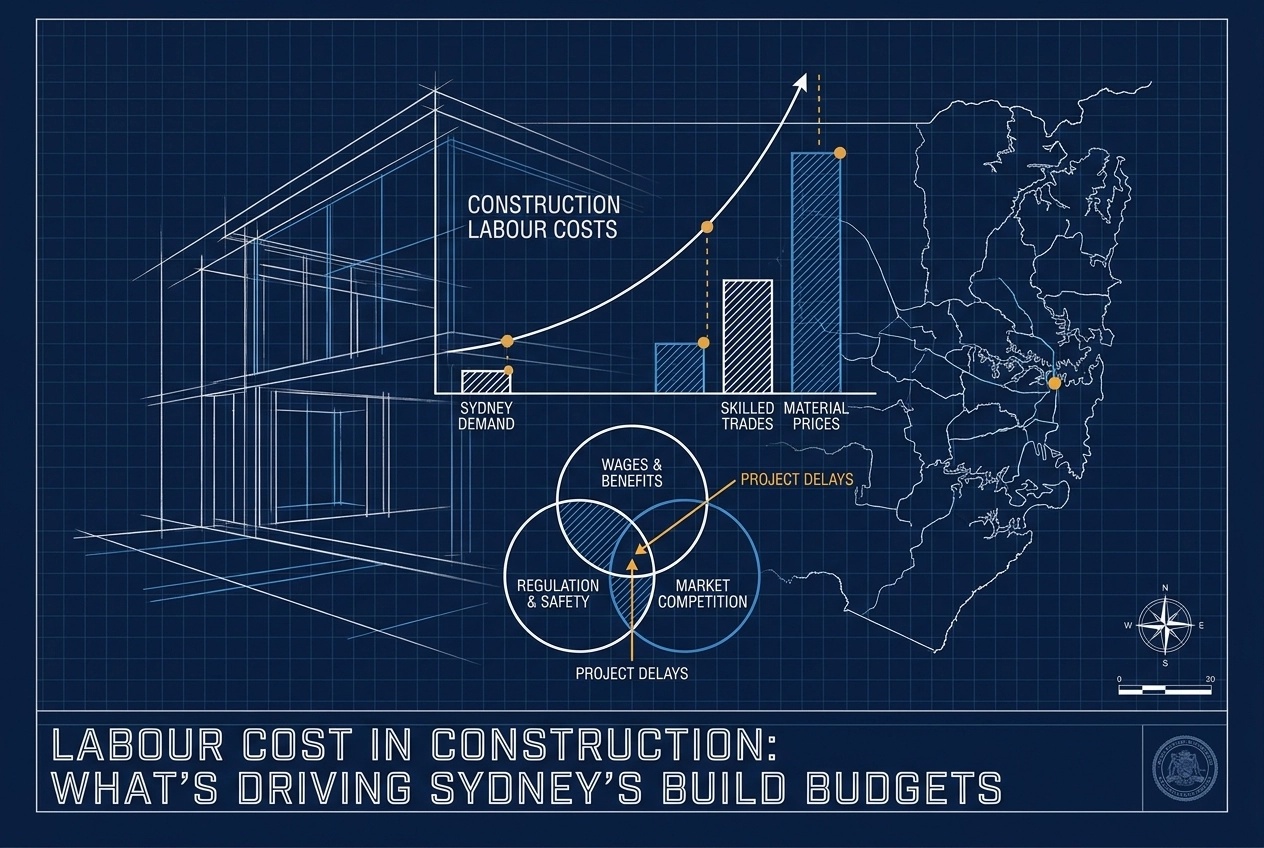
Sydney's construction sector is under pressure, and the numbers tell a clear story. Project budgets are climbing, timelines are stretching, and for developers, builders, and project managers alike, one variable keeps rising to the top of every cost conversation: labour cost.
Understanding what drives labour expenses in construction is no longer optional knowledge for those working in the industry. It is a fundamental competency that shapes how projects are planned, priced, and delivered. From skilled trade shortages and award rate increases to the compounding effects of major infrastructure pipelines drawing workers away from residential and commercial builds, the forces behind Sydney's rising labour costs are both structural and immediate.
This analysis breaks down the key factors pushing labour budgets higher across Sydney's construction market. You will gain a clearer picture of how wages, workforce availability, project complexity, and regulatory requirements interact to determine what you actually pay to get a building out of the ground. Whether you are costing a new development or reviewing an existing contract, this is the context you need to make informed decisions.
What Is Labour Cost in Construction?
Labour cost in construction refers to all expenditure associated with human effort applied directly to a project. Direct labour cost covers the wages, allowances, and statutory on-costs paid to workers physically engaged on site, including carpenters, concreters, electricians, and plumbers, whose hours can be traced to a specific task or work package. Subcontractor labour, by contrast, is embedded within a trade package price, whether structured as a lump sum or a schedule of rates, alongside materials, plant, and the subcontractor's margin. This distinction matters because the labour component within a subcontract package is not independently visible unless a detailed cost breakout is requested and assessed by a qualified quantity surveyor.
The true cost of a labour hour extends well beyond the base wage rate. In Australia, employer on-costs typically add 25 to 35 per cent above the base rate once superannuation (currently 11.5%), WorkCover levies, payroll tax, annual and personal leave entitlements, and tool or travel allowances are included. A worker earning $45 per hour on paper may represent a true all-in cost of $56 to $61 per hour to the employer. Understanding this burden rate is fundamental to accurate cost planning and feasibility assessment, particularly where labour intensity varies significantly across trade packages. For further context on how to calculate labor costs in construction, burden rate methodology is a core component of any reliable estimate.
Labour and materials costs are frequently bundled together in builder and subcontractor pricing, which creates a significant challenge for independent cost assessment. When a principal receives a lump-sum quote, the proportion attributable to labour versus materials is often indistinguishable without QS-level analysis. This matters because labour-heavy scopes carry a different risk profile: they are more exposed to productivity fluctuations, trade availability, and wage movements than materials-driven packages.
Labour cost also presents differently depending on contract structure. In cost-plus contracts, it appears as a transparent, auditable line item. In lump-sum contracts, it is absorbed into trade package rates. In scopes covered by provisional sums or prime-cost items, labour rates and productivity assumptions are the primary variables determining whether the final cost aligns with the original allowance. According to construction labour cost tracking best practices for 2026, inaccurate labour data at the estimation stage is one of the most common causes of budget divergence during delivery.
For cost planners and project advisors, understanding the labour-to-materials split within a project budget directly informs procurement strategy, risk allocation, and contingency setting across the project lifecycle.
How Much of a Construction Project's Cost Is Labour?
Labour represents a significant and structurally persistent share of total construction cost across all project typologies. For standard residential builds, labour typically accounts for 30 to 40% of total construction cost, encompassing formwork, framing, wet trades, finishing, and services installation. For complex commercial and fit-out projects, that proportion rises to 40 to 50%, driven by higher trade skill intensity, more demanding finishes specifications, and the concentration of mechanical and electrical services work per square metre of floor area.
Trade-by-Trade Labour Intensity
Not all construction trades carry equal labour cost density. Structural concrete and formwork are among the most labour-intensive activities on any project, requiring significant hours for falsework erection, reinforcement placement, pours, and stripping. Prefabricated framing systems and precast concrete elements partially offset this by shifting fabrication labour off-site, reducing site hours and programme duration. However, the trades that carry the highest skilled-labour cost density are electrical and mechanical services. These trades require licensed, non-substitutable personnel whose hourly rates reflect both qualification requirements and acute market scarcity.
The connection between materials and labour is direct and consequential in electrical work. Electrical equipment costs rose 6.3% year-on-year to March 2026, driven largely by copper pricing flowing through to cable, conduit, and switchgear. More complex electrical installations demand more skilled hours, and those hours cannot be value-engineered away without compromising building performance, compliance, or safety. Where equipment specifications increase in complexity, the associated labour quantum increases proportionally.
Apartment Construction and Height-Driven Labour Intensity
High-rise apartment construction amplifies labour cost as a share of total project cost more than almost any other typology. Sydney apartment construction costs range from $3,500 to $7,000 per m² GFA depending on building height, with labour intensity increasing with every additional storey. Crane time, restricted floor-by-floor access, vertical logistics, and the need for simultaneous multi-trade coordination on compressed floor plates all extend programme duration and inflate preliminaries. Apartment construction value across NSW, Victoria, and Queensland has risen 50% since 2020, a figure that reflects compounded labour and material cost escalation rather than a step-change in project scope.
When benchmarking these costs, it is important to understand what published rates from references such as Rawlinsons and RLB's Riders Digest actually include. These references incorporate substructure, structure, finishes, building services, preliminaries, and builder's margin and overheads. They exclude GST, land, professional fees, and external site works. Because preliminaries and builder's margin are directly sensitive to labour cost movements, any sustained rise in trade labour rates flows through to the total published benchmark rate, making those figures a useful but dynamic reference rather than a fixed ceiling.
What Is Driving Labour Cost Escalation in Sydney and NSW?
Several interconnected structural forces are driving labour cost escalation across Sydney and NSW, and understanding each one is essential for building realistic project budgets and credible business cases.
Structural Trade Workforce Shortages
The pipeline of qualified tradespeople in NSW has not kept pace with sustained construction demand, and that imbalance is most acute in electrical, plumbing, and concrete trades. Apprenticeship commencement rates have consistently fallen short of the volumes required to replace retiring tradespeople and absorb demand from the state's infrastructure and development pipeline. The practical consequence is that subcontractors in these trades operate from a position of pricing power, particularly during periods of concurrent public and private sector activity. Infrastructure Australia's 2025 Infrastructure Market Capacity Report explicitly identifies workforce availability as a core constraint across Australia's construction sector, documenting the competition between major public infrastructure programs and private sector projects for the same limited pool of skilled labour. Competitive tendering processes offer limited protection in this environment; when qualified subcontractors are scarce, tender returns reflect that scarcity regardless of procurement methodology.
Wage Growth and EBA Outcomes
Enterprise bargaining agreement outcomes in the commercial construction sector have delivered sustained above-CPI wage increases for key trades, embedding multi-year cost escalation into project budgets well before contracts are awarded. EBA rate structures in commercial construction can produce effective hourly rates for experienced tradespeople that substantially exceed the base award rate for the same classification, particularly when overtime loadings on extended site weeks are factored in. Fair Work Commission minimum wage decisions compound this dynamic: each annual adjustment establishes a higher floor that feeds into the next round of EBA negotiations. For project financiers and owners assessing cost plans prepared 18 to 24 months ahead of construction, this creates a documented escalation risk that must be explicitly modelled rather than absorbed into contingency.
Productivity Drag as a Hidden Cost Multiplier
Declining on-site productivity is a compounding labour cost driver that receives insufficient attention in standard escalation reporting. Oxford Economics' analysis of the construction productivity challenge in Australia identifies regulatory complexity, work health and safety compliance obligations, and fragmented subcontractor workforces as the primary mechanisms reducing output per labour hour on Australian sites. The consequence is that more hours are required to complete a defined scope, a cost increase that does not appear as a wage movement in any index but carries an identical budget impact. In the NSW context, layered compliance requirements from SafeWork NSW, development approval conditions, and inspection regimes create administrative and on-site coordination demands that absorb productive time across trades.
Input Price Data and the Signal Between Indices
ABS data to March 2026 shows builder input prices, covering both materials and labour paid by builders, rising 2.5% year-on-year, while house construction output prices rose 4.1% over the same period. The gap between these two indices is analytically significant: it indicates that builders are passing through costs at a rate that exceeds their direct input cost growth, a behaviour consistent with margin recovery and embedded risk pricing in a tight labour market. For clients assessing tender returns or negotiating contract structures, this divergence warrants careful attention.
Structural Outlook and Migration Pipeline Constraints
RLB's 2026 construction outlook explicitly flags elevated cost escalation as a continuing condition rather than a post-COVID correction reverting toward a prior baseline. Independent assessments from multiple cost consultancies reinforce a consistent market view: project budgets built on assumptions of near-term labour cost normalisation carry material risk. Skilled migration policy adjustments have been made to address trade shortages, but the lag between visa approvals, credential recognition through bodies such as the Trades Recognition Authority and NSW Fair Trading licensing, and genuine on-site productivity means workforce relief materialises slowly. For projects tendering in 2026 and 2027, the budgetary benefit of expanded migration pipelines remains limited and should not be treated as a planning assumption without careful qualification.
The Scale of Cumulative Labour Cost Escalation Since 2020
The data accumulated since 2020 makes a compelling and commercially significant case: Australian construction costs have not merely risen, they have structurally reset. House construction prices increased 40.8% between September 2020 and June 2024, and continued climbing at 4.1% year-on-year to March 2026, including a 1.1% rise in the March 2026 quarter alone. For Sydney developers, owners, and project financiers, this compounding trajectory means any cost model or feasibility assessment anchored to pre-2021 benchmarks carries material unreliability that can undermine investment decisions and procurement strategies.
The scale of escalation in the apartment sector is even more pronounced. Construction value has risen 50% since 2020 across NSW, Victoria, and Queensland, reflecting not just materials inflation but the amplified effect of wage growth applied across the far larger labour-hour pools inherent in multi-storey typologies. Fire services, structural complexity, lifts, and extensive common areas mean that a percentage increase in trade labour rates flows through a far greater volume of hours per square metre than in detached residential construction. This is a critical distinction for developers assessing mid-rise and high-rise feasibility in Sydney's current cost environment.
At the national level, the average house build cost reached $474,939 in 2024-25, up 37.5% from $345,410 in 2019-20, according to ABS Building Activity data and current cost benchmarks. These are builder-reported job values excluding land, confirming that even conservative feasibility models from five years ago require full recalibration before informing any current business case or investment decision.
A notable divergence has also emerged between input and output pricing. The new dwelling CPI, excluding land, rose 4.5% in the year to March 2026, while builder input prices, covering both materials and labour paid by builders, rose only 2.5% over the same period. This gap may reflect margin recovery following sustained losses under fixed-price contracts, or deliberate risk pricing in response to the 2,361 initial external administrator reports recorded in the construction sector during 2024-25, more than any other Australian industry. The ABS Producer Price Indexes confirm output price growth remains firmly positive.
On the materials side, relief is narrow and category-specific rather than indicative of a broad reversal. Electrical equipment costs rose 6.3% year to March 2026, driven in part by copper price movements, while concrete, cement and sand rose 2.8% and timber, board and joinery rose 2.8% annually despite a modest 0.2% quarterly fall. The timber dip is a single-category, single-quarter movement against an annual figure still firmly in positive territory, and should not be interpreted as a signal of broad-based materials deflation. For project cost planning purposes, the overall environment remains one of sustained escalation across the majority of cost categories, with labour continuing to underpin the structural floor beneath all headline figures.
Fixed-Price Contracts and Labour Cost: Why the Risk Has Not Gone Away
A lump-sum or fixed-price contract does not eliminate labour cost risk for clients. It relocates that risk into specific contractual mechanisms that are frequently overlooked during procurement. The most consequential of these are provisional sums and prime-cost items. Provisional sums are used where scope cannot be fully defined at tender stage, covering elements such as services trade installations, external works, landscaping, and authority-imposed requirements. When these items are subsequently instructed during construction, they are valued at prevailing labour rates at the time of instruction, not the rates embedded in the original tender. In a market where construction labour costs have risen structurally since 2020, the difference between the two can be material. As prime cost sum analysis demonstrates, PC items carry a subtler but equally real exposure: they defer material selection without formally re-pricing the associated installation labour, leaving the client exposed to productivity, supervision, and trade rate movements that were never captured in the original contract sum.
When Builder Insolvency Makes the Risk Concrete
The theoretical risk embedded in provisional sums and contract pricing becomes a direct financial liability when a builder becomes insolvent mid-project. The Australian construction sector recorded 2,361 initial external administrator reports in 2024-25, more failures than any other industry in Australia and approximately one in four of all national business failures. Labour cost overruns on fixed-price contracts where margins were originally priced too thin are a documented contributing factor. When a builder enters administration during construction, the client must re-tender incomplete works in the current labour market. Given that house construction output prices rose 40.8% between September 2020 and June 2024 and continue rising at 4.1% year-on-year to March 2026, the gap between rates embedded in an earlier contract and rates available in the current market can be substantial. That cost gap falls entirely on the client unless a performance bond, parent company guarantee, or equivalent risk provision was established at procurement. In the absence of such protections, the client absorbs both the re-procurement cost and the adverse market movement.
Why Tender Analysis Is a Risk Management Tool, Not a Formality
Independent assessment of a contractor's labour rates at tender stage is one of the most practical and commercially significant risk mitigation steps available to clients before contract execution. As detailed guidance on provisional sum and PC item mechanics confirms, these items create floating cost components within what appears to be a fixed-price arrangement. A quantity surveyor benchmarking a tender submission against current market labour rates can identify two distinct failure modes: a submission priced too low to be viable, which signals insolvency risk before it materialises; and a submission priced above prevailing market rates, which represents an avoidable cost to the client. Both scenarios are identifiable through structured tender analysis. Without that analysis, clients are committing to a contract with limited visibility into whether the pricing foundation is commercially sound.
Reading the Current Market Signals
The divergence between builder input prices and output prices provides a useful reference point for understanding current market conditions. Builder input prices, covering materials and labour paid by contractors, rose 2.5% year-on-year to March 2026. Output prices, which reflect what clients pay, rose 4.1% over the same period. This gap suggests that builders are currently recovering margin above cost growth, which is a rational response to years of compressed returns and elevated insolvency risk. For clients, this means the risk runs in both directions: tenders submitted at above-market rates may indicate margin padding, while unusually competitive submissions may signal that a contractor has under-priced labour and is relying on variation income to close the gap. Independent cost plan benchmarking at tender stage, referenced against current market data, remains the most reliable mechanism for distinguishing between the two before contract execution.
How a Quantity Surveyor Assesses and Manages Labour Cost
Understanding how a quantity surveyor actively manages labour cost across the project lifecycle is what separates effective cost governance from reactive budget management. A QS applies structured, evidence-based methods at each stage of a project to keep labour costs visible, verifiable, and defensible.
Progress Claim Assessment
When a contractor submits a progress claim, an independent QS does not simply accept the stated value of work completed. The assessment process involves cross-referencing claimed labour hours and trade rates against the contract schedule of rates, proprietary QS cost databases, and current market benchmarks. Each trade package is reviewed individually, and where claimed labour content appears inconsistent with the physical progress observed on site or exceeds scheduled rates without contractual justification, the QS will flag and adjust the assessment accordingly. This independent scrutiny protects the client from certifying inflated labour claims that could compound across multiple payment cycles and distort the project's financial position.
Variation Valuation
Scope changes are an inherent feature of complex construction projects, and the labour component of every instructed variation carries commercial risk. A contractor seeking to recover margin eroded elsewhere in the contract may price variation labour at rates significantly above market levels, particularly where the variation scope is difficult for the client to independently benchmark. A QS counters this by applying current trade rate data and cost plan benchmarks to assess the fair value of each variation. This discipline is especially important in the current NSW market, where quantity surveying construction costs remain elevated and contractors are under sustained commercial pressure.
Labour Rate Verification in Tender Analysis
Tender analysis is one of the most consequential points at which a QS can influence a project's labour cost outcome. Reviewing subcontractor labour rates against market expectations reveals both over-pricing and under-pricing, and each carries distinct risk. Over-priced labour inflates the contract sum directly. Under-priced labour is more insidious; it signals financial fragility, increases the probability of mid-project disputes and claims for additional payment, and is a recognised precursor to subcontractor insolvency. With the construction sector recording 2,361 external administrator appointments in 2024 to 2025, the highest of any Australian industry, identifying unsustainable labour pricing at tender stage is a risk management imperative.
Cost Planning and Bills of Quantities
A credible cost plan for a 2026 Sydney or NSW project must embed explicit labour escalation allowances calibrated to Enterprise Bargaining Agreement trajectories, trade availability conditions, and programme duration. Generic contingency lines are not a substitute for this analysis. Separately, a detailed bill of quantities prepared by an independent QS makes labour content visible and auditable at a trade-by-trade level, enabling meaningful tender comparison and supporting rigorous variation assessment throughout construction. Lump-sum tendering does not provide this transparency, and projects procured without a BOQ consistently face greater difficulty in isolating and challenging labour cost movements as they emerge.
Labour Cost in Construction Disputes and Expert Evidence
Labour cost overruns sit at the centre of a significant proportion of construction disputes. Disagreements over the reasonable cost of labour in variations, the valuation of daywork, and the quantification of delay and disruption claims all require expert analysis that goes well beyond what a contractor's own site records can establish. A contractor's internal cost data reflects what that contractor paid, not necessarily what the work should reasonably have cost under the applicable contract terms and prevailing market conditions. That distinction is fundamental in contested proceedings.
In adjudication, arbitration, and litigation, an independent quantity surveyor acting as expert witness provides the decision-maker with a methodologically grounded assessment of the labour content of disputed work. This assessment draws on published cost databases, current market rate evidence, industry benchmarks, and construction standards to establish a defensible position on what the labour component of a variation or claim should reasonably have cost. The expert's role is not to advocate for either party but to assist the tribunal with technically complex quantum questions that require specialist knowledge. Methodological transparency, including a clearly articulated approach to labour rate selection and resource quantification, is what separates credible expert evidence from self-serving cost submissions.
Defect rectification costing presents a particular challenge in this context. Labour rates applicable to remediation work on existing structures are consistently higher than equivalent new-build rates, for well-founded practical reasons. Access constraints, working within occupied or partially occupied buildings, the need to protect adjacent completed work, and sequencing complexity all increase the labour hours and associated costs required to perform remedial tasks. An expert assessment that applies new-build labour benchmarks to a rectification claim will materially undervalue that claim. A competent QS expert accounts for these labour cost premiums explicitly, with reference to the specific site conditions and the nature of the remediation scope.
Delay and disruption claims introduce a further layer of labour cost quantification. Where one party's actions extend the project programme, the claiming party typically incurs additional labour costs across extended preliminaries, prolonged trade engagement, and extended supervision. Each of these heads of cost must be independently quantified and substantiated. Unverified contractor records or unsubstantiated global estimates rarely withstand scrutiny in formal proceedings.
The quality of expert evidence on labour cost ultimately depends on three factors: the QS's demonstrable independence from the parties, the transparency of the methodology applied, and the currency of the market rate knowledge brought to bear. A quantity surveyor who is actively engaged in cost planning, tender analysis, and procurement advisory work on live projects carries a practical understanding of current Sydney and NSW labour market conditions that a desktop-only reviewer cannot replicate. That current market knowledge, applied within a rigorous and transparent expert framework, is what gives expert evidence on labour cost its persuasive weight in contested proceedings.
Sydney vs. Regional NSW: Understanding Labour Cost Differentials
Labour costs in Greater Sydney carry a structural premium over regional NSW locations that cannot be accounted for simply by applying a blanket percentage adjustment. The premium is driven by three converging forces: higher living costs that push base wage expectations upward, stronger competition for skilled trades across a denser and more complex project pipeline, and the physical demands of urban construction itself. Site access restrictions, traffic management requirements, noise curfews, and constrained delivery windows all compress productive hours and require additional coordination effort. Sydney apartment construction costs ranging from $3,500 to $7,000 per m² GFA illustrate the cumulative effect of these pressures. High-rise typologies demand crane scheduling, vertical transportation of materials across multiple floors, and multi-trade sequencing in confined floor plates, each of which adds measurable labour hours that do not appear in suburban or regional cost benchmarks.
Western Sydney growth corridors are currently experiencing a concentrated version of this pressure. The Western Sydney International Airport precinct alone engaged more than 2,000 workers expending approximately 9 million hours on terminal construction, while the broader Australian Government commitment of $19 billion in infrastructure investment into Western Sydney is driving simultaneous demand across electrical, civil, structural, and mechanical trade disciplines. When multiple large principal contractors are competing for the same regional trade workforce at the same time, all-in labour rates and subcontractor margins respond accordingly. Project budgets prepared without acknowledging this corridor-specific demand concentration will carry understated labour cost risk from the outset.
Regional NSW projects face a structurally different but equally significant challenge. Trade availability outside major urban centres is materially lower, and project budgets must accommodate travel and accommodation allowances for tradespeople mobilising from Sydney or interstate, higher daywork rates to attract workers willing to leave metropolitan centres, and extended programme durations that inflate preliminary and general costs even where base rates may appear comparable. A feasibility study or cost plan benchmarked against Sydney rates without geographic adjustment will systematically understate these exposures. For public infrastructure and civil works clients delivering programs across multiple regional locations, independent quantity surveying assessment with location-specific cost modelling is not optional; it is the commercially responsible baseline for a credible and defensible business case.
Illustrative Example: Labour Cost Escalation in a Sydney Development Budget
To illustrate the practical commercial consequences of labour cost escalation, consider the following scenario based on publicly available market benchmarks. A mid-rise residential apartment project in Sydney, with a gross floor area of 5,000 m² representing approximately 50 units, was assessed at feasibility in 2021 using a benchmark rate of $4,200 per m² GFA. At that rate, the construction cost estimate at project inception was $21,000,000. This figure reflected the market conditions that prevailed before the post-COVID surge in construction input costs took hold across the Sydney and NSW market.
Applying Cumulative Escalation to the 2021 Benchmark
Apartment construction value across NSW has risen approximately 50% since 2020, a figure consistent with the broader pattern of sustained escalation documented across multiple cost indices and market reports. Applying that cumulative uplift to the 2021 benchmark produces a recalibrated 2026 rate in the range of $5,800 to $6,300 per m² GFA for a project of this scale and height. The resulting revised construction cost estimate falls between $29,000,000 and $31,500,000, representing an increase of $8,000,000 to $10,500,000 on the 2021 figure. A developer who has not refreshed their feasibility study since project inception is carrying that entire gap as an unacknowledged exposure, invisible within their original financial model.
Isolating the Labour-Attributable Cost Increase
If labour represents approximately 40% of total construction cost for a mid-rise apartment project of this type, a proportion consistent with commonly applied industry benchmarks for buildings of this complexity, the labour-attributable share of the revised 2026 estimate is approximately $11,600,000 to $12,600,000. More critically, the labour-attributable portion of the cost increase alone is approximately $3,200,000 to $4,200,000. This is a figure that would not have appeared anywhere in a 2021 feasibility study, yet it directly affects equity return calculations, project viability thresholds, and the adequacy of construction finance facilities relative to actual delivery risk. Lenders typically size construction loans against independently verified cost plans; a cost plan anchored to a 2021 benchmark may materially understate the facility required to complete the project.
Why Professional Cost Management Is Indispensable
Without an updated independent cost plan reflecting current labour market conditions, the risks to project outcome are material and compounding. A developer proceeding on 2021 figures faces the possibility that the project is not viable at current costs, that construction finance is structured against an understated budget, or that contingency allowances are insufficient to absorb ongoing escalation during the delivery period. An independent quantity surveyor provides the structured reassessment that transforms a stale benchmark into a project-specific, procurement-ready cost position, accounting for current trade rates, site conditions, programme duration, and contract risk allocation.
Disclaimer: The figures used in this example are illustrative benchmarks based on publicly available market data and are provided for educational purposes only. They do not constitute formal cost advice. A project-specific quantity surveyor assessment is required before any investment, financing, or procurement decision is made.
Managing Labour Cost Risk in Sydney and NSW Projects: Practical Considerations
The most common and costly mistake in managing labour cost on Sydney and NSW projects is treating quantity surveyor engagement as a procurement-stage exercise. By the time a project reaches tender, the decisions that most significantly shape labour cost exposure have already been made: site selection, programme duration, design complexity, structural system, and trade package sequencing are all established. Engaging a QS at feasibility stage, when labour market conditions can be incorporated into the cost plan that underpins the investment decision, is the most effective risk mitigation available. A feasibility-stage cost plan that reflects current EBA wage schedules, trade availability, and market loading gives clients a realistic baseline before capital is committed.
For projects with programmes extending beyond 12 months, a flat contingency percentage is structurally inadequate as a response to labour cost risk. Construction cost escalation in NSW continued at 4.1% year-on-year to March 2026, and labour is increasingly identified as the structural driver that persists even where material prices ease. Project budgets for multi-stage or long-programme works should include an explicitly modelled escalation allowance, calibrated to current EBA outlook, known trade shortages in the relevant package mix, and the timing of major labour-intensive construction phases. A single blended contingency cannot replicate this level of programme-sensitive cost modelling.
Where labour cost transparency matters, the procurement document structure is critical. Lump-sum contracts supported by minimal documentation make labour content invisible to the client, which creates a systematic disadvantage in variation negotiations. A properly structured tender incorporating a detailed bill of quantities or schedule of rates gives the client visibility over labour content at every trade package level, and provides the measurement basis for evaluating variations against independently established rates rather than contractor assertions.
Provisional sums and prime-cost items require particular attention during contract review. These are the mechanisms by which labour cost risk most commonly re-enters a nominally fixed contract after execution. Each provisional sum should be tested at cost plan stage for adequacy against current market rates, and the basis for prime-cost items should be independently verified before the contract is signed.
Finally, procurement strategy warrants careful consideration in a constrained labour market. Early contractor involvement, design-and-construct delivery with a well-defined employer's requirements document, and staged tendering can each improve the quality of labour cost information available at commitment stage, and reduce the gap between tendered and final costs.
Conclusion: Labour Cost as a Commercial Risk, Not Just a Budget Line
Labour cost has emerged as the most structurally persistent driver of construction cost escalation across Sydney and NSW, and the evidence accumulated through 2026 leaves little room for optimism about a near-term correction. Trade shortages, sustained wage growth, and productivity constraints embedded in the current delivery environment are not cyclical pressures that will resolve with a change in market conditions. They reflect structural shifts in how construction labour is supplied, priced, and retained, and any project budget that does not account for these dynamics carries material commercial risk from the outset.
Independent quantity surveying assessment remains the most reliable mechanism for managing that risk across a project's full lifecycle. From feasibility and business case development through cost planning, procurement, tender analysis, contract administration, and dispute resolution, a qualified QS applies structured commercial oversight at every stage where labour cost assumptions are tested against market reality. That discipline is not a luxury for large or complex projects; it is the baseline standard of care for any project where cost certainty matters.
The actionable message for developers and project owners is direct: if your feasibility or business case has not been independently reviewed against current labour market conditions within the last twelve months, the cost assumptions underpinning your investment decision are likely to be materially understated. With house construction output prices rising 4.1% year-on-year to March 2026 and RLB's outlook confirming elevated escalation continuing into the forward period, stale cost plans carry measurable financial exposure.
Quantity Surveyors Sydney provides independent cost planning, bills of quantities, tender analysis, progress claim assessment, and expert witness services across residential, commercial, and infrastructure projects throughout Sydney and NSW. Engaging professional advice early in the project lifecycle remains the most cost-effective investment available in the current construction market.