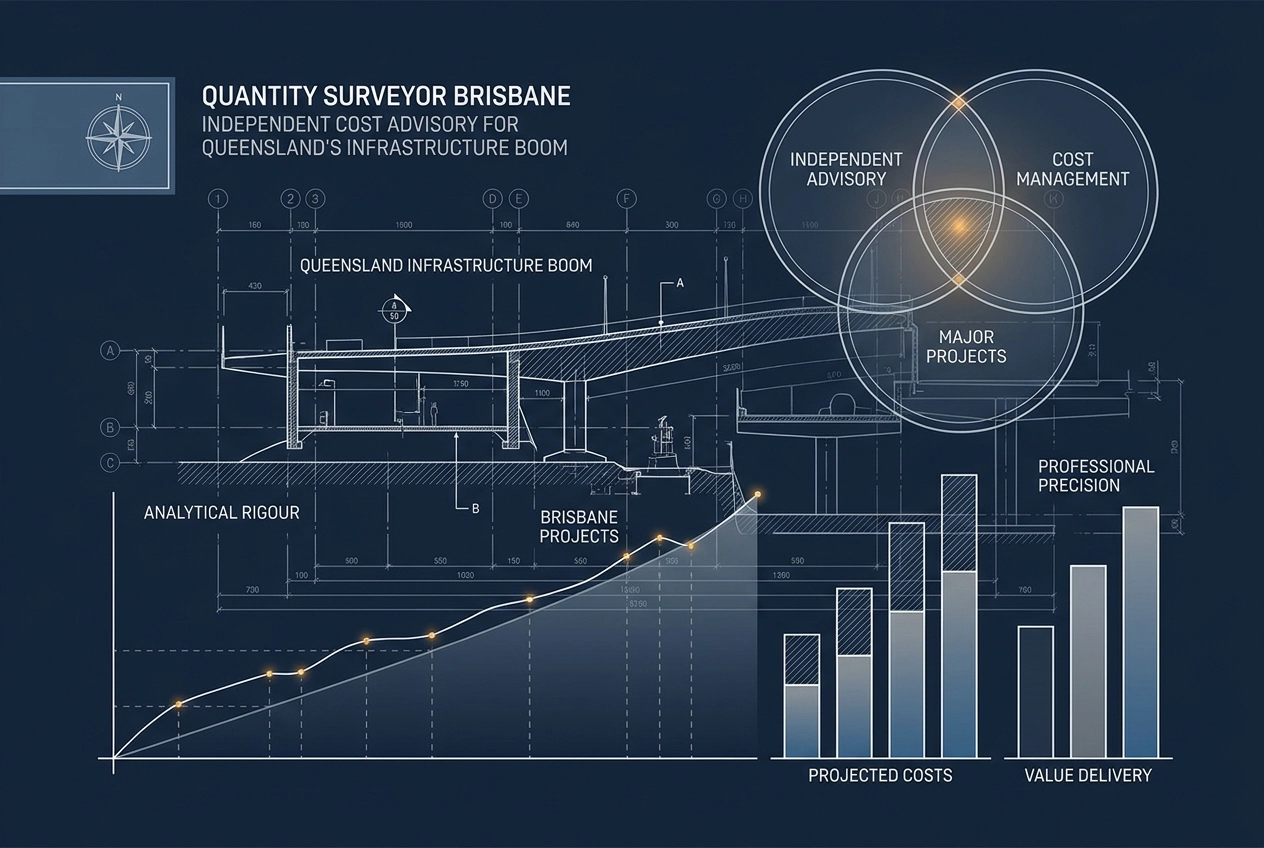
Queensland is in the middle of one of the most significant infrastructure expansions in its history. With billions of dollars flowing into transport networks, social infrastructure, and urban development ahead of the 2032 Brisbane Olympic Games, the stakes for accurate cost management have never been higher. Yet many project owners and developers are still making critical financial decisions without independent, expert guidance.
Engaging a qualified quantity surveyor Brisbane professionals trust is no longer a strategic luxury; it is a fundamental requirement for any project seeking financial clarity in this competitive market. Whether you are a developer navigating escalating construction costs, a government agency managing public expenditure, or an investor assessing feasibility, independent cost advisory can mean the difference between a project that delivers value and one that hemorrhages budget from day one.
This analysis examines how independent quantity surveying services are shaping Queensland's infrastructure boom, what separates genuine expertise from surface-level cost estimation, and how discerning clients can leverage specialist advisory to protect their financial position throughout every stage of the project lifecycle.
Brisbane's Infrastructure Inflection Point
Queensland's 2026-27 State Budget represents a structural shift in the scale and complexity of public capital investment, committing $119.241 billion over four years in what the Queensland Government has described as the largest capital program in the state's history. The single-year allocation for 2026-27 alone stands at $29.616 billion, supporting an estimated 71,500 jobs statewide across transport, health, energy, social housing, education, and disaster reconstruction. This is not a cyclical uptick in construction activity. It is a generational reset of Queensland's infrastructure baseline, and it carries proportionate demands on the cost management and commercial advisory disciplines that underpin successful project delivery.
The project pipeline spanning Greater Brisbane and its growth corridors is simultaneously broad and time-compressed. The transport program totals $11.165 billion, anchored by the $9 billion Bruce Highway Targeted Safety Program and the continuing delivery of Cross River Rail, alongside committed investment in the Coomera Connector, Faster Rail to the Gold Coast, and the Mooloolah River Interchange. Health infrastructure reaches a record $4.04 billion in 2026-27, while energy, social housing, and education programs add further layers of concurrent procurement demand. The Queensland Audit Office's Major Projects 2025 report, tabled in December 2025, explicitly identifies workforce shortages and supply cost pressures as systemic risks to major project delivery across this pipeline, noting that these challenges must be managed to ensure the effective delivery of Queensland's growing capital program.
Overlaying this baseline program is the fixed deadline of the 2032 Brisbane Olympic and Paralympic Games, which requires more than $7.1 billion in venue investment and an additional $12.4 billion in associated transport infrastructure. The 2032 delivery date is immovable, which means feasibility windows, procurement lead times, and construction programmes are being compressed simultaneously across multiple asset classes and client organisations. This convergence of Olympics preparation, population-driven corridor development across the Gold Coast, Sunshine Coast, and Coomera, and major linear infrastructure delivery creates cost risk conditions that are qualitatively different from standard procurement environments.
At this scale and velocity, the consequences of budget overruns, procurement missteps, or contract disputes are material for project owners, contractors, and financiers alike. Independent quantity surveying engagement, in this context, is a strategic input to investment decision-making and commercial risk management, not a procedural formality. This article examines Brisbane's infrastructure cost landscape in detail, outlines the quantity surveyor services most relevant to major Queensland projects, analyses the procurement frameworks governing public capital delivery, and sets out how clients can evaluate independent advisory capability at this stage of the infrastructure cycle. For further context on the scope of Games-related and legacy infrastructure delivery, the analysis published by WT Partnership on building backbone infrastructure for the Games and beyond provides useful sector framing.
Queensland's Capital Program at Scale
Queensland's transport sector commands the largest single allocation within the capital program, with an $11.165 billion transport budget underpinning some of the most commercially complex infrastructure delivery in Australia. The $9 billion Bruce Highway Targeted Safety Program alone represents a multi-year, multi-package delivery challenge spanning hundreds of kilometres of corridor, involving complex staging, traffic management, geotechnical uncertainty, and significant community interface obligations. Concurrent delivery of Cross River Rail, which the Queensland Audit Office confirmed in its Major Projects 2025 report carries ongoing cost pressures and a revised delivery timeline, compounds the challenge for Queensland's delivery agencies. Projects of this nature require robust independent cost oversight from concept through to commissioning, with particular emphasis on procurement strategy, risk-adjusted cost planning, and contract administration disciplines that protect the principal's commercial position across long delivery horizons.
The record $4.04 billion health infrastructure investment in 2026-27 introduces a distinct but equally demanding layer of program complexity. Hospital and research facility construction operates within tight functional briefs, clinical continuity constraints, and highly regulated procurement frameworks, all of which elevate cost and programme risk beyond what standard commercial construction benchmarks would suggest. Demand for specialist quantity surveying services across this sector, including detailed cost planning at each design stage, tender documentation, tender advisory, and rigorous contract administration, is growing in direct proportion to the scale of investment. Community health facility programs distributed across regional Queensland add further scope and geographic spread to an already stretched delivery environment.
A critical dimension of Queensland's capital program that is often underweighted in metropolitan analysis is its regional distribution. With 69.3% of Queensland's capital investment directed outside Greater Brisbane and 48,500 regional jobs supported across the state, the demand for quantity surveying and commercial advisory services is genuinely statewide. Projects in regional and remote locations carry their own distinct cost drivers, including mobilisation costs, local subcontractor capacity limitations, extended supply chains, and Aboriginal and Torres Strait Islander community engagement obligations. Infrastructure advisors operating solely from a Brisbane base may struggle to provide the national delivery capability and regional cost intelligence that these programs require.
The Brisbane 2032 Olympics is accelerating a parallel wave of infrastructure commitment, with more than $7.1 billion committed to venue renovation and construction and a further $12.4 billion identified for transport infrastructure essential to the Games. New venue construction, including the Victoria Park Olympic Stadium and Brisbane Arena, alongside precinct development and transport connectivity upgrades, each carries distinct procurement timeframes, programming constraints, and legacy obligations that benefit directly from early quantity surveyor engagement. The complexity of Games-related procurement frameworks, including social procurement requirements and multi-stakeholder governance arrangements, makes independent commercial oversight a functional necessity rather than an optional advisory service.
Across all of these concurrent programs, the compounding effect of simultaneous delivery creates systemic market risks that no single project budget can fully absorb in isolation. Infrastructure construction disruption is already affecting road-based logistics across Brisbane, with labour market pressure, subcontractor capacity constraints, and supply chain volatility intensifying as the program accelerates toward 2032. When interdependent programs compete for the same trade packages and materials, cost escalation in one area can produce cascading delays and overruns across others. Independent cost oversight, applied consistently from early project definition through to close-out, provides the objective benchmark against which emerging commercial risks can be identified, quantified, and managed before they translate into unrecoverable budget exposures.
What a Quantity Surveyor Does on Major Brisbane Projects
Against the backdrop of Queensland's record capital program, the practical question for project owners and agencies is what specialist quantity surveying engagement actually delivers at each stage of a major Brisbane project. The answer spans the full project lifecycle, from the earliest investment decision through to final commercial close-out.
Front-End: Feasibility, Cost Planning and Business Case Development
At the front end of a project, a quantity surveyor develops the financial framework that determines whether a project proceeds at all. Concept-stage cost plans, order-of-magnitude estimates, and investment-grade budget assessments provide the quantitative foundation for business case development, funding submissions, and gateway approvals across both public agency and private developer clients. These outputs are not simply indicative figures; they represent structured, defensible cost positions that must withstand scrutiny from treasury, investment committees, financiers, and procurement authorities. On major Queensland transport and utilities projects, early-stage cost certainty also shapes decisions around staging, scope prioritisation, and value engineering, all of which have downstream consequences for program delivery and budget performance. Engaging a specialist quantity surveyor at concept and pre-feasibility stages consistently reduces the risk of scope misalignment between approved budgets and actual market pricing when projects reach tender.
Procurement: Bills of Quantities, Tender Management and Contract Strategy
Through the procurement phase, the quantity surveyor's role shifts to structured market engagement and commercial risk allocation. Preparation of detailed bills of quantities, tender documentation packages, and pricing schedules provides the basis for competitive, like-for-like tender evaluation. QS professionals advise clients on contract strategy, including the selection of appropriate forms of contract and risk-sharing mechanisms suited to the specific project type and delivery environment. Tender analysis goes beyond price comparison; it encompasses assessment of contractor methodology, programme assumptions, risk allowances, and commercial terms. Negotiation support during the preferred contractor phase helps clients achieve contract execution at a price that reflects genuine market conditions rather than initial bid positions. On Queensland infrastructure projects, this procurement discipline is particularly important given the competitive pressures created by the volume of concurrent work across the state's capital program.
Construction: Contract Administration, Variations and Cost Performance
During construction, independent quantity surveying services provide clients with an accurate, real-time view of cost performance against the approved budget. Contract administration responsibilities include assessment of progress claims, evaluation of variations, and management of the contractual notice and entitlement processes that govern financial outcomes. Earned value reporting integrates cost and programme data to identify emerging performance trends before they become unmanageable budget overruns. On active Brisbane infrastructure programs such as rail upgrades and civil works packages, quantity surveyor roles in Brisbane routinely include certifying monthly payment claims, tracking Target Outturn Cost adjustments, and reporting to commercial governance frameworks. This layer of independent oversight protects clients from cost drift and provides the evidential record needed to manage contractor claims effectively.
Project Controls: Forecasting, Risk and Governance Integration
On complex, multi-contract infrastructure programs, quantity surveying services extend into integrated project controls. Cost forecasting, cash flow modelling, risk quantification, and change management processes are embedded within program governance structures to support proactive decision-making at senior levels. Risk registers are maintained as live financial instruments, with quantified contingency drawdown tracked against approved allowances. Schedule-driven cost forecasting connects construction programme changes to their financial consequences in real time. Senior infrastructure QS practitioners operating in Brisbane's market are expected to manage risk identification and analysis alongside cost budgeting and financial reporting, reflecting the integrated nature of controls delivery on large programs.
Project Close-Out: Final Accounts, Claims Resolution and Commercial Intelligence
At project completion, final account settlement and claims resolution represent the last significant commercial exposure for infrastructure owners. A specialist quantity surveyor manages this process by preparing and negotiating final account positions, assessing contractor claims against contractual entitlements, and achieving commercial close-out at a figure consistent with the approved budget. Equally important is the systematic capture of commercial intelligence, including analysis of cost variances, procurement outcomes, and lessons learned, that improves cost planning accuracy and contract strategy on future projects within a client's portfolio.
Brisbane Construction Cost Dynamics in 2026
Brisbane's construction market is navigating one of its most complex cost environments in recent history. Construction cost escalation is forecast to remain elevated through 2026, with leading cost advisory firms confirming this is not a correction cycle but a sustained period of upward pressure. The RICS Q1 2026 Global Construction Monitor recorded Australia's cost of materials index at +86, the highest reading since this data was first captured domestically, while the broader Construction Sentiment Index fell from +21 to +11 in the same period. Labour shortages affecting an estimated 130,000 workers nationally, concentrated subcontractor capacity across concurrent major projects, and ongoing materials price volatility are converging to create a cost environment where budget certainty is genuinely difficult to achieve without rigorous, independent cost management discipline from project inception.
The Olympics 2032 Forward Pricing Effect
The Brisbane 2032 Olympic pipeline is already reshaping how subcontractors and procurement teams approach pricing, well before the peak construction window arrives. Brisbane recorded actual cost escalation of +5.2% in 2024, with a forecast of +5% for 2025, and cumulative escalation potentially exceeding 30% by 2029 as Olympic construction and labour shortages converge. Subcontractors pricing work scheduled in the 2028 to 2032 window are increasingly embedding forward risk premiums to account for anticipated resource competition at peak programme intensity. While no published benchmark currently quantifies the precise premium range being applied to tenders for that delivery window, experienced quantity surveyors working in the Brisbane civil and building sectors are observing this behaviour in live tender returns. For clients committing to projects with construction programmes that extend into or overlap with the Olympic delivery corridor, early contractor engagement and commercially structured procurement strategies are not optional risk management measures; they are fundamental to achieving a realistic cost position.
Brisbane vs Sydney: A Narrowing Cost Gap
Sydney has historically commanded a cost premium over Brisbane in sectors including high-rise commercial construction and technically complex urban civil works. That differential is narrowing. Brisbane's 2025 forecast escalation rate of +5% exceeded Sydney's forecast of +4.5% over the same period, a directional shift that reflects the structural pressure of Queensland's record capital programme rather than a short-term market anomaly. In civil infrastructure specifically, trade labour rates and formwork costs in Brisbane are tracking closer to Sydney benchmarks than at any point in recent years. Developers and investors evaluating market exposure across both cities should factor in not only current construction cost rates but also the forward escalation trajectory, particularly for projects with staged delivery programmes extending beyond 2027. An independent quantity surveyor with active market presence across both markets provides a more reliable basis for this comparison than relying on published indices alone.
Materials Volatility and Front-End Cost Planning
Australia-wide construction material costs are running approximately 5.4% higher year on year, with specific commodity categories carrying significantly greater risk for projects with extended procurement lead times. Structural steel has tracked +14% year on year in 2025, with forecasts of a further +10 to 15% in 2026. Copper wire and conduit recorded increases of +22 to 36% in 2025, with +15 to 25% forecast for 2026, driven by data centre demand and constrained global supply. Electrical switchgear now carries lead times of two to four years in some configurations, directly affecting programme sequencing for major civil and building projects. The Altus Group's Australian Construction Material Price Outlook for Q1 2026 provides further granularity on commodity-specific pressures relevant to infrastructure procurement. For project owners, these conditions make early contractor engagement and explicitly modelled cost escalation allowances a non-negotiable component of front-end cost planning, not a contingency item to be addressed at tender stage.
The Independent QS Role in Volatile Tender Markets
In a market where planning approvals for major projects are up 39% yet converting pipeline to live construction remains constrained by cost and credit conditions, the gap between a submitted tender price and a defensible market rate has rarely been wider. Independent quantity surveyors provide clients with the market intelligence to make informed commercial decisions: benchmarking tender returns against current rate databases, identifying pricing anomalies at trade package level, and advising on whether to accept, negotiate, or re-tender based on an objective reading of market conditions rather than programme pressure alone. Knowing what a project should realistically cost in the current Brisbane market, supported by current labour and materials rate intelligence, is the foundation on which sound procurement decisions are made.
Queensland Procurement Frameworks: What Infrastructure Clients Need to Know
Queensland Government infrastructure procurement operates under a framework that differs materially from New South Wales equivalents, and for interstate clients or advisors entering the Brisbane market in 2026, understanding those differences is an operational necessity, not a background consideration. The Queensland Procurement Policy 2026, which took effect on 1 January 2026, reframes procurement as a strategic lever for economic, social, and environmental value creation. Critically, it ringfences 30% of annual government procurement spend for local small-to-family businesses, establishes explicit local industry participation obligations through the Queensland Charter for Local Content, and introduces a Procurement Assurance Model commencing 1 January 2027. These are structural requirements embedded in contract strategy from the outset, not administrative conditions to be addressed at financial close.
The Queensland Building and Construction Commission licensing framework adds a further layer of Queensland-specific compliance that commercial managers and project owners must understand when assessing contractor eligibility and financial standing. The QBCC governs contractor and subcontractor licensing on Queensland building projects, and its financial reporting obligations, including minimum financial requirements tied to Maximum Revenue thresholds and Net Tangible Assets, create a framework for evaluating contractor financial health that has no direct equivalent in NSW. For project owners and their quantity surveyors, reviewing QBCC financial reporting compliance is a material component of contractor risk assessment, particularly on projects where subcontractor insolvency risk is a live concern during delivery.
Procurement strategy selection is where early quantity surveyor engagement delivers the most consequential value. Queensland Government guidance on BCM procurement is explicit that selecting the correct contract model, whether alliance, managing contractor, design and construct, or construct-only, is central to managing risk and reducing disputes. Building projects valued at $1 million or more must proceed through the Prequalification system, and specialist or consultant contracts above $60,000 carry the same requirement. A quantity surveyor engaged at the strategy phase can assess risk profile, client capability, and market conditions to inform the contract model selection and ensure prequalification lead times are built into the programme before tender documents are prepared.
Project bank accounts represent a further Queensland-specific mechanism that affects how construction contracts are structured and administered. Under the Building Industry Fairness (Security of Payment) Act 2017, project bank accounts are mandated on Queensland Government building contracts above prescribed thresholds, creating a statutory payment security regime for subcontractors. For commercial managers, this mechanism affects cash flow modelling, subcontractor payment risk assessment, and the contract administration workflow in ways that are not present on equivalent NSW projects. Understanding how funds flow through a project bank account structure, and how that interacts with progress claim assessments and retention management, requires practitioners with direct Queensland delivery experience.
The combined effect of these frameworks means that for interstate clients and advisors, misalignment with Queensland procurement policy is not a recoverable administrative oversight. In an infrastructure market operating at the scale described in Queensland's current capital program, procurement delays attributable to prequalification gaps, local content non-compliance, or project bank account mismanagement carry programme and commercial consequences that compound quickly. Engaging advisors with direct familiarity with the Queensland supplier and procurement environment from the earliest stages of project planning is the most effective way to avoid those risks before they become delivery problems.
Why Engage an Independent National Quantity Surveyor for Brisbane Projects
The value of an independent, nationally operating quantity surveyor becomes most apparent precisely when project stakes are highest. On technically complex infrastructure projects, where budget overruns carry consequences for program delivery, financing covenants, and public accountability, the commercial integrity of cost advice is not a procedural formality. It is a material risk management consideration.
Independence removes structural conflict from cost advice. A quantity surveying practice without existing commercial relationships with Brisbane-based contractors, subcontractors, or developers is structurally positioned to provide cost assessments, tender evaluations, and quantum opinions that are free from the implicit pressures that can influence locally embedded advisors. This is not a criticism of local capability. It reflects a practical reality: firms with established referral relationships, ongoing subcontract arrangements, or longstanding client ties within a regional market face conflicts, whether disclosed or not, that can distort the impartiality of their advice. For infrastructure owners, government agencies, and financiers who require cost opinions they can defend to a board, a funding body, or a tribunal, that independence is the foundation of the service.
Cross-jurisdictional benchmarking adds a dimension that local-only advisors cannot replicate. A national practice with active project engagements across Sydney, Melbourne, and Brisbane holds live cost data from comparable infrastructure programs delivered across different market conditions, labour pools, and procurement environments. When a Queensland transport or utilities tender comes in above the approved project budget, the ability to contextualise that outcome against comparable projects in other Australian markets provides clients with analytically grounded options: challenge the tender on commercial grounds, revise scope, or accept the market as priced. Without that cross-market reference data, cost advice becomes circular, benchmarking Brisbane against Brisbane rather than against the broader Australian infrastructure cost environment.
Remote and hybrid advisory delivery is now established practice across the infrastructure sector. Cost planning, feasibility analysis, bills of quantities preparation, tender documentation review, progress claim assessment, and contract administration support are routinely delivered by national practices without full-time physical presence in the project location. Front-end services, which represent the highest-value phases for cost certainty and risk identification, are particularly well suited to remote delivery given their analytical and document-intensive nature. Post-contract services, including payment claim reviews, variation assessments, and final account resolution, follow the same pattern. Clients engaging a national advisor for Brisbane projects should expect a structured hybrid model, not a limitation on service quality.
Infrastructure cost advisory is a specialist discipline, not a general quantity surveying capability. The commercial management of transport corridors, water treatment assets, energy transmission infrastructure, and civil works involves procurement frameworks, risk allocation structures, and measurement methodologies that differ materially from residential or mixed-use development. Clients pursuing technically complex Queensland projects are best served by advisors whose primary practice is infrastructure cost and commercial management, with demonstrated sector depth across transport, civil, utilities, water, and energy.
For dispute resolution and expert witness engagements, geographic independence is a professional requirement. A QS expert who is commercially embedded in the Brisbane construction market, with existing relationships involving parties to a dispute, faces credibility exposure in adjudication or court that a nationally independent firm does not. Opinions on quantum, delay costs, and contract interpretation must withstand adversarial scrutiny. The independence that underpins everyday cost advice becomes, in a dispute context, the single most important qualification an expert can hold.
Key QS Engagement Points Across the Brisbane Project Lifecycle
Structured engagement at each stage of the project lifecycle is where quantity surveying expertise translates directly into commercial outcomes. For Brisbane infrastructure projects operating within Queensland's record capital program, the timing and depth of QS involvement at each phase materially influences cost certainty, procurement quality, and delivery performance.
Concept and Feasibility
At the concept stage, order-of-magnitude cost estimates serve a specific and critical function: they establish commercial viability before significant design expenditure is committed. In Brisbane's current market, where contractor capacity is under sustained pressure from the Olympics 2032 pipeline and the $29.616 billion 2026-27 capital works program, market sounding on contractor appetite is as important as the cost estimate itself. A preliminary risk allowance that underestimates subcontractor scarcity or materials escalation at this stage creates a misleading basis for investment decisions that can be difficult to correct later. Independent QS input at concept stage protects clients from progressing projects that are commercially unviable under current market conditions.
Business Case and Budget Approval
Investment-grade cost planning aligned to Queensland Treasury cost estimation guidelines and Infrastructure Australia requirements provides the quantitative foundation that funding approvals, project controls baselines, and contingency frameworks depend upon. Class 3 to Class 5 cost estimates prepared for business cases require defensible methodology, clearly stated confidence levels, and risk-adjusted contingency structures that can withstand scrutiny from treasury analysts, independent reviewers, and infrastructure advisory panels. A cost plan that does not meet these standards exposes the project to budget resets, scope reductions, or delayed approvals at the point where momentum is most critical.
Procurement and Tender Management
Procurement strategy advice, bill of quantities preparation, tender documentation review, and tender evaluation support each contribute to the quality of market responses received and the robustness of the commercial position at contract award. In Queensland, procurement model selection, whether ECI, design and construct, or managing contractor, has direct implications for risk allocation, cost transparency, and the client's ability to manage scope changes during delivery. Independent QS input at this stage ensures tender documents are commercially complete, evaluation criteria are defensible, and contract terms reflect a balanced risk position before execution.
Construction and Delivery
Progress claim assessment, variation and change management, cost-to-complete forecasting, and monthly project cost reporting provide the financial visibility that project owners and funders require to maintain budget control through construction. Variation management is particularly consequential on complex Brisbane infrastructure projects, where scope changes can compound quickly across trade packages. Regular cost-to-complete reporting, prepared independently of the contractor, gives owners an accurate picture of financial exposure and supports timely decision-making when budget pressures emerge.
Close-Out and Dispute Resolution
Final account preparation and negotiation, claims assessment, quantum expert reports, and adjudication support address the commercial tail that follows practical completion on complex projects. Queensland's Building Industry Fairness (Security of Payment) Act 2017 provides a statutory adjudication pathway for payment disputes, but the quality of quantum evidence prepared by the claimant or respondent frequently determines the outcome. Unresolved financial issues on major infrastructure projects can persist for 12 to 24 months after practical completion, making structured close-out support and access to experienced quantum experts a material risk management consideration from the earliest project stages.
How Quantity Surveyor Fees Are Typically Structured
Fee structures for quantity surveying engagements vary according to the nature of the commission, the clarity of scope at the time of appointment, and the scale of the project. Understanding how these models work helps clients select the most appropriate arrangement and avoid structural conflicts that can compromise the quality of advice received.
Percentage-based fees are most commonly used for comprehensive cost management appointments across the full project lifecycle. On infrastructure projects, full-service engagements typically range from approximately 0.5% to 2.5% of the estimated or actual construction value, with the percentage scaling downward as project value increases. A $500 million transport project commands a materially lower percentage rate than a $5 million civil works package, reflecting the economies of larger commissions. The scope of retained services is the primary variable within that range; a full appointment covering cost planning, procurement support, contract administration, and close-out will sit toward the upper bound compared with a narrower cost reporting brief.
Fixed-fee arrangements suit discrete, well-defined deliverables where scope can be established with reasonable certainty at the outset. A single concept-stage cost plan, a bill of quantities prepared from issued-for-tender documentation, a tender evaluation report, or an expert witness report are all appropriate candidates for fixed-fee engagement. Clients benefit from cost certainty on defined advisory deliverables, provided the engagement letter clearly specifies what constitutes a scope change that would trigger a fee revision.
Time-based or hourly fee structures are appropriate where the volume of work cannot be predicted in advance. Ongoing contract administration support, change management advisory during construction, and litigation-related quantum analysis all carry inherent scope uncertainty that makes fixed-fee pricing impractical. For expert witness engagements in particular, the progression of proceedings determines the volume of instruction, making time-charge billing the recognised industry standard.
Clients should approach percentage-based fee proposals with careful scrutiny. A quantity surveyor remunerated as a percentage of project cost has a theoretical financial interest in a higher project value, which sits in tension with the adviser's core function of minimising cost and protecting the client's commercial position. Fixed and time-based fee models preserve the independence that underpins credible cost advice.
For Queensland Government clients, the engagement of quantity surveying advisory services on major projects may itself be subject to formal procurement requirements under the Queensland Procurement Policy, including panel arrangements or select tender processes. Early consultation with the client agency's procurement team ensures that advisory services are engaged through the appropriate channel and that fee proposals are structured in a format consistent with agency requirements.
Engaging Independent Cost Advisory for Brisbane Infrastructure Projects
Brisbane's record infrastructure pipeline, anchored by a $119.241 billion four-year capital program, makes the case for early, independent quantity surveying engagement more compelling than at any previous point in Queensland's history. From concept development and feasibility through procurement, construction, and close-out, structured cost and commercial advisory reduces the risk of budget overruns, procurement failures, and contractual disputes that inevitably emerge on complex infrastructure projects delivered under sustained market pressure.
Independent cost and commercial advisory gives government agencies, developers, and contractors the budget certainty, procurement rigour, and contract oversight needed to navigate Queensland's demanding delivery environment with confidence and accountability.
Quantity Surveyors Sydney provides infrastructure-focused cost planning, procurement advisory, contract administration, and expert witness services for clients operating across Queensland and nationally. Our independent advisory model is designed to serve project owners, contractors, and financiers who require objective, technically grounded commercial advice at every stage of the project lifecycle.
Clients seeking independent quantity surveying support for Brisbane or Queensland infrastructure projects are encouraged to contact us directly to discuss project requirements, advisory scope, and how our services can be structured to meet their specific delivery objectives.
Conclusion
Queensland's infrastructure boom represents both an extraordinary opportunity and a serious financial risk for project owners who move forward without expert guidance. Independent quantity surveying delivers the cost certainty, procurement intelligence, and financial accountability that complex projects demand. Accurate estimates prevent budget blowouts before they begin, rigorous cost control keeps projects on track during delivery, and impartial advisory protects your interests at every stage.
With construction costs still volatile and project timelines tightening ahead of 2032, the margin for financial error is shrinking. Engaging a trusted quantity surveyor Brisbane professionals rely on is the single most effective step you can take to protect your investment and strengthen your project's viability.
Do not leave your next project exposed to cost uncertainty. Contact an independent quantity surveying firm today and build your financial foundation on expert, impartial advice from day one.