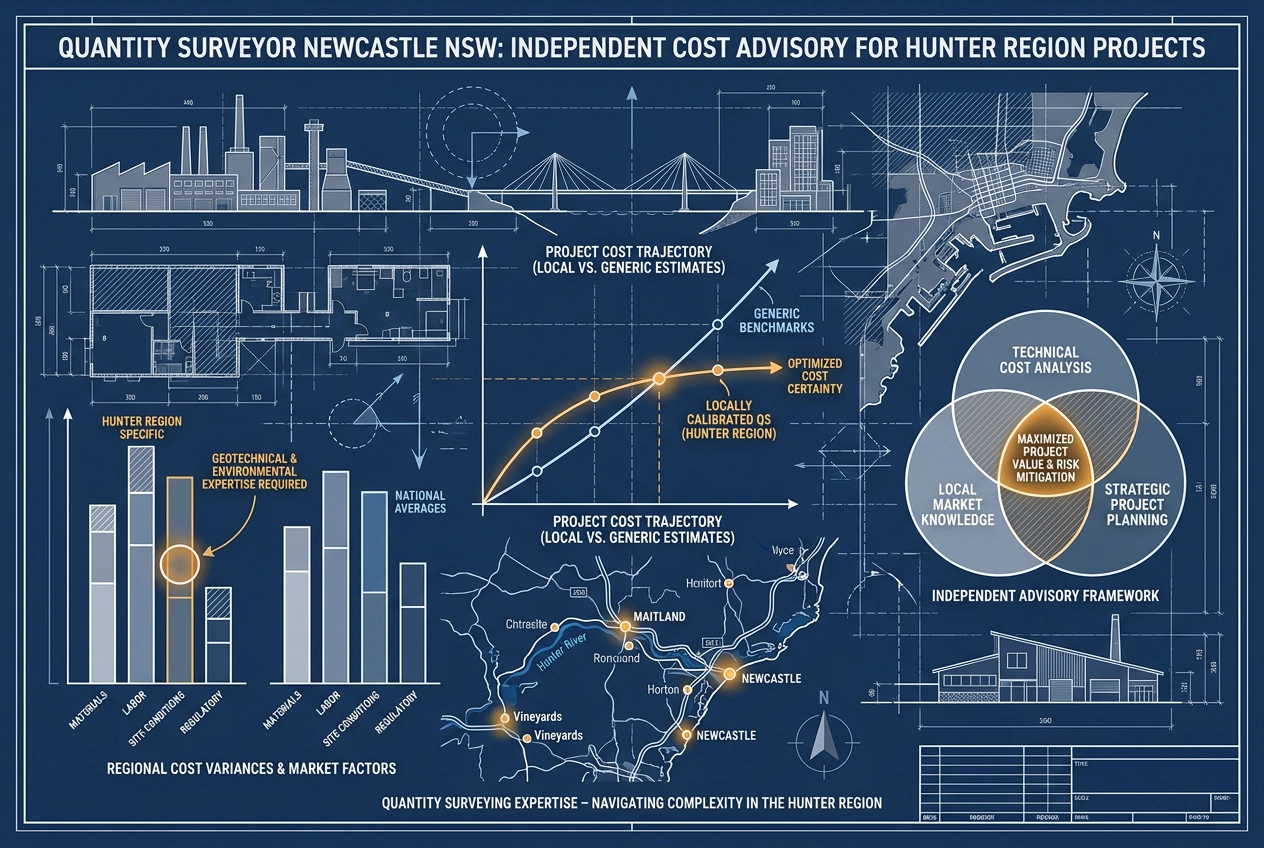
Newcastle's construction market is growing fast, and the cost pressures shaping projects here bear little resemblance to those driving budgets in metropolitan Sydney. Skilled trades are in short supply, contractor pools are shallower, materials freight adds meaningful cost to almost every build, and Hunter councils each bring their own development contributions regimes to the table. For developers, builders, and project owners operating in this region, generic cost advice transposed from a CBD practice can leave significant gaps in budget accuracy and procurement strategy.
Engaging a quantity surveyor Newcastle NSW practitioners and developers can rely on means working with someone who understands these dynamics from the inside, not a firm that occasionally travels north on the Pacific Highway. This post examines what makes the Hunter Region construction market genuinely distinct, why that distinction has real consequences for project cost management, and how independent regional QS expertise delivers better outcomes than metropolitan practices stretched across geography. From skilled labour wage pressures to council planning environments across Hunter local government areas, the analysis that follows makes the case for advice that is calibrated to this market, not borrowed from another one.
The Hunter Region Construction Market Is Not a Smaller Version of Sydney
The Hunter Region is not a smaller, slower version of Sydney's construction market. It operates as a structurally distinct economy with its own cost drivers, procurement culture, and sector dynamics that diverge materially from CBD benchmarks.
Active construction spans residential and mixed-use development, commercial and industrial works, civil and council infrastructure, and mining and resources support. Each sector carries distinct procurement requirements and cost benchmarks. The energy transition is adding further complexity: projects like the Waratah Super Battery at Liddell and the Hunter Energy Hub represent a growing pipeline of industrial and infrastructure construction that sits well outside conventional residential or commercial cost frameworks.
The Hunter Insight Dashboard tracks the region's employment base at approximately 372,000 jobs as of July 2026, with housing prices across the Newcastle Statistical Subdivision rising 12.2% year-on-year to a median of $920,000. These are not Sydney numbers transposed north; they reflect an independent regional cycle.
Sustained quantity surveying recruitment across firms including Lake Macquarie City Council, regional builders, and engineering consultancies confirms both the scale and diversity of regional construction activity. The market supports dedicated, specialist QS capacity because project complexity demands it.
The core risk for developers and builders is straightforward. National practices that apply Sydney cost databases to Hunter Region projects introduce systematic bias. Labour rates, materials pricing, freight allowances, subcontractor availability, and procurement lead times all behave differently in a regional market. For guidance on how construction management in the current NSW market shapes cost outcomes, regional calibration is the starting point, not an optional refinement. Feasibility conclusions built on metropolitan benchmarks frequently do not survive contact with the regional tender market.
Skilled Labour Shortages and Regional Wage Pressures
The cost gap between metropolitan benchmarks and Hunter Region reality is most acute in the labour market. Skilled subcontractors across structural, civil, mechanical, and specialist trades face demand from residential construction, council infrastructure programmes, and resources sector activity, and that overlap is a structural feature of the regional economy that keeps subcontractor books full at rates Sydney cost databases do not reflect.
When cost plans are built from metropolitan rate cards, subcontract labour allowances will be understated before a single tender is returned. The labour cost escalation pressures already evident across NSW are amplified regionally, where the pool of available tradespeople is shallower and competitive tension between projects is correspondingly lower. Nationally, construction and related trades remain on the Occupation Shortage List, confirming that undersupply is systemic, not site-specific.
Where regional subcontractors are unavailable or fully committed, project teams source trade labour from Sydney or interstate. That decision carries mobilisation and accommodation cost loadings that simply do not exist in metropolitan cost plans but can be material line items in a regional project budget.
Competition from mining and resources operations compounds this. The Hunter's energy and resources sector draws qualified tradespeople at premium rates, particularly in mechanical and structural disciplines, placing upward pressure on regional labour costs across construction trades.
A quantity surveyor with direct Newcastle and Hunter Region market exposure prices these realities into the cost plan at feasibility stage. That calibration reduces the risk of subcontract tender returns that exceed an approved budget, which is among the most disruptive and avoidable commercial outcomes on any regional project.
Transport Escalation and Materials Supply Chain Dynamics
Labour cost pressures do not operate in isolation. Materials supply adds a compounding layer of regional cost risk that metropolitan cost models routinely fail to capture.
Bulk materials, structural steel, prefabricated components, and specialist equipment are typically sourced from outside the immediate region, and prudent cost planning should allow for freight, cartage, and delivery coordination costs that are absent from metropolitan rate databases. These loadings are not trivial line items; on larger civil or commercial projects they represent a measurable percentage of total materials cost.
Supplier concentration in regional NSW amplifies the problem. Fewer local distributors mean reduced competitive tension on pricing and longer lead times for specialist procurement.
Cost drivers and escalation in NSW civil engineering projects illustrate how these regional supply chain variables interact with broader escalation risk. When global or national supply disruptions occur, metropolitan projects can typically re-source or substitute materials from a deeper local supplier network. Regional projects generally have fewer alternatives, which can constrain options when supply disruptions occur.
Sound construction cost planning for Hunter Region projects must therefore incorporate realistic freight allowances, delivery scheduling contingencies, and the cost of maintaining larger on-site material buffers. These buffers serve as a hedge against supply chain variability but carry their own holding and management costs.
A quantity surveyor calibrated to the Newcastle and Hunter Region market prices these realities into cost plans from the outset, rather than applying metropolitan materials rates to regional delivery conditions and leaving the difference to emerge at tender.
Contractor Market Depth and Procurement Risk in Regional NSW
In the Hunter Region, the pool of qualified contractors and subcontractors available to price a given package is materially smaller than in Sydney, and for specialist trade categories, structural steel fabrication, mechanical services, civil earthworks with mining-grade equipment, the realistic tender pool may be very limited.
That scarcity has direct commercial consequences. Fewer tenderers means reduced competitive tension, which translates to higher pricing and a greater probability that the procurement outcome reflects a negotiated position rather than genuine market competition. A project budgeted against metropolitan benchmarks, then tendered into a thin regional market, risks producing returns that exceed the approved cost plan.
Procurement strategy must therefore be designed around the market that actually exists, not the depth of competition a Sydney CBD project would attract. Applying open competitive tendering frameworks borrowed from metropolitan practice to a regional project with limited contractor depth often produces poor commercial outcomes: inadequate submissions, non-conforming responses, or tenderers declining to participate altogether.
Alternative approaches, including early contractor engagement, structured pre-qualification frameworks, and phased tender strategies, frequently deliver stronger commercial results in regional markets. Engaging potential contractors before tender issue builds market interest, allows package scope to be tested against available capacity, and reduces the risk of a failed tender round. For specialist packages, negotiated procurement with benchmarked cost validation may be more commercially defensible than a competitive process that attracts only one genuine submission. Effective procurement strategy and tender management in engineering projects requires this kind of market-aware structuring.
Independent construction cost management advice from a QS familiar with Hunter Region contractor capacity allows clients to right-size packages, sequence procurement realistically, and structure contract terms that the regional market will actually respond to.
Council Planning Environments and Development Contributions Across Hunter Councils
Procurement risk does not end with contractor selection. The regulatory and planning environment across Hunter councils introduces a separate layer of cost and programme variability that feasibility studies must address with equal rigour.
Newcastle City Council, Lake Macquarie City Council, and Maitland City Council each administer distinct development contribution frameworks, infrastructure levy structures, and planning approval processes. Newcastle operates both Section 7.11 and Section 7.12 contribution plans, with precinct-specific rates that shift materially between areas. The Broadmeadow Development Contributions Plan proposes contribution rates tied to a precinct requiring significant supporting infrastructure investment, a scale that signals meaningful and ongoing levy exposure for development in that corridor. Critically, Newcastle's transition toward Section 7.11 plans across much of its LGA is projected to collect nearly three times the contribution revenue of its previous Section 7.12 regime, a step-change with direct feasibility implications.
Applying Sydney LGA contribution rates as a proxy for Hunter councils produces unreliable feasibility inputs. Rates, works schedules, nexus requirements, and payment timing all vary by council and by precinct within each council. Planning approval timeframes also differ across the region, directly affecting holding cost calculations and financing assumptions that metropolitan benchmarks cannot replicate.
Environmental and heritage constraints compound this further. Flood planning levels, coastal hazard overlays, and heritage protections apply inconsistently across the Hunter Region, carrying distinct cost consequences for design, compliance, and any remediation scope.
Understanding NSW regulations, market conditions, and procurement frameworks in a regional context is not supplementary knowledge for a Hunter Region feasibility study; it is a prerequisite for producing cost plans that hold up against actual approval conditions and levy obligations.
Why Regional QS Expertise Outperforms a Sydney Firm That Can Travel
That structural bias plays out differently at each stage of the project lifecycle, and regional QS expertise addresses it at every one.
Strong credentials built in Sydney's CBD market do not transfer automatically to regional project advice. The bias introduced by metropolitan cost databases is structural, not incidental, and it compounds across labour, materials, freight, and procurement risk.
Regional QS expertise is calibrated knowledge, not proximity. It means understanding which subcontractor pools are realistically available for specific trade packages, how regional materials pricing behaves under supply pressure, and how local contractor capacity constrains procurement strategy. A cost plan built from that knowledge reflects what the Hunter Region tender market will actually return, rather than what a CBD benchmark database predicts.
That calibration matters across the full project lifecycle. From initial feasibility through cost planning disciplines applied across Sydney's diverse construction market, tendering, contract administration, and progress claim assessment, regional misalignment introduces compounding error at each stage. A budget established against metropolitan benchmarks may diverge materially from regional tender returns, creating risk at the point the investment decision is tested.
Engaging a quantity surveyor with genuine Newcastle and Hunter Region market knowledge addresses this risk at the point where it is cheapest to correct: before commitments are made. That is the practical case for regional expertise over a capable firm that can travel.
Construction Sectors Requiring Regional Cost Advisory in the Hunter Region
Regional cost advisory applies across five distinct sectors active in the Hunter Region, each with its own cost pressures and procurement characteristics.
Residential and mixed-use development across Newcastle, Lake Macquarie, Maitland, and the Hunter growth corridors faces compounding feasibility pressures. Median lot prices in Newcastle and Lake Macquarie reached $565,000 in December 2025, a 10.78% year-on-year increase. Combined with council contribution frameworks that differ materially between local government areas, cost planning must model these variables explicitly rather than borrowing Sydney LGA assumptions.
Civil and council infrastructure works for local government clients, including Lake Macquarie City Council and Maitland City Council, require bills of quantities, procurement strategy, and contract administration calibrated to regional contractor capacity. With the broader construction market contracting, competitive procurement management becomes critical for councils managing constrained capital budgets. The range of infrastructure sub-sectors requiring specialist cost advisory extends well beyond roads and drainage.
Commercial, industrial, and logistics development driven by the Hunter Region's $119.8 billion gross regional product requires feasibility studies and cost plans that reflect regional construction economics. Applying Sydney benchmarks to regional commercial projects will systematically misstate both construction costs and programme risk.
Mining, resources, and energy transition capital works present distinct cost challenges. The Hunter's coal-to-renewables transition, including battery storage and solar PV projects, involves specialist subcontractors and supply chains with significant logistical cost loadings that standard cost models do not capture.
Legacy industrial land remediation and civil upgrades require cost planning that accounts for site-specific contamination risks, specialist contractor availability, and regulatory compliance obligations particular to the Hunter's industrial history.
Engaging Independent QS Advice for Your Hunter Region Project
The question for any Hunter Region developer or builder is when to engage regionally calibrated advice, and the answer is at feasibility, before commitments are made.
Regionally calibrated quantity surveying advice is not a premium service. It is the baseline standard for sound construction cost management on any Hunter Region project. Developers and builders who apply Sydney benchmarks to Newcastle projects are not saving money on advisory fees; they are carrying unquantified cost risk into investment decisions.
For any developer or builder assessing project feasibility, planning a tender programme, or managing construction costs in Newcastle and regional NSW, the practical step is straightforward: engage a quantity surveyor whose advice is grounded in Hunter Region market knowledge, not transposed from a metropolitan practice.
Quantity Surveyors Sydney provides independent cost advisory, construction cost planning, feasibility studies, and contract administration for projects across Newcastle, the Hunter Region, and broader regional NSW. Our work spans civil, commercial, industrial, and resources-related construction; further detail on how we support mining and construction sector clients is available in our overview of how Quantity Surveyors Sydney supports civil mining and construction projects.
To discuss your specific project, contact us directly for independent, regionally focused advice.
Conclusion
Hunter Region projects carry cost pressures that metropolitan benchmarks do not account for, and the right time to address that is before commitments are made.
Contact Quantity Surveyors Sydney today to discuss your Hunter Region project and receive independent, locally informed cost advisory that reflects the market you are actually building in.