
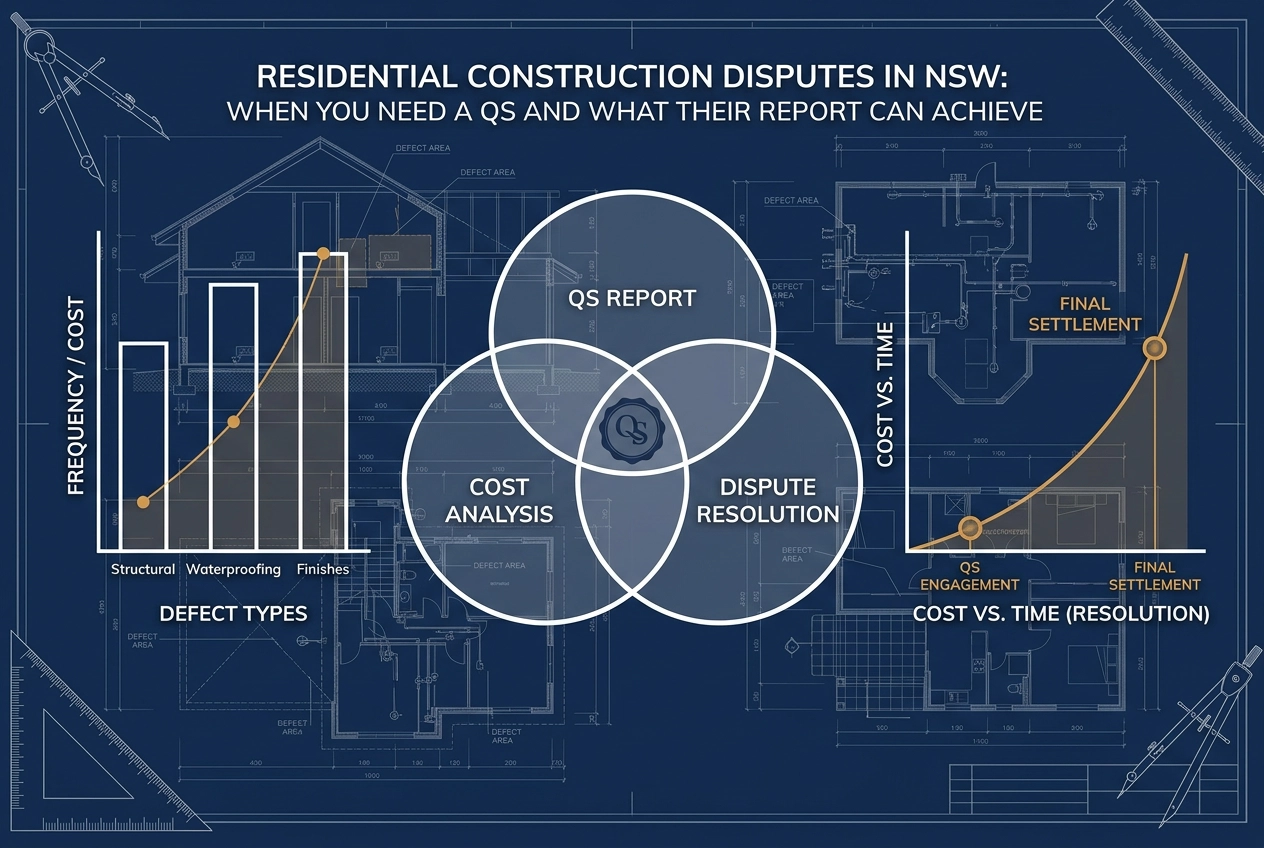
Discovering that your newly built home has serious defects is one of the most stressful experiences a homeowner can face. Whether it is cracked foundations, water ingress, or substandard workmanship, residential construction disputes in NSW can quickly become overwhelming, particularly when you are unsure of your rights or how to build a credible claim.
The good news is that NSW has a structured legal framework designed specifically to protect homeowners and small developers. The NSW Civil and Administrative Tribunal, known as NCAT, provides an accessible pathway to resolution without the complexity and cost of traditional courts. But navigating that pathway successfully often depends on one critical piece of evidence: a professionally prepared Quantity Surveyor cost report.
This guide walks you through everything you need to know, from understanding your rights under the Home Building Act to commissioning a defensible QS report that can anchor your claim. You will learn when to act, what your report must contain, how to use it across different dispute pathways, and whether the investment makes financial sense for your situation. If you are facing a building dispute, this is where to start.
The NSW Framework for Residential Building Disputes
The Home Building Act 1989 (NSW) is the foundation of residential construction law in this state. It governs all residential building contracts, implies statutory warranties into every contract regardless of what the written agreement says, and defines your rights when building work is defective or incomplete. Those warranties apply to any residential building work valued above $5,000, covering new construction, renovations, additions, and repairs.
When disputes cannot be resolved directly, the NSW Civil and Administrative Tribunal (NCAT) Housing and Property division is the dedicated forum. NCAT was designed to be more accessible and less expensive than the court system, making it the practical first choice for homeowners and small developers pursuing defect claims without full legal representation.
Before escalating to NCAT, however, several alternative pathways exist:
Direct negotiation with your builder, using your defect notice as the basis for discussion
NSW Fair Trading mediation, a free government-facilitated process that can resolve disputes before formal proceedings
Builder warranty claims, where the builder's own obligations under the Act require them to rectify defective work
Home Building Compensation Fund (HBCF) insurance claims, available where a licensed builder has become insolvent, died, or disappeared, and the project exceeded $20,000 in value
Each pathway carries different procedural requirements and different standards of evidence. The decision on which route to pursue depends on the nature of the defect, the builder's response to your initial approach, and the total value of your claim. Choosing the wrong pathway, or pursuing pathways in the wrong sequence, can affect both your costs and your prospects of recovery. The question of tribunal vs court jurisdiction becomes relevant if your claim value exceeds NCAT's limits or enforcement becomes necessary.
A quantity surveyor's cost report is relevant evidence across all of these pathways. What changes is the format, level of detail, and degree of formal rigour required. A report prepared for NCAT proceedings must meet a higher evidentiary standard than one prepared to support an initial negotiation. Understanding the pathway first allows the QS to prepare a report that is fit for purpose from the outset.
Understanding Building Defects Under NSW Law
As established under the Home Building Act 1989 (NSW), those statutory warranties require that work is carried out with due care and skill, in accordance with the agreed plans and specifications, and that all materials supplied are suitable and fit for their intended purpose. These protections apply automatically; you do not need to negotiate them.
The Two-Tier Warranty System
NSW law draws a clear line between two categories of defect, and that line has direct consequences for your claim.
Major defects affect significant building elements: structural components, fire safety systems, and waterproofing are frequently cited examples. A six-year statutory warranty period applies to major defects. Other defects, covering finish quality, fixtures, and non-structural elements, carry a two-year warranty period.
The distinction is not cosmetic. A defect classified as minor when it legally qualifies as major may still be claimable years after a two-year claim would have expired, and the rectification cost for a major defect is typically far greater. Misclassification, in either direction, directly affects whether you can claim and how much you can recover.
Where a Quantity Surveyor Fits In
A quantity surveyor does not make legal determinations about defect classification; that is the role of your legal adviser, informed by building inspection evidence and case law. What the QS does is cost the rectification work within whatever scope the legal characterisation defines. If your adviser is advancing a case based on major defects, the QS report must price the work on that basis, accurately and in sufficient detail to withstand challenge.
A report that prices defect rectification work loosely, or conflates major and minor defect scopes, creates problems at tribunal that are difficult to fix later.
Defect Categories That Generate Significant Claims
Defects involving waterproofing, structural elements, and roofing are among those that commonly generate significant claims, though the full range of claimable defects is defined by the statutory warranty scope rather than any fixed list. Each of these requires scope-specific costing; a single line estimate does not reflect the staged access, specialist trades, and consequential damage typically involved.
Understanding how building defects interact with insurance obligations and cost assessment is also relevant for homeowners who may face parallel insurance or warranty processes alongside a direct dispute.
Statutory Periods and the Defect Notice: Why Timing Is Critical
Knowing your defect classification is only half the battle. The other half is acting before the clock runs out.
Under the Home Building Act 1989 (NSW), both warranty periods, six years for major defects and two years for other defects, run from the date of completion of the building work or, in some cases, from the date an occupation certificate is issued. These can differ. If your project involved staged construction or a strata arrangement, the trigger date requires careful confirmation before you commission any professional report or issue any formal notice.
Issuing a defect notice is not optional procedure; it is a rights-preserving step. The notice should identify each defect specifically, reference the applicable statutory warranty, and give your builder a reasonable opportunity to rectify before you escalate. Think of it as the formal record that your claim existed within the warranty period and that the builder was given the chance to respond.
The quality of that notice matters. A vague description such as "water damage to ground floor" gives a builder room to dispute scope and severity. A notice informed by a preliminary building inspection, one that identifies the location, extent, and likely cause of each defect, is far harder to dismiss. It also sets the scope that a quantity surveyor will later price, so imprecision at the notice stage creates ambiguity in the cost report.
If your builder ignores the notice, responds inadequately, or contests the defects entirely, that non-response is typically the trigger for formal dispute resolution. It is also the point at which QS engagement becomes necessary, because quantifying the rectification cost moves from a negotiating tool to an evidentiary requirement.
One point that homeowners sometimes underestimate: the statutory deadline is absolute. A claim lodged after the relevant warranty period has expired will generally not succeed, regardless of how severe the defect is or how compelling your evidence. If you are uncertain whether you are within time, seek legal advice and commence documentation immediately. Delay carries real risk.
For those who purchased a property with pre-existing defects, the question of when the warranty period commenced can be genuinely contested. The trigger date is fixed by statute at completion or occupation certificate, not at the point you discovered the defect. This timing gap is a recognised complexity, particularly in strata and multi-residential projects where ownership changes hands after practical completion. Regardless of when the dispute crystallises, QS evidence quantifying the defect remains essential.
When to Commission a Quantity Surveyor in a Residential Dispute
Once you have issued a defect notice and the builder's response leaves the dispute unresolved, the question becomes not whether to engage a quantity surveyor, but when. The answer is earlier than most homeowners act.
The most common mistake is waiting until legal proceedings have commenced before commissioning a QS report. By that point, legal costs are already accumulating and the quantum of the claim remains unresolved, which is precisely what a QS can fix quickly. Engaging a QS at the defect notice stage, or when initial negotiations break down, produces better outcomes and keeps total dispute costs lower.
Four indicators that QS engagement is warranted:
Your builder has disputed your cost estimates or produced their own lower figure
The defects span multiple trades or the likely claim value is substantial relative to the cost of a professional report (complexity and scope matter more than a fixed dollar figure)
The defects span multiple trades or building systems requiring coordinated scope assessment
The matter is heading toward NCAT
Where defects are scattered across a large home or development, a QS provides the only reliable method of producing a defensible, itemised cost schedule that separates each defect, its rectification methodology, and its associated cost. A rough estimate will not survive scrutiny at tribunal; a structured QS report will.
Early engagement also reduces legal costs directly. When the quantum is established from the outset, negotiations are more focused, mediation is more likely to resolve the matter without proceeding further, and your legal adviser spends less time on cost quantification issues that the QS has already resolved. For practical guidance on the right moment to bring in a quantity surveyor, see when to engage a quantity surveyor: a practical guide for clients.
If you have already obtained a building inspection report, you have the scope input a QS needs. The two roles are complementary. The building inspector identifies and describes the defects; the QS costs the work required to fix them. There is no duplication, only a logical sequence.
Small developers managing defect disputes across multiple lots or units should engage a QS earlier than an individual homeowner would. Compounding claim values and the need for consistent cost methodology across a development make early, coordinated QS involvement a practical necessity rather than an optional step.
What a Defensible QS Defect Rectification Report Must Contain
Once you have engaged a QS, the value of their involvement depends entirely on the quality of the report they produce. A rough estimate or a one-page summary will not survive scrutiny at NCAT. The opposing party, their experts, and the tribunal member will all examine the document closely, and any gap in methodology or pricing basis will be used to challenge the figures. A defensible report is a structured, itemised document built to withstand that challenge.
Cross-referencing defects to the inspection report
Every defect being costed must be clearly identified in the report and cross-referenced to the building inspection report or defect schedule. This linkage removes any ambiguity about what is being claimed. If the inspection report identifies cracking to the balcony waterproofing membrane as item 7, the QS report should price that rectification as a discrete line item tied to item 7, not absorbed into a generalised waterproofing allowance. Unambiguous scope linkage prevents the opposing party from arguing that the costs claimed go beyond the defects identified.
Transparent costing methodology
Each line item must show its working. The scope of work, the method of rectification, the quantities measured, and the unit rates applied should all be visible and auditable. A lump sum with no derivation is almost impossible to defend and easy to attack. If rectifying a defective bathroom waterproofing installation requires tile removal, membrane replacement, and retiling across 12 square metres, the report should say exactly that, with quantities and rates set out separately so any reviewer can follow the arithmetic.
Current, substantiated pricing
Rates must reflect the current Sydney or regional NSW market. The QS should support their pricing by reference to industry pricing guides, recent subcontractor quotes, supplier schedules, or their own database of comparable recent work. Rates that appear outdated or unsupported will be challenged, and a tribunal member cannot accept figures that have no evidential basis. For frequently asked questions about how QS pricing is established and what sources are typically used, that resource covers the methodology in plain terms.
Preliminaries, overheads, margin, and GST
These components must appear as separate, identified items, not buried in trade rates. Preliminaries cover site establishment, protection works, and supervision; contractor overheads and margin reflect the legitimate cost of engaging a building contractor rather than individual tradespeople. GST is a real cost to the homeowner. Each of these items is routinely contested, and their correct inclusion can add materially to the total claim.
Phased or staged rectification
Where defect rectification work requires staged access, such as waterproofing in an occupied building, the report should include methodology notes explaining why the approach costed is reasonable. This matters because the builder may argue that a cheaper single-access method was available; the QS needs to pre-empt that argument with a reasoned explanation.
Reliance and assumptions
Where the QS has relied on the building inspector's description of a defect, that reliance should be stated explicitly. Where the full extent of damage cannot be confirmed without invasive investigation, the QS should flag those items as subject to review once access is available, rather than presenting uncertain figures as fixed costs.
How to Use Your QS Report Across Different Dispute Pathways
Once your report is prepared to the standard described above, how you deploy it determines how much of its value you actually recover.
In NCAT proceedings, the QS report functions as expert evidence on quantum. NCAT's Procedural Direction 3 applies specifically to Home Building Act claims exceeding $30,000, and under that framework the tribunal relies on expert evidence to determine technical matters it cannot resolve from the parties' submissions alone. The tribunal cannot award costs it cannot verify; a methodologically transparent QS report provides that verification, and in many cases it is the primary document on which a damages award is based. The QS's paramount duty in this context is to the tribunal, not to the engaging party, and the report must reflect that independence throughout.
At mediation and in direct negotiation, the report shifts your position materially. Builders and their insurers are far more likely to settle at a realistic figure when confronted with a professionally prepared, itemised cost schedule. A vague claim invites a low counter-offer; a schedule they cannot credibly dismiss does not.
For Home Building Compensation Fund (HBCF) claims, which arise when a builder becomes insolvent, dies, or disappears, the insurer will conduct its own assessment. An independent QS report establishes your position before that process begins, and prevents the insurer from undervaluing the claim without a reasoned basis for doing so. Without it, you are responding to their figure rather than defending your own.
Where the builder submits a competing estimate, the QS report serves as an independent counterpoint. A builder's self-assessed rectification cost carries obvious credibility problems; the tribunal will generally prefer a report that shows its methodology over one that does not.
Beyond NCAT, the report retains utility. If the claim value exceeds the tribunal's jurisdiction, or if enforcement of an NCAT order requires escalation to the Supreme Court or District Court, the same QS report supports those proceedings without requiring a new engagement.
Where the dispute resolves before any hearing, the QS report provides the settlement sum and can be incorporated directly into a deed of settlement to define the scope of rectification work the builder is required to perform. This prevents later disputes about what was agreed. For guidance on gathering the supporting documentation that underpins all of these pathways, the introduction to collecting evidence for construction claims sets out the foundational steps.
Cost vs Claim Value: When a QS Report Makes Financial Sense
Knowing a QS report can be used across multiple dispute pathways is useful; knowing whether commissioning one makes financial sense for your specific situation is the practical question that follows.
QS fees for a residential defect rectification report in Sydney vary with the scope of work. A straightforward single-trade claim, such as defective tiling in a bathroom, costs less to quantify than a multi-trade report covering waterproofing, structural cracking, and substandard electrical work across a large home. The level of detail required for NCAT also affects the fee, since a tribunal-ready report demands more rigour than an informal assessment.
As a general principle, QS engagement becomes financially justified when the claim value is likely to exceed the report fee by a meaningful multiple. For most residential disputes, claim value should be weighed against report scope and complexity, a matter your QS can advise on during an initial consultation. For any matter heading to NCAT, professional quantification is almost always worthwhile regardless of claim size, because the tribunal bases its award on the evidence presented, not on what rectification actually costs.
That last point matters. Homeowners who proceed to NCAT without professional cost evidence risk receiving an award well below actual rectification costs, simply because the tribunal cannot justify a higher figure from the material before it. The cost of not obtaining a QS report can significantly exceed the report fee itself.
For small developers managing defect management obligations across a residential project, the calculus is straightforward. QS engagement is not an extraordinary expense; it is a standard project cost that sits within the defect liability budget, allocated against the same line items as other dispute management activities.
There is also an indirect cost to prolonged disputes that is easy to overlook. Unresolved residential construction disputes affect your ability to sell, refinance, or occupy a property. A QS report that accelerates settlement or strengthens your NCAT position has value beyond the claim sum recovered.
If you are unsure whether your claim justifies a full NCAT-ready report, a preliminary QS assessment is a cost-effective starting point. This shorter, less formal document establishes indicative claim value and informs the decision on whether to escalate, without committing to the full cost of a comprehensive expert report. For answers to common questions about fees and scope, the frequently asked questions on QS costs in Sydney is a useful reference before your initial consultation.
Working With a QS on a Residential Dispute: What to Expect
Once you have decided a QS report is the right investment, understanding the engagement process helps you move efficiently and avoid delays that can harm your position.
The process begins with an initial consultation. The QS will review the nature of your dispute, the defects identified, and the documentation you have available, then scope the report and provide a fee estimate before formal engagement begins. Come prepared with as much as you have.
What Documents to Gather
To produce a defensible report, the QS will need:
The building contract and any signed variations
Approved plans and specifications
The building inspection or defect report
The defect notice issued to your builder
All correspondence with the builder about the defects
Missing documents slow the process. Gathering these before your first meeting reduces back-and-forth and keeps the engagement on track.
The Site Inspection
A site inspection is standard. The QS needs to observe the defects directly, confirm the scope described in the inspection report, take measurements, and assess any access constraints that affect how rectification work would be carried out and what it will cost. Photographs and measurements taken on site are part of what makes the report defensible.
Timeline and Specialist Coordination
Allow several weeks from engagement to delivery of a completed report. Complexity and document availability are the main variables. Do not wait until a filing deadline is imminent; a report prepared under time pressure is more likely to contain gaps that the opposing party can exploit.
The QS may also need to liaise with your building inspector, structural engineer, or other specialists. This coordination is normal. It ensures the cost report accurately reflects the full rectification scope recommended by each expert, rather than costing a narrower scope that leaves items unclaimed.
Report Structure and Defensibility
A defensible report does more than list costs. Each item must be traceable from the defect identified in the inspection report through the rectification methodology to the final cost figure. For disputes exceeding $30,000, expert evidence is mandatory in NCAT proceedings under the Home Building Act, and the QS may be required to appear and give oral evidence on their findings. Clarify this possibility at the outset so that the engagement scope and fee reflect it. For answers to common procedural questions, the frequently asked questions on advanced QS dispute resolution techniques covers this and related matters in more detail.
Taking the Next Step in Your Residential Building Dispute
Once your QS has delivered the report and you understand how it will be used, the pathway forward is clear.
Document your defects thoroughly, issue a formal defect notice to your builder, engage a QS early to quantify the claim, then use the report across whichever dispute pathway applies, whether that is NCAT, mediation, an HBCF insurance claim, or negotiated settlement.
As covered above, NCAT, builders, and insurers all respond differently to a professionally prepared, itemised report, and in each case, having one materially strengthens your position.
Timing is the variable you control most. Statutory warranty periods under the Home Building Act 1989 (NSW) are fixed. A major defect claim outside the six-year period is generally unrecoverable, regardless of how serious the defect is or how strong your evidence might be. Early professional engagement does two things: it preserves your legal rights, and it improves your prospects of resolving the dispute efficiently, before costs escalate on both sides.
Quantity Surveyors Sydney prepares independent defect rectification costing reports for homeowners and residential developers across NSW. Our reports are prepared to the evidentiary standard required for NCAT proceedings and other formal dispute resolution forums, with transparent methodology, current market pricing, and clear linkage to the defect scope.
If you have identified defects and are unsure where to start, contact our team for an initial assessment.
Conclusion
The case for early, professional QS engagement rests on four fixed points established throughout this guide: statutory periods are non-negotiable; the report is frequently the deciding evidence; early action reduces total costs; and the report must meet the evidentiary standard of the forum. Commission one prepared to that standard.
Quantity Surveyors Sydney is ready to help. Contact our team today for an initial assessment and take the first concrete step toward resolving your dispute with confidence.