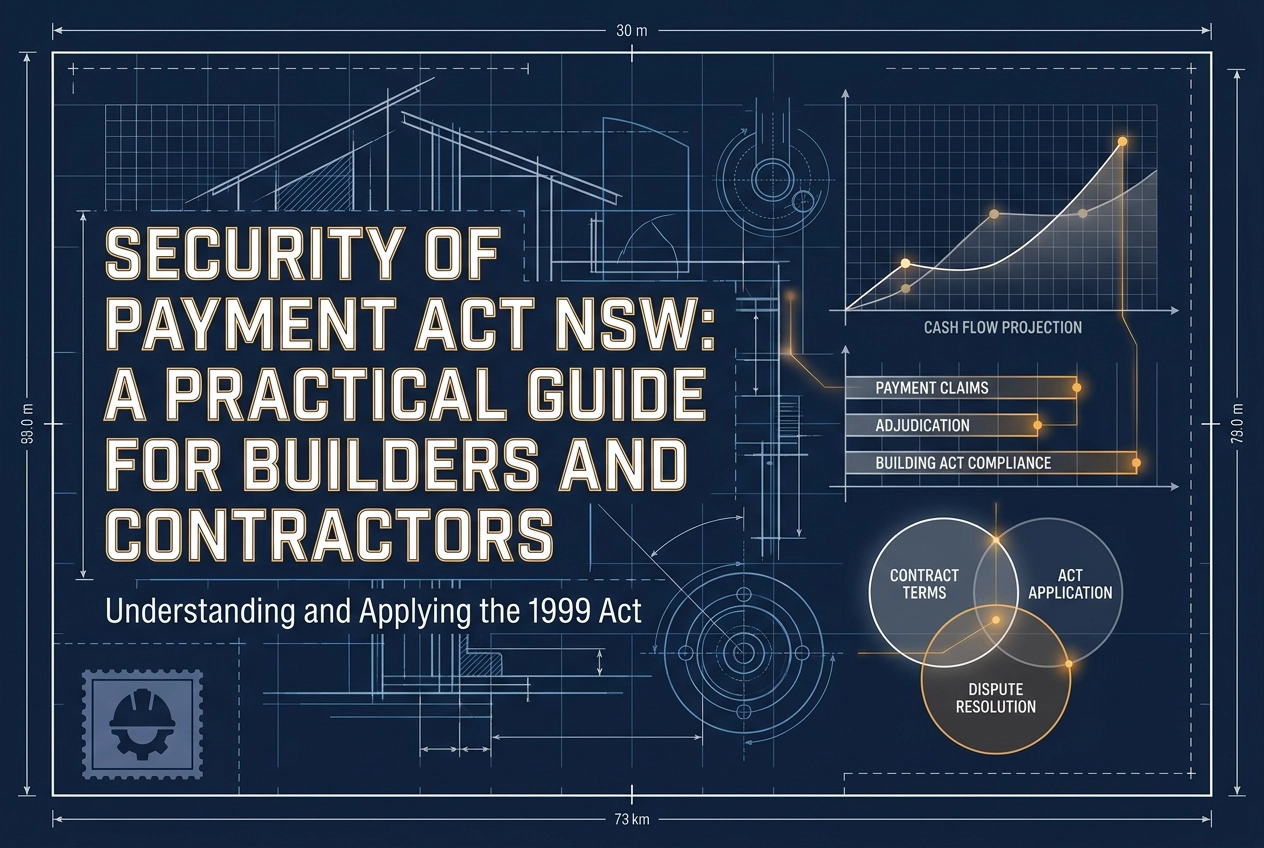
Getting paid on time should be straightforward, but in the construction industry, delayed or disputed payments can threaten the survival of even the most established businesses. That is where the Security of Payment Act NSW becomes one of the most powerful tools available to builders, subcontractors, and suppliers working across New South Wales.
Formally known as the Building and Construction Industry Security of Payment Act 1999, this legislation was designed to keep money flowing through the construction supply chain by giving contractors a fast and enforceable pathway to recover unpaid progress claims. Yet despite its significance, many in the industry either underuse it or misapply it entirely.
This guide cuts through the complexity. Whether you are lodging your first payment claim or navigating a formal adjudication dispute, you will walk away with a clear understanding of how the Act works, what your obligations are, and exactly how to protect your right to payment at every stage of a project. Let this be your practical reference point for getting the most out of this critical piece of legislation.
What Is the Building and Construction Industry Security of Payment Act 1999 (NSW)?
The Building and Construction Industry Security of Payment Act 1999 (NSW), formally Act No 46 of 1999, is the governing legislation that regulates progress payment entitlements across the NSW construction industry. The Act is currently in force, and practitioners must be aware that its most significant amendments apply to construction contracts entered into after 21 October 2019. The contract date therefore functions as a critical threshold when assessing which procedural rules govern a payment dispute.
The Act's stated legislative object is straightforward but far-reaching: to ensure that parties who carry out construction work, or supply related goods and services under a construction contract, are entitled to and can recover progress payments. This cash flow protection operates on an interim basis, giving successful claimants the liquidity to continue operating while any final contractual or legal determination remains pending.
Critically, the Act creates statutory rights to progress payments that function entirely independently of contract terms. Parties cannot contract out of the Act's protections, and provisions that attempt to make payment conditional on a head contractor first receiving funds from the principal are rendered void under section 12. This prohibition on "pay when paid" clauses is a cornerstone protection for subcontractors and suppliers throughout the contractual chain.
The legislation applies broadly across commercial, industrial, civil, and infrastructure projects in NSW. It covers head contractors, subcontractors, materials suppliers, hire companies, and consultants providing construction-related services including engineering, contract administration, and project management. Informal arrangements, including those made verbally or by text message, are also captured. A thorough understanding of the Act's scope forms the essential foundation for every payment claim, adjudication application, and commercial dispute resolution strategy undertaken on NSW construction and infrastructure projects.
What Construction Work and Contracts Does the Act Cover?
The Building and Construction Industry Security of Payment Act 1999 (NSW) applies to a deliberately broad range of construction activities and contractual arrangements. Understanding the precise scope of coverage is an essential first step before serving a payment claim or responding to one.
Section 5 defines "construction work" expansively, capturing building, civil, engineering, and infrastructure works across the full physical lifecycle of a project. This includes the construction, alteration, repair, restoration, maintenance, and demolition of structures, as well as associated site preparation, excavation, and installation of services. The breadth of this definition is intentional; it reflects the legislature's intent to protect cash flow across the entire spectrum of physical construction activity, from early civil works through to final site remediation and demolition.
Section 6 extends the Act's reach beyond parties performing physical work. The supply of related goods and services provided under a construction contract is also covered. This includes the supply of materials and plant, and critically, professional services such as architectural, design, engineering, and quantity surveying services. Consultants and suppliers are therefore potential claimants under the Act, not only head contractors and subcontractors performing on-site construction.
Geographically, the Act applies to contracts entered into in NSW, or where the construction work is physically carried out in NSW, regardless of where the contract was formally executed. This captures the majority of commercial construction contracts operating within the state.
Contracts entered into after 21 October 2019 are governed by updated procedural timelines and obligations introduced by the 2018 amendments, and this framework remains operative as of 2026.
Not all contracts fall within scope. The most commonly encountered exclusion applies to residential building work carried out for an owner who resides, or intends to reside, at the premises. Additional exclusions exist and should be carefully reviewed. Confirming whether a contract falls within the Act's coverage before serving a payment claim is a critical threshold step; proceeding on an out-of-scope contract can invalidate the entire claim.
Key Rights and Protections the Act Creates
Part 2 of the Act, spanning sections 8 through 12A, establishes the core statutory rights that underpin the entire security of payment framework in NSW. Understanding these rights is essential for any party operating under a construction contract, whether as a principal, head contractor, subcontractor, or supplier.
Statutory Entitlement to Progress Payments
Section 8 creates a statutory right to progress payments that exists independently of any contractual arrangement. The entitlement arises on and from each reference date specified in the contract. Where the contract is silent on reference dates, the default position activates automatically: the entitlement arises on and from the last day of each month in which construction work is carried out or related goods and services are supplied. This default mechanism ensures that parties cannot be deprived of a recurring payment entitlement simply because a contract is poorly drafted or deliberately vague on payment timing.
Prohibition on 'Pay When Paid' Provisions
Section 12 expressly voids any contractual term that makes a party's payment obligation conditional on that party first receiving payment from someone above them in the contractual chain. A head contractor cannot lawfully withhold payment from a subcontractor on the basis that the principal has not yet paid the head contractor. This protection is particularly significant on large, multi-tiered infrastructure and civil projects, where upstream insolvency or payment disputes would otherwise cascade downward, leaving subcontractors and suppliers exposed through no fault of their own.
Retention Money Trust Account Obligations
Section 12A requires head contractors to hold retention money withheld from subcontractors in a designated trust account. This provision directly addresses the historically significant risk of subcontractors losing retained funds when a head contractor becomes insolvent. Compliance with these trust obligations remains an area of active regulatory attention, and head contractors should treat s.12A as a non-negotiable compliance requirement rather than an administrative formality.
Protections as Statutory Minimums
The Act's protections function as a statutory floor. Any contractual term that attempts to diminish, exclude, or reduce the rights the Act confers is rendered void to the extent of the inconsistency. Regardless of how a construction contract is negotiated or drafted, claimants retain the minimum entitlements Parliament has established. Parties with superior bargaining power cannot draft away these protections, which is precisely the legislative intent. Collectively, these rights address the structural power imbalance that historically disadvantaged subcontractors and suppliers throughout construction payment chains, providing practical and enforceable mechanisms that do not require costly litigation to activate.
The NSW Security of Payment Process — Step by Step
Understanding the five procedural steps under the Act is essential for any party operating in the NSW construction industry. Whether you are a contractor pursuing an unpaid progress claim or a principal managing your exposure as a respondent, procedural compliance at each stage directly determines your rights and remedies.
Step 1: Preparing and Serving a Payment Claim
The process begins when the claimant serves a payment claim on the respondent on or after a reference date. The reference date is the trigger point that establishes when a claim can validly be made, typically arising at the end of each month or at a milestone identified in the contract. The payment claim must identify the construction work or related goods and services to which it relates, state the amount claimed, and include a statement that the claim is made under the Act. Head contractors carry an additional obligation: they must attach a supporting statement confirming that all subcontractors have been paid amounts owing to them. Failure to include this supporting statement exposes the head contractor to potential penalties and can affect the validity of the claim itself.
Step 2: The Respondent's Payment Schedule
Upon receiving a valid payment claim, the respondent must serve a payment schedule within 10 business days for contracts entered into after October 2019. The schedule must identify the scheduled amount the respondent proposes to pay and, where that amount is less than the claimed amount, provide reasons for the difference. The consequences of failing to serve a payment schedule within time are serious: the respondent becomes liable for the full claimed amount and, critically, loses the right to raise defences or counterclaims in any subsequent adjudication or enforcement proceedings. This is one of the most significant procedural risks under the Act for respondents.
Step 3: Lodging an Adjudication Application
Where the respondent fails to pay the scheduled amount, serves a payment schedule for less than the claimed amount, or serves no payment schedule at all, the claimant may lodge an adjudication application with an Authorised Nominating Authority. Applications must be lodged within strict prescribed timeframes that vary depending on which of those circumstances applies. Missing these windows extinguishes the claimant's right to adjudication on that claim.
Step 4: Adjudication Determination
The ANA appoints a qualified, independent adjudicator who considers the application, any adjudication response submitted by the respondent, and all supporting material. The adjudicator must deliver a determination within statutory timeframes, typically 10 business days, extendable to 15 business days with the parties' consent. The determination sets the adjudicated amount, is binding on both parties, and is enforceable as a judgment debt. Importantly, the determination provides interim relief rather than a final resolution of the underlying contractual dispute, meaning parties retain the right to pursue final resolution through arbitration or litigation.
Step 5: Enforcement
Once a determination is made, the claimant may obtain an adjudication certificate and file it as a judgment in a court of competent jurisdiction. This enforcement pathway, explained further in the NSW adjudication framework published by Adjudicate Today, means the claimant does not need to re-litigate payment entitlement. The entire process, from serving a payment claim through to an enforceable judgment, typically takes approximately 6 to 10 weeks, compared to 12 months or more for conventional litigation. That speed and enforceability is precisely why the Act remains a critical commercial tool for contractors, subcontractors, and suppliers managing cash flow on infrastructure and construction projects throughout NSW.
Head Contractor Obligations: Supporting Statements and Retention Money
Beyond the procedural steps covered earlier, the Act imposes two specific compliance obligations that fall exclusively on head contractors and carry significant legal consequences if ignored.
Supporting Statement Requirement
When a head contractor serves a payment claim on a principal, the Act requires that a supporting statement in the prescribed form must accompany that claim. The supporting statement must either declare that all subcontractors have been paid every amount that has become due and payable under their respective subcontracts, or specifically disclose any amounts that remain outstanding. This obligation applies only to head contractors serving claims upward on principals; it does not extend to subcontractors making claims against head contractors.
The prescribed form requirement is strict. A general written declaration is insufficient; the form set out under the Building and Construction Industry Security of Payment Regulation 2020 (NSW) must be used. The supporting statement functions as a transparency mechanism, requiring head contractors to actively certify their downstream payment conduct at every payment cycle rather than allowing issues to remain undisclosed until a dispute arises.
Serving a payment claim on a principal without the required supporting statement, or providing a false or misleading supporting statement, constitutes a criminal offence under the Act. The consequences are material: a defective or missing supporting statement can invalidate the payment claim itself, disrupting the head contractor's adjudication rights and cash flow. A false declaration creates direct criminal exposure, not merely civil liability. Principals who identify a missing or defective statement may legitimately dispute the validity of the claim. These obligations were strengthened by the amendments to the Building and Construction Industry Security of Payment Act 1999 (NSW) that commenced on 21 October 2019.
Retention Money Trust Account Obligations
Section 12A of the Act requires head contractors to deposit retention money withheld from subcontractors into a dedicated trust account, entirely separate from general operating funds. The account must be held with an authorised deposit-taking institution, and the legislative intent is unambiguous: retention money belongs beneficially to the subcontractor until the contractual conditions for its release are satisfied. It must not be accessible to the head contractor's creditors or treated as working capital.
Head contractors carry specific record-keeping obligations, including maintaining accurate records of deposits, withdrawals, and the balance attributable to each subcontractor. Subcontractors have a statutory right to request information about the trust account held on their behalf. Failure to respond accurately and promptly creates regulatory exposure and potential civil liability, particularly where retention money has not been properly quarantined and the head contractor subsequently becomes insolvent.
For head contractors operating across commercial and infrastructure projects in NSW, supporting statement compliance and retention trust management should be treated as standing internal obligations embedded within project commercial processes, not as administrative formalities to be addressed reactively.
Common Pitfalls for Claimants and Respondents
Procedural errors under the Act are disproportionately costly relative to the effort required to avoid them. Both claimants and respondents frequently underestimate how little margin for error the legislation provides, and a single misstep can be determinative regardless of the underlying commercial merits of a position.
Timing errors represent the most common category of failure. A payment claim served before a reference date has arisen is simply not valid under the Act and will not engage the statutory machinery. Equally, claimants who miss the adjudication application window lose the right to adjudicate that particular claim entirely; the window cannot be reopened. For respondents, the payment schedule deadline operates as an absolute cutoff. Failing to serve a compliant payment schedule within the prescribed period removes the right to contest the claimed amount in adjudication, and the full sum becomes recoverable as a statutory debt through the courts. These deadlines should be identified and diarised the moment a claim is received.
Deficient payment claims present a separate but related risk. A claim that fails to clearly identify the construction work, reference the relevant reference date, or include the required statutory endorsement that the claim is made under the Act may be found not to constitute a valid payment claim at all. Where that occurs, the adjudicator has no jurisdiction to determine the dispute, and any purported determination may be void. Claimants should treat every element of a payment claim as a compliance exercise, not a commercial document alone.
Inadequate substantiation at adjudication is a persistent problem, particularly for claims involving variations, delay costs, or disputed quantities. Adjudicators can only assess what is placed before them; a claim with weak valuation evidence will often yield a lower determination than the underlying entitlement would support.
Attempts to re-serve a defective claim introduce further complications. Because claimants are entitled to only one payment claim per reference date, and reference dates once consumed cannot be reused, attempting to re-serve risks exhausting an entitlement without achieving a valid claim. As adjudicate.com.au's Security of Payment Guide 2026 makes clear, the Act rewards preparation and penalises improvisation. Specialist advice should be obtained at the first sign of a procedural complication, not after an error has already taken effect.
Jurisdictional Challenges and Court Review of Adjudication Determinations
Adjudication determinations under the Act are not final in the same way as court judgments. A respondent who considers a determination flawed retains the right to challenge it in the NSW Supreme Court, but only on limited and well-defined grounds. The three recognised bases for judicial review are jurisdictional error, denial of natural justice, and failure by the adjudicator to comply with the Act's requirements. These are not broad merits-based appeals; courts will not simply substitute their own view of the correct outcome for that of the adjudicator.
What Constitutes a Jurisdictional Error
A jurisdictional error arises where the adjudicator acts beyond the scope of their statutory authority. Because an adjudicator's power is entirely derived from and constrained by the Act, any purported determination made without a valid jurisdictional foundation is void rather than merely voidable. Common examples include determining a claim that does not arise under a valid construction contract, or proceeding on the basis of a payment claim that was invalid on its face due to non-compliance with the Act's formal or timing requirements. As confirmed by the DLA Piper security of payment overview for Australia, the NSW Act operates within a strict procedural framework where each step in the process must independently satisfy statutory requirements.
Limits on Re-Running a Failed Adjudication
A critical and often misunderstood consequence of jurisdictional error concerns whether a claimant can simply lodge a fresh adjudication application after the first was set aside. NSW courts have developed meaningful limits on this approach. Where the underlying payment claim was itself invalid, a subsequent adjudication application built on that same defective foundation will not be competent. Not every procedural defect can be cured by starting again; the validity of the payment claim, the construction contract, and the adjudication application must each be established independently.
Interim Nature and Preserved Legal Rights
Courts have consistently affirmed the Act's interim character. A successful adjudication determination does not permanently extinguish the parties' underlying contractual or legal rights. Parties retain full entitlement to pursue final resolution of payment disputes through arbitration or litigation, notwithstanding any adjudication outcome. This design principle distinguishes SOP adjudication from binding arbitral awards and reinforces that the Act is a cash flow protection mechanism, not a final dispute resolution forum.
The growing body of NSW case law on jurisdictional errors, including landmark decisions such as Brodyn Pty Ltd v Davenport [2004] and Chase Oyster Bar Pty Ltd v Hamo Industries Pty Ltd [2010], underscores a consistent judicial message: procedural precision from claim preparation through to adjudication application is not optional. Every upstream failure carries the potential to invalidate every downstream step in the chain.
The Quantity Surveyor's Role in Security of Payment Claims
A quantity surveyor plays a central role in preparing and substantiating payment claims under the Security of Payment Act NSW. Where payment disputes arise, the quality and structure of the evidence presented is often the determining factor in adjudication outcomes. An independently prepared QS valuation provides precisely what the Act demands: a methodologically sound, contractually referenced assessment of work completed, variations, preliminaries, and materials on site that is credible, transparent, and capable of withstanding scrutiny.
Preparing and Substantiating Payment Claims
Progress claim assessment is a core quantity surveying service, and one that is particularly valuable in the context of SOP proceedings. An experienced quantity surveyor can independently assess the value of work completed to date, identify and quantify each claimed item against the contract and supporting documentation, and structure the claim in a form that is clear, defensible, and consistent with contract requirements. Because payment claims under the Act are locked on issue and cannot be revised once served, accuracy from the outset is critical. A professionally prepared valuation removes the ambiguity that respondents can exploit when formulating grounds for withholding payment.
As 10 Things Every Construction Industry Player Must Know notes, general understanding of how the legislation operates remains poorly understood across much of the industry, and claims are frequently built on a strategy of the other party being unprepared. Independent QS involvement directly counteracts that risk.
Supporting Respondents with Payment Schedules
For respondents, the consequences of a deficient or absent payment schedule are severe. A quantity surveyor can independently assess the claimed amount, identify which items are accepted, disputed, or subject to legitimate deduction, and provide a reasoned valuation that supports the respondent's position comprehensively. Since reasons not raised in the payment schedule cannot be introduced at adjudication, the schedule must be complete and technically substantiated from the moment it is served.
Strengthening Adjudication Submissions
In adjudication, an independently prepared QS valuation provides the adjudicator with structured, evidence-based cost data under the framework established by Section 10 of the Act. This materially strengthens the credibility of a submission relative to claims supported only by internal records or contractor-prepared schedules.
Quantity Surveyors Sydney provides independent progress claim assessment, contract administration, and commercial management services across commercial, industrial, and infrastructure projects throughout NSW, supporting both claimants and respondents in preparing technically sound and procedurally compliant SOP submissions.
NSW Security of Payment Compliance Checklist for Builders and Contractors
The following checklist consolidates the critical compliance obligations covered throughout this guide into a practical reference for builders, contractors, and subcontractors operating under the Act in NSW.
Before Serving a Payment Claim
Confirm that a reference date has arisen under your contract before serving any payment claim. Verify that the contract is a construction contract within the Act's scope, as certain contracts may fall outside the statutory regime. The claim must identify the construction work or related goods and services to which it relates, state the claimed amount, and include the mandatory statutory endorsement confirming it is made under the Act. Omitting that endorsement means the Act will not engage, and the entire downstream process collapses. Only one payment claim may be served per reference date period.
Head Contractors: Supporting Statement and Retention Trust
If you are a head contractor serving a payment claim on a principal, you must attach a completed supporting statement in the prescribed form. That statement must confirm either that all subcontractors have been paid or disclose any outstanding amounts owed. Separately, any retention money held under the contract must be deposited in a compliant trust account. This obligation applies independently of any payment dispute and cannot be deferred until a problem arises. Refer to NSW Fair Trading's guidance on security of payment and the Sprintlaw overview of Australian commercial contracts for current compliance context.
After Serving a Payment Claim
Calendar the payment schedule due date immediately. For contracts entered into after 21 October 2019, the respondent has 10 business days to serve a payment schedule. Also calendar all adjudication application windows, which are strictly time-limited. Do not interpret silence as acceptance; active deadline tracking is a non-negotiable operational discipline.
If Serving a Payment Schedule as Respondent
Respond within the 10-business-day window, identify the scheduled amount, and provide written reasons for every deduction. All grounds for withholding payment must appear in the schedule; new reasons cannot be introduced at adjudication. A nil schedule or a failure to respond triggers immediate statutory debt liability for the full claimed amount.
Before Lodging an Adjudication Application
Confirm that your chosen nominating authority is an Authorised Nominating Authority under the Act. Prepare a structured application supported by rigorous valuation evidence, preferably prepared or reviewed by a qualified quantity surveyor, given that adjudication determinations cannot be appealed on their merits. Lodge the application within the prescribed timeframe without exception; late applications are rejected outright, forfeiting the statutory recovery mechanism entirely.
Current Trends in NSW and Australian Security of Payment Law
The post-21 October 2019 amendments to the NSW Act remain the operative framework as of 2026. Any contract formed after that date is subject to the updated procedural regime in its entirety, including revised payment claim timelines, claimant obligations regarding supporting statements, and streamlined adjudication procedures. Practitioners, contractors, and their commercial advisors must apply these rules precisely. Applying pre-2019 procedures to a post-2019 contract is itself a source of jurisdictional risk, and errors of this kind are rarely recoverable once a deficient process has been initiated.
The broader national picture reflects a clear and accelerating trend toward stronger payment protections across the construction supply chain. Victoria's Building Legislation Amendment (Fairer Payments on Jobsites and Other Matters) Act 2025 introduced significant reforms effective from 15 April 2026, including the abolition of reference dates in favour of a monthly entitlement to make a payment claim, extension of the payment claim window from three to six months, and payment terms capped at 20 business days. Western Australia has simultaneously progressed a construction trust scheme for government projects above $1.5 million. The direction of reform nationally is unambiguous: subcontractor payment protections are being strengthened, not wound back.
Retention money trust account compliance under s.12A continues to attract active regulatory attention in NSW. Head contractors are expected to maintain properly structured trust accounts, accurate records, and timely subcontractor reporting. These obligations are not administrative formalities; non-compliance carries material legal exposure.
Judicial scrutiny of adjudication determinations has also intensified. NSW courts have produced a growing body of precedent concerning the validity of payment claims, reference date entitlements, and the boundaries of adjudicator authority. Jurisdictional error remains a live basis for challenge, and practitioners must structure claims and responses with this risk in mind.
NSW Fair Trading and the Australian Small Business and Family Enterprise Ombudsman both publish adjudication activity data. Monitoring these sources provides useful intelligence on claim volumes, determination outcomes, and emerging patterns that inform commercial strategy on construction projects.
How Sydney Quantity Surveyors Supports Security of Payment Claims
Navigating a security of payment dispute without independent cost evidence places any party at a material disadvantage. Sydney Quantity Surveyors provides independent progress claim assessment services that are structured to withstand scrutiny at every stage of the process, whether at the payment schedule stage, in adjudication, or in subsequent court proceedings. Our payment claims are prepared by reference to contract requirements, measured quantities, and current construction industry cost benchmarks, ensuring that each claimed amount is properly substantiated and professionally presented.
Our commercial management and contract administration services extend well beyond dispute support. We work with contractors, subcontractors, and developers from early-stage contract review through to final account settlement, helping clients establish sound payment claim discipline before problems arise. Early identification of contractual obligations, notice requirements, and valuation methodologies reduces the likelihood of claims being disputed or rejected on procedural grounds.
For respondents facing an incoming payment claim, the consequences of a deficient payment schedule are severe. Under the Act, failure to serve a compliant payment schedule within the prescribed timeframe can render the full claimed amount a statutory debt, recoverable without further adjudication. Sydney Quantity Surveyors prepares and reviews payment schedules on behalf of respondents, providing independent cost assessments that identify legitimate grounds for deductions while ensuring the response is structured to minimise statutory debt exposure.
Where disputes proceed to adjudication, the quality of cost evidence is often decisive. Our team prepares detailed valuation submissions and expert cost reports that provide adjudicators with structured, evidence-based data. Independently prepared and professionally presented reports carry greater weight than self-assessed figures, particularly where quantum is genuinely contested.
Whether you are a head contractor, subcontractor, developer, or project manager, Sydney Quantity Surveyors offers the commercial and technical expertise to protect your position and support a well-managed payment process.
Conclusion: Protecting Your Payment Rights Under the NSW Act
The NSW Security of Payment Act provides builders, contractors, and subcontractors with powerful statutory rights to recover progress payments, but those rights depend entirely on procedural precision at every step. Reference dates, payment claim validity, supporting documentation, and statutory response timeframes are not administrative formalities; they are the foundations upon which enforceable payment rights are built or lost.
The most important actions any party can take are to understand their reference dates clearly, serve valid payment claims with proper supporting documentation, respond to payment schedules within statutory timeframes, and engage experienced advisors early when a dispute arises. Delays in seeking advice almost always reduce the options available.
Engaging an independent quantity surveyor to prepare or review payment claims significantly strengthens the evidentiary foundation of both adjudication applications and payment schedule responses. Accurate, well-structured cost evidence improves outcomes at every stage of the process.
Contact Sydney Quantity Surveyors to discuss progress claim assessment, contract administration, or commercial management support for your NSW construction project.