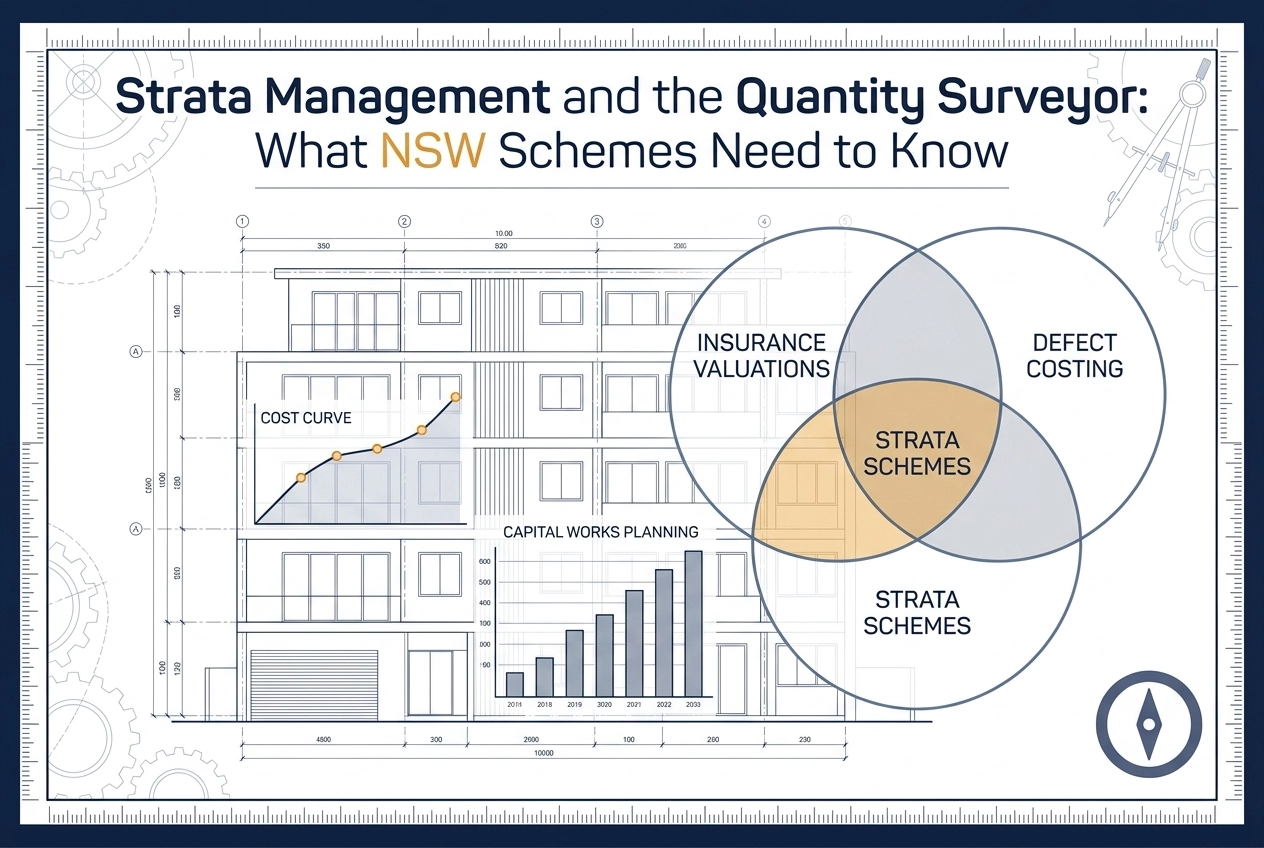
Running a strata scheme in New South Wales involves far more complexity than most owners and committee members anticipate. Between maintaining aging infrastructure, forecasting long-term capital expenditure, and ensuring legal compliance, the financial demands on a scheme can quickly become overwhelming. This is where effective strata management intersects with a discipline that remains underutilised across the industry: quantity surveying.
A qualified quantity surveyor brings a level of financial precision and construction expertise that can fundamentally change how a strata scheme plans, budgets, and protects its assets. Yet many schemes continue to overlook this resource, often to their detriment when unexpected levies or funding shortfalls emerge.
In this analysis, we examine the critical relationship between strata management practice and quantity surveying services in NSW. You will gain a clearer understanding of how capital works fund planning works, why depreciation schedules matter, and how engaging the right professionals can strengthen your scheme's financial position for years to come. Whether you sit on an owners corporation committee or manage schemes professionally, this is knowledge worth having.
The Scale of the Problem: Strata in Australia and NSW
Australia's strata sector represents one of the most significant concentrations of privately held built assets in the country. Across the nation, 367,970 strata schemes encompass 3,173,631 individual lots, with an estimated total insured value of $1.4 trillion, according to the Australasian Strata Insights 2024 report. At that scale, the accuracy of reinstatement cost data is not a procedural formality; it is a matter of genuine national financial consequence. Errors in sum-insured calculations, compounded across thousands of schemes, represent a structural gap in how Australia protects one of its largest asset classes.
NSW sits at the centre of this picture. The state accounts for 91,078 schemes and 1,055,664 lots, the largest lot count of any Australian jurisdiction, with approximately 17% of all NSW residents living in strata-titled dwellings. That concentration places the adequacy of strata insurance and cost management firmly in the public interest. When insurance sums are outdated or construction costs are poorly understood, the financial exposure falls directly on lot owners, many of whom are unaware of the gap until a claim event makes it unavoidable.
Nationally, roughly 1 in 6 Australians lives in strata housing, a proportion that continues to grow as metropolitan infill development drives apartment construction across every major city. The consequences of systemic underinsurance therefore extend well beyond individual owners corporations to affect a substantial share of the national housing stock.
Premium escalation has intensified the urgency. The Owners Corporation Network's submission to the Senate Select Committee recorded an estimated 82% average rise in strata insurance premiums over the five years to mid-2024, with climate-exposed schemes experiencing increases many times higher. One 50-unit complex saw its annual premium climb from $28,000 in 2022 to $95,000 in 2025, a 239% increase across just three years. This level of escalation places severe pressure on owners corporation budgets and exposes schemes carrying outdated sums insured to compounding risk.
Even as the broader commercial insurance market shows early signs of softening in 2026, strata buildings with unresolved defects or sums insured that have not kept pace with construction cost inflation continue to attract disproportionate premium loading. As the CHU 2025 Strata Market Report highlights, insurer appetite remains selective, and accurate reinstatement cost data has become a direct lever that owners corporations can use to support more informed negotiations with insurers and brokers. Independent quantity surveying input, grounded in current construction cost benchmarks rather than broker estimates, is increasingly the practical tool that closes this gap.
Why NSW Strata Schemes Are Now Operating Without a Legislative Safety Net
The legislative protection that once prompted NSW strata schemes to periodically verify their insurance coverage no longer exists. Under the former Strata Schemes Management Act 1996, section 85 imposed a statutory obligation requiring owners corporations to obtain independent insurance valuations at prescribed intervals. When the NSW Parliament replaced that Act with the Strata Schemes Management Act 2015, that valuation requirement was not carried across. Three subsequent waves of reform, culminating in the Strata Schemes Legislation Amendment Bill 2025 which passed parliament on 18 February 2025, have each left this gap undisturbed. No statutory valuation mandate currently applies to any NSW strata scheme.
What the 2015 Act does require, under sections 160 and 161, is that owners corporations insure their buildings to a condition "not worse or less extensive than when new." The obligation is real, but it is unaccompanied by any prescribed method, mandatory assessment cycle, or minimum standard to confirm that the nominated sum insured actually satisfies it. In practical terms, an owners corporation can satisfy the letter of the law by nominating any figure, with no external mechanism to test whether that figure bears any relationship to current construction costs. The NSW Government's guidance for strata committees and owners outlines the broader governance obligations introduced through reform, but insurance sum adequacy remains outside the legislative frame entirely.
The contrast with other Australian jurisdictions is operationally significant. Both Victoria and Queensland require independent insurance valuations on a five-year statutory cycle under their respective strata legislation. In those states, an external regulatory trigger compels schemes to review reinstatement costs at set intervals, regardless of committee awareness or initiative. NSW owners corporations and their managing agents operate with no equivalent prompt. The decision whether to obtain an independent reinstatement cost assessment is entirely discretionary.
This legislative vacuum has a direct consequence for professional accountability. Because no regulatory obligation will initiate a review, the responsibility to act rests entirely with the strata manager and the owners corporation committee. For strata managers operating under the Property and Stock Agents Act 2002 (NSW), that responsibility carries professional weight. Recommending an independent reinstatement cost assessment is no longer a matter of regulatory compliance; it is a matter of professional prudence, and the liability exposure that accompanies inaction falls squarely on those who hold the governance role.
The Underinsurance Crisis: Causes, Scale, and Consequences
The scale of Australia's strata underinsurance problem is difficult to overstate. Industry data consistently indicates that approximately 80% of Australian strata buildings carry insufficient coverage to fund a full reinstatement following a major loss event. This means the overwhelming majority of owners corporation policies would fall short if a fire, flood, or structural failure required a complete rebuild. With Australia's strata sector representing an estimated $1.4 trillion in total insured value across 3.1 million lots, even a modest average shortfall translates to hundreds of billions of dollars in unprotected exposure across the sector.
The root cause is a persistent and widespread conflation of market value with reinstatement cost. These are fundamentally different figures, and in high-demand markets like inner Sydney, the gap between them can be substantial. Market value reflects what a buyer would pay for the property on the open market, including land. Reinstatement cost reflects what it would actually cost to demolish the existing structure, remove debris, and rebuild to an equivalent standard in compliance with current building codes, council requirements, and Australian Standards. Professional fees, compliance upgrades, and applicable taxes must also be incorporated. None of these elements are captured in a real estate valuation, meaning owners who anchor their sum insured to market price data are systematically underprotected.
Compounding the problem is the structural unreliability of insurer-supplied estimates and broker-generated figures. These are typically derived from indexed schedules or rule-of-thumb multipliers, not from current, site-specific construction cost assessments. Research published by the Strata Community Association found that 42% of policyholders maintained their existing sum insured at renewal without adjustment, and only approximately one-third adopted insurer-suggested indexation, even during periods of significant cost escalation. Indexation, even where applied, remains a blunt instrument that cannot account for site-specific conditions, building complexity, or localised labour and subcontractor pricing.
Post-pandemic construction cost inflation has sharply accelerated the adequacy gap. Steel prices rose 42.1% in the twelve months to March 2022 alone, with timber prices increasing 20.6% over the same period. Labour shortages, supply chain disruption, and elevated subcontractor rates have persisted well beyond the immediate pandemic period, meaning a sum insured set in 2021 or 2022 may now materially understate actual reinstatement exposure without any policy change having occurred. For buildings on the longer end of the recommended three-to-five-year valuation cycle, this erosion of coverage adequacy compounds year on year.
The financial consequences of getting this wrong fall directly on lot owners. Between 40% and 60% of a strata insurance premium is driven by claims from natural perils and building-related losses, which underscores how closely premium pricing tracks actual reinstatement risk. Where the sum insured no longer reflects genuine rebuild costs, the owners corporation bears full responsibility for any funding shortfall, as broader reporting on Australia's underinsurance crisis confirms is an increasingly common outcome. Independent, construction-cost-grounded replacement cost assessments are the only reliable mechanism for closing this gap.
How a Quantity Surveyor Determines Reinstatement Cost
A reinstatement cost assessment prepared by a qualified quantity surveyor follows a structured, evidence-based methodology that bears little resemblance to the index-adjusted or desktop-calculated figures that appear on insurance renewal notices. The process begins with a physical, measured survey of the building. The quantity surveyor establishes gross floor areas across all levels, identifies the structural system (concrete frame, post-tensioned slab, load-bearing masonry, or hybrid construction), documents the facade specification, records the internal finishes standard, and maps the building services configuration including hydraulic, mechanical, electrical, and fire protection systems. These inputs are unique to each scheme. No two strata buildings carry identical construction characteristics, and no desk-based estimate can replicate the specificity that a measured survey produces. This quantitative foundation is what distinguishes a professionally prepared assessment from a figure generated by an automated tool or adjusted from a previous year's sum insured.
Once the measured data is established, construction cost rates are applied from current, Sydney-specific cost databases. The rates reflect actual contractor and subcontractor pricing operating in the local market, accounting for Sydney's labour costs, material supply chains, site access conditions, and prevailing margin structures. Applying national average rates or insurer-maintained indices to a Sydney strata building introduces systematic error; the most common outcome is underinsurance, sometimes by a material margin. Local market intelligence is not optional in this exercise; it is the mechanism through which the assessed figure achieves credibility.
The assessment also incorporates two categories of cost that are routinely omitted from simplified insurance estimates. The first is demolition and site clearance. For multi-storey concrete construction, buildings with basement car parks, or schemes on constrained urban sites, demolition represents a substantial line item before a single brick of the replacement structure is laid. The second category encompasses professional fees and statutory charges. Any reinstatement project requires the engagement of architects, structural and hydraulic engineers, a project manager, and a building certifier. Development application fees, building consent costs, and compliance expenditure under current planning and building codes must also be accounted for. These items collectively represent a meaningful percentage of total reinstatement expenditure and are consistently excluded from automated or broker-prepared estimates. For a more detailed explanation of what the assessment process involves at a methodological level, the RICS professional guide to reinstatement cost assessments provides useful conceptual context, noting that the framework shares alignment with Australian professional practice even though the regulatory environments differ.
GST is applied to the total reinstatement figure in accordance with standard Australian practice, and the completed assessment is presented with full supporting methodology. Strata managers, committee members, and their insurers can examine the measured areas, the cost rates applied, the fee allowances included, and the GST treatment. This transparency is a governance advantage that an unexplained renewal notice figure cannot provide.
As an indicative orientation for Sydney in 2026, medium-density residential strata buildings typically carry reinstatement costs in the range of approximately $3,500 to $5,500 per square metre. High-rise residential and mixed-use buildings attract higher rates, with structural complexity, facade specification, and services content all driving variation above that range. These figures should be treated as directional benchmarks only. Individual building characteristics, particularly where non-standard construction, heritage elements, or significant below-grade structure is involved, can produce reinstatement costs that sit materially outside any published range. The only reliable basis for an accurate sum insured is a building-specific assessment prepared from measured data and current local cost intelligence.
Building Defects, Insurance Claims, and the Cost Connection
The defect problem embedded in NSW's apartment stock is not an abstract policy concern; it is a financially material risk that directly shapes insurance outcomes for owners corporations across the state. Industry survey data indicates that approximately 85% of recently assessed apartment buildings carry at least one identifiable defect, while 53% of NSW strata buildings have been found to contain a serious defect. These figures, supported by the NSW Building Commission's active 2025 Strata Defects Survey targeting class 2 buildings constructed between 2018 and 2024, confirm that defect prevalence is not a fringe issue. It is a structural characteristic of the post-boom apartment cohort, and insurers are pricing accordingly.
The insurance market response to this data is increasingly pointed. Buildings with known, unresolved defects present compounded risk exposure at renewal, and underwriters are applying greater scrutiny to defect disclosure during the policy negotiation process. Where serious defects are identified but unquantified, owners corporations may find coverage conditions tightened, specific exclusions applied, or renewal declined. The practical consequence is significant: a claim event that intersects with an excluded defect category can result in a partial settlement or outright declination, leaving the scheme to fund rectification entirely from levies. This intersection between defect status and policy exclusions has emerged as one of the most consequential commercial issues facing strata committees in 2026.
Independent defect rectification cost assessment is the commercially rational response to this exposure. A quantity surveyor's rectification assessment establishes the actual, current construction cost required to remedy identified defects to a compliant standard. This is not a legal opinion or an engineering condition report; it is a financially substantiated cost figure grounded in contractor pricing, trade sequencing, and construction methodology. That figure becomes directly actionable across multiple contexts: as financial evidence in NCAT proceedings using the Scott Schedule framework, as a basis for developer warranty negotiations, and as a documented disclosure for insurers assessing renewal terms.
The currency of that cost data matters considerably. Post-2015 apartment construction in Sydney generated a sustained wave of defect claims, and construction cost escalation across the same period has been substantial. An assessment prepared in 2022 or 2023 may materially understate the cost of remediation today, given movements in contractor pricing, labour availability, and material costs. Owners corporations relying on dated assessments risk underfunding rectification reserves, understating claim quantum in tribunal proceedings, or presenting figures to insurers that no longer reflect market reality. The emerging insurance market shift flagged by industry analysts in response to NSW apartment defect data reinforces that the financial stakes attached to accurate, current cost information are only increasing.
Capital Works Fund Planning as an Integrated Risk Strategy
Under Section 80 of the Strata Schemes Management Act 2015 (NSW), every owners corporation is required to establish and maintain a capital works fund to meet the anticipated costs of major repair, maintenance, and replacement of common property. Following amendments effective 1 April 2026, all new and renewed plans must comply with a mandatory standard form requiring a minimum ten-year rolling forecast, life cycle costing by major building element, and built-in adjustments for inflation and contingency. Plans prepared before that date do not satisfy the new requirement when they fall due for renewal, meaning a significant number of NSW schemes are currently operating against forecasts that neither meet current regulatory expectations nor reflect post-pandemic construction cost conditions.
A quantity surveyor's capital works fund plan does more than satisfy a compliance obligation. It establishes a structured, element-by-element expenditure forecast across roofing, waterproofing membranes, mechanical services, lift systems, facades, and common area finishes, calibrated to each component's known design life and current replacement cost. This granularity enables levy contributions to be set at levels that will genuinely fund anticipated works, rather than reflecting political pressure to minimise short-term levies. When a fund runs short, the consequence is typically a special levy, often representing tens of thousands of dollars per lot raised at short notice. Underfunding is not an unexpected event; it is a planning failure arising from forecasting horizons that are too short and cost data that is not current or site-specific.
The connection between capital works fund planning and insurance reinstatement cost assessment is analytically direct. Both exercises require a current, accurate understanding of the building's physical condition and the cost to repair or replace its components. Both depend on site-specific construction cost data rather than index adjustments or rule-of-thumb estimates. Commissioning both from the same independent quantity surveyor creates measurable cost efficiency and ensures the cost assumptions underpinning each exercise are internally consistent.
An underfunded capital works fund and an inadequate sum insured are frequently symptoms of the same underlying problem: a failure to quantify the building's total cost exposure using current, independently sourced data. Together, these two gaps represent the principal financial risk facing NSW owners corporations. Strata managers who treat capital works planning and insurance cost review as an integrated component of their advisory service are better positioned to advise committees on levy adequacy, reduce the likelihood of unplanned special levies following major component failures, and demonstrate the professional diligence expected of a licensed strata manager operating under conditions of increasing regulatory and financial scrutiny.
The Strata Manager's Professional Exposure When the Sum Insured Is Wrong
Arranging building insurance is one of the most consequential administrative functions a strata managing agent performs, and it is also one of the most legally exposed. A strata manager who places or renews building insurance without recommending that the owners corporation obtain an independent reinstatement cost assessment is not simply following common practice; they are assuming a degree of professional risk that may not be adequately covered by professional indemnity insurance if a major claim subsequently reveals a material shortfall in the sum insured. When approximately 80% of Australian strata buildings are underinsured, the statistical likelihood that any given building carries inadequate coverage is high enough to constitute a foreseeable risk, not an unlikely one.
The repeal of the former NSW statutory valuation mandate does not extinguish the manager's professional obligations. In the absence of a legislative trigger, the duty to act shifts entirely onto the manager's own standard of care and the terms of the management agreement. Both sources of obligation may impose a higher standard than is commonly appreciated. Industry commentary published in 2025 has stated explicitly that "legal expectations of strata managers are higher, and courts expect proactive risk management," framing the avoidance of underinsurance traps as a core professional responsibility rather than an optional enhancement. A manager who relies on insurer-supplied figures without questioning their basis may find that standard difficult to meet in a post-claim dispute.
The commission transparency dimension compounds the exposure considerably. Strata managers receiving commissions of 20% or more on building insurance premiums face an inherent credibility problem if the sum insured later proves inadequate. The NSW Productivity and Equality Commission has formally reviewed the market impacts of prohibiting such commissions, signalling that regulatory scrutiny of this practice is real and escalating. An independent quantity surveyor's reinstatement cost assessment removes any basis for the suggestion that the sum insured was influenced by the manager's financial relationship with the insurer, rather than by an objective assessment of what it would actually cost to rebuild the building.
Recommending an independent assessment also creates a contemporaneous, documentable record of professional diligence. Under NSW strata legislation, records are now required to be maintained in digital form from 11 June 2024 onward, with a seven-year retention obligation under section 180 of the Act. A written recommendation to obtain a quantity surveyor's assessment, made at the point of policy renewal, becomes a durable and discoverable artefact in any subsequent dispute. Legal professionals advising owners corporations in post-claim proceedings increasingly require independent cost assessments as evidentiary foundations; a strata manager who can point to a recommendation on the record is in a materially stronger position than one whose file contains only insurer correspondence and premium notices. Proactive engagement with strata management compliance obligations is increasingly what separates professionally defensible conduct from conduct that becomes the subject of scrutiny after the fact.
When a Claim Is Made: The QS Role in Strata Reinstatement
Once an insurance claim is accepted, the quantity surveyor's role undergoes a fundamental shift. The function moves from pre-loss advisory work into active cost management, and the value that an independent QS delivers at this stage is both substantial and almost entirely overlooked in standard strata practice. Preparing a detailed scope of works and independent cost plan for reinstatement gives the owners corporation a defensible benchmark against which insurer-appointed assessors, loss adjusters, and prospective builders can be objectively evaluated. Without this benchmark, the owners corporation is effectively negotiating blind, dependent on figures produced by parties whose interests are not necessarily aligned with achieving full and proper reinstatement.
Cash settlement assessment is perhaps the most underutilised service available to owners corporations at the claims stage. Approximately 40,000 to 60,000 strata insurance claims are lodged across Australia each year, and a significant proportion result in cash settlement offers rather than insurer-managed reinstatement. When an insurer presents a lump sum in lieu of managed repairs, the owners corporation must decide whether to accept it, often without the technical capacity to verify whether the offered amount is sufficient to actually complete the works. An independent QS assessment of the actual cost to reinstate, prepared against current market rates and a defined scope, provides the evidentiary basis for that decision before any settlement is accepted.
During reinstatement construction, progress claim assessment protects the owners corporation from a risk that rarely receives attention in strata contexts: overpayment. Certifying that amounts claimed by a builder reflect work genuinely completed and materials actually delivered is a standard quantity surveying function on construction contracts of all scales. That function applies equally to strata reinstatement projects, where committee members typically lack the technical background to interrogate a contractor's payment claim independently.
Where reinstatement works generate disputes, whether between the owners corporation, the appointed builder, or the insurer, a quantity surveyor with expert witness capability can prepare formal reports quantifying disputed works, cost overruns, delays, or deficient reinstatement. Those reports form the evidentiary foundation required for NCAT proceedings or civil litigation, grounding the dispute in independently verified cost data rather than competing assertions.
The post-claim QS role is conspicuously absent from public strata resources, yet it represents some of the highest-value professional intervention available to an owners corporation following a significant loss event. Engaging an independent quantity surveyor after a claim is accepted is not a duplication of the strata manager's coordination role; it is the commercial and technical complement to it.
How Quantity Surveyors Sydney Supports Strata Schemes and Their Managers
Quantity Surveyors Sydney delivers a focused suite of independent cost advisory services designed specifically to meet the needs of strata schemes, owners corporation committees, and the strata managers who support them across Sydney and New South Wales.
Our reinstatement cost assessments are prepared using current local construction cost data, reflecting actual market conditions for demolition, removal of debris, professional fees, escalation allowances, and full structural reinstatement to an equivalent-as-new standard. Each report is structured with complete methodology transparency, allowing strata managers, committee members, and insurers to understand precisely how the assessed figure has been derived. This transparency matters most when a committee is challenged to justify its sum insured at an AGM or when an insurer requests evidence supporting the nominated coverage amount.
Where building defects have been identified, our defect rectification costing service provides a credible, independently prepared quantification of the construction cost to remedy each defect. These reports are structured to serve as financial evidence in NCAT proceedings, to support negotiations with developers, and to meet insurer disclosure obligations. In a building environment where 53% of NSW strata buildings have been identified as carrying a serious defect, having access to defensible, independently prepared cost evidence is no longer optional for committees seeking to protect lot owners.
Our capital works fund plans deliver a ten-year expenditure forecast across all major common property components, structured in compliance with the Strata Schemes Management Act 2015. These plans give strata managers a reliable basis on which to advise committees on levy adequacy, reducing the risk of underfunded reserves and unplanned special levies.
Where a claim has been made or is anticipated, our team prepares cash settlement assessments, progress claim certifications, and expert witness reports, providing the commercial and evidentiary support that owners corporations and their legal advisers require at the most consequential stages of a claim.
Strata managers, owners corporation committees, legal professionals, and insurers are encouraged to contact Quantity Surveyors Sydney to discuss the specific circumstances of their scheme and confirm that independent cost advice is working in their interest.
Conclusion: Acting Without a Legislative Prompt
NSW strata schemes enter 2026 carrying a compounding set of financial risks that no single measure can fully address in isolation. An estimated 80% underinsurance rate, a 53% serious defect prevalence, sustained premium escalation, and the complete absence of a statutory requirement to verify the adequacy of the sum insured have converged into a risk environment that demands deliberate, professional action.
The absence of a legislative mandate in NSW is not a signal that the matter is low priority. It is, more precisely, a signal that the professional judgement of strata managing agents and the diligence of owners corporation committees are the only safeguards that exist. Victoria and Queensland impose mandatory valuation cycles; NSW does not. That distinction places the entire burden of risk management on the parties closest to the scheme.
The four services examined throughout this article, namely independent reinstatement cost assessment, defect rectification costing, capital works fund planning, and post-claim quantity surveyor support, are not independent of one another. They represent an integrated risk management response. Each addresses a distinct financial exposure, and together they provide a coherent framework for protecting scheme assets and lot owner equity.
Engaging a quantity surveyor is a commercially rational decision. The cost of an independent assessment is materially smaller than the financial exposure created by an inadequate sum insured or an underfunded capital works reserve. Strata managers and committee members who commission that work now, before a claim is lodged, before a premium dispute arises, and before a defect escalates into litigation, are best placed to protect their scheme, their lot owners, and their own professional standing.