Most strata owners accept their levy notices without question, assuming the numbers are simply what they are. But if you have ever wondered why your strata pay obligations seem to climb year after year, or why owners in similar buildings pay vastly different amounts, the answer lies in a set of specific, calculable factors that many owners never fully investigate.
Understanding what drives your strata costs is not just an academic exercise. It has real financial implications, whether you are budgeting for an investment property, negotiating a purchase, or trying to make sense of a recent levy increase. The variables involved range from building age and shared amenity load to administrative fund management and how well your owners corporation plans for long-term capital expenses.
In this analysis, we break down the core determinants of strata pay, moving beyond surface-level explanations to examine the structural and financial mechanics at work. By the end, you will have a clearer picture of what you are actually paying for, what is reasonable, and where there may be room to ask harder questions of your strata manager or committee.
The Strata Pay Problem Most Owners Do Not See
Sydney is one of the most densely stratified cities on the planet, with over 1.2 million people in NSW living in strata schemes. Despite this scale, the methodology underpinning levy-setting remains poorly understood by the majority of owners, committee members, and even some strata managers. Levies are approved at each Annual General Meeting, yet the assumptions driving capital works contributions are rarely interrogated in that forum. The result is a sector-wide planning problem that accumulates silently, quarter by quarter, until it cannot be ignored.
A widely documented capital works shortfall of 50 to 75 percent exists across many NSW schemes. A representative example illustrates the gap clearly: a 12-lot walk-up on the North Shore collecting approximately $20,000 per year into its capital works fund, when a defensible replacement-value analysis indicates $30,000 to $35,000 per year is required. The scheme appears financially functional on paper. The structural deficit, however, compounds with each passing year. According to Capital Works Fund vs. Special Levies in NSW, when a fund is insufficient to meet an essential repair, the scheme must resort to a special levy, an immediate high-impact payment that can cause genuine financial distress for lot owners.
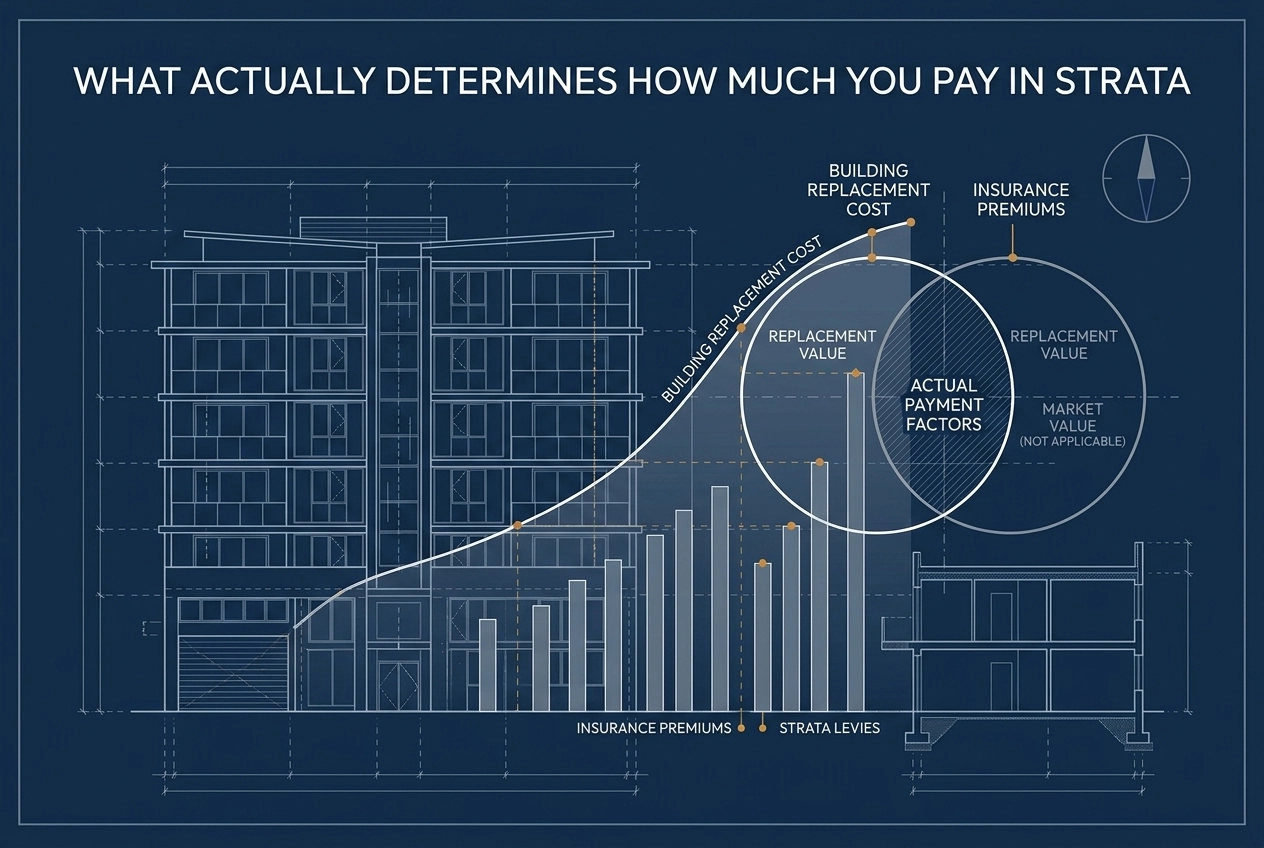
The root cause of this shortfall is a single methodological error: using property market value rather than building replacement cost as the benchmark for capital works contributions. Market value reflects land, location, and buyer sentiment. None of those factors influence what it costs to replace a roof membrane, repair concrete spalling, or modernise a lift. Replacement cost reflects actual construction economics, and it is the only defensible basis for sizing capital works contributions. As outlined in The ABCs of Funding Capital Works in a Strata Scheme, without a clear funding strategy, committees become reactive, delaying works or defaulting to suboptimal choices under financial pressure.
A $15,000 annual shortfall compounds into a $150,000-plus funding gap over ten years, before accounting for construction cost inflation. Correctly structured levy planning, grounded in replacement-value benchmarking and a properly prepared 10-year capital works fund plan, is the most effective way to prevent that outcome.
How Strata Levies Are Determined in NSW
Under the Strata Schemes Management Act 2015, every NSW owners' corporation is required to maintain two separate and distinct levy funds. The Administrative Fund covers recurring operational expenses, including insurance premiums, routine maintenance, cleaning, utilities, and strata manager fees. The Capital Works Fund accumulates reserves specifically for major future expenditure, such as roof replacement, lift refurbishment, facade repairs, and fire safety upgrades. These funds serve fundamentally different financial purposes and must be budgeted, reported, and managed separately. Conflating the two is a common source of financial mismanagement in strata schemes and contributes directly to underfunded reserves.
An owner's levy contribution is not divided equally across all lots. Instead, each owner's share is determined by their lot's unit entitlement, a figure registered on the strata plan that reflects each lot's proportional share of the total scheme entitlements. A larger apartment or one with greater common property access will typically carry a higher unit entitlement, and therefore a higher levy obligation, than a smaller lot within the same scheme. Levies are generally issued quarterly with at least 30 days' written notice, though urgent funding situations may permit shorter notice periods under the legislation.
NSW law also requires each scheme to maintain a 10-year capital works fund plan. Under the 2025 strata reforms, which passed parliament on 18 February 2025, the mandatory review period for this plan was adjusted to every five years, increasing accountability for levy adequacy across the sector.
Critically, a capital works fund plan is only as reliable as the cost assumptions underlying it. Projected replacement costs, asset condition assessments, and construction cost escalation allowances all directly determine whether accumulated reserves will be sufficient when major works fall due. A plan built on outdated or conservative cost estimates will systematically underfund the scheme, leaving owners exposed to significant special levies at short notice. This is where independent, technically grounded cost advice becomes essential to sound strata financial planning.
Why the Property Value Rule of Thumb Fails
The commonly cited rule of thumb, contributing roughly half a percent of a property's market value per year into capital works, contains a fundamental methodological flaw that distorts funding outcomes across every price tier in Sydney's strata market. Property market value and construction replacement cost are calculated from entirely different inputs and respond to entirely different economic forces. Market value reflects land scarcity, postcode desirability, proximity to transport and employment, and prevailing buyer sentiment. None of these factors have any bearing on what it physically costs to replace a roof membrane, overhaul a lift system, or re-render a building facade.
The practical consequences of this conflation become clear through a direct comparison. Consider a two-bedroom unit in Penrith and a comparable unit in Chatswood. The cost to replace the roof on either building, assessed on a per-square-metre construction basis, is virtually identical. Materials, labour, scaffolding, and site management costs do not shift dramatically between western and upper north shore Sydney. Yet the Chatswood market value may be two to three times higher than the Penrith equivalent. Applying the property-value rule mechanically would require Chatswood owners to fund capital works at two to three times the rate that the actual scope of physical works demands, while Penrith owners, with lower market values relative to their replacement cost exposure, may be chronically underfunding the same assets.
This distortion is not random; it is systematic and directional. Schemes in premium postcodes generate levy estimates that appear robust on paper but are disconnected from the real cost of asset maintenance. Schemes in lower-value areas, meanwhile, face the inverse problem: their levy contributions may fall materially short of what genuine replacement cost analysis would require. As real estate rules of thumb analysis confirms, percentage-of-value shortcuts function only as pre-screening tools and consistently fall apart under asset-specific scrutiny.
Neither outcome, overfunding by postcode premium or underfunding by market discount, is tethered to the actual cost of maintaining and replacing the built assets that owners collectively own. A defensible capital works funding methodology must begin with replacement value, not market value, and must be grounded in a properly scoped 10-year capital works fund plan prepared with quantity surveying rigour.
The Replacement Cost Standard: A More Defensible Benchmark
Quantity surveying practice supports a contribution benchmark of 0.5 to 1 percent of the building's current replacement value per year to the capital works fund alone. The lower end of this range applies to simple walk-up schemes with minimal plant and building services, where the principal expenditure items are roofing, external painting, and basic plumbing. The upper end applies to schemes with lifts, mechanical plant, complex facades, or significant fire and hydraulic infrastructure, where replacement and refurbishment cycles are more frequent, more technically involved, and considerably more expensive.
This benchmark rests on a critical distinction that is often overlooked in levy-setting discussions. Replacement value is a construction-cost-based figure, derived from measured quantities, current market rates for materials and labour, and a professional assessment of the building's physical components. It is not a market valuation. It does not move with interest rates, suburb sentiment, or land values. A building's replacement cost in Penrith and an equivalent building in Chatswood will produce comparable figures because the cost to rebuild is governed by construction economics, not property markets. This objectivity is precisely what makes it a defensible foundation for long-term fund planning.
A properly scoped replacement cost assessment also serves a dual purpose in scheme financial management. The same component-level analysis that supports a 10-year capital works fund plan provides the factual basis for determining an adequate sum insured under the scheme's building policy. Given that NSW strata law changes effective 1 April 2026 introduced standardised capital works fund plan forms and mandatory certification requirements for new multi-storey developments, the case for a single, professionally prepared replacement cost assessment serving both functions is increasingly compelling.
The range between 0.5 and 1 percent is not arbitrary. It reflects genuine variation in asset complexity, maintenance liability, and expected expenditure profiles across a 10-year planning horizon. A 12-lot walk-up with a single roof membrane, shared garden areas, and no mechanical plant sits clearly toward the lower end. A 60-lot building with two passenger lifts, a basement carpark, a pressurised fire system, a centralised hot water plant, and an aluminium curtain wall facade sits firmly at the upper end. A qualified quantity surveyor can determine where a specific scheme sits within that range through a documented assessment process, producing a figure that strata committees, owners, and financiers can interrogate, audit, and rely upon. As the Strata Community Association NSW notes, levies must be grounded in a tabled budget and approved at the AGM; a replacement-cost-anchored assessment provides the professional evidence base that gives that process genuine rigour.
Strata Insurance and the Underinsurance Problem
Building insurance is a legal obligation for every strata scheme across Australia, and the policy must cover the full replacement value of the building. This includes the structure, common property areas, building systems such as plumbing, fire safety, and ducted air conditioning, and fixed lot items including built-in cabinetry, bathroom fixtures, and windows. Despite this clear statutory requirement, approximately 80 percent of Australian strata buildings are estimated to be underinsured, representing one of the most significant and least visible financial risks facing owners corporations today.
The Premium Cost and the Stale Valuation Problem
The average strata insurance premium reached approximately $981 per lot per year in 2026 to 2027, making insurance one of the largest single line items within the Administrative Fund. Yet the sum insured underpinning that premium is frequently calculated from a valuation conducted three to five years prior. Construction costs have escalated continuously due to labour shortages, supply chain pressures, and rising material costs, meaning a valuation completed in 2022 bears little resemblance to what it would actually cost to demolish, clear, and rebuild the same structure today. The gap between the insured figure and the true replacement cost widens silently with every passing year, without any change to the policy documentation that might alert a committee to the exposure.
This is a structural problem, not an administrative oversight. Only two of Australia's eight jurisdictions, Victoria and Queensland, impose a mandatory periodic insurance valuation. NSW, which contains over one million strata lots, repealed its former five-year valuation requirement under legislative reform, leaving no statutory mechanism to verify that the sum insured on any given policy reflects current replacement costs.
Regulatory Scrutiny and the Defects Exclusion
NSW Strata Hub annual reporting now requires schemes to disclose their sum insured to government, creating a publicly accessible benchmark for replacement value scrutiny. Schemes with demonstrably inadequate sums insured face growing reputational and financial exposure as this data becomes accessible to regulators, prospective purchasers, and financiers.
A further complication sits entirely outside the insurance framework. Building defects including concrete cancer, waterproofing failures, and combustible cladding are not insurable events. They are classified as maintenance or construction defect issues, and their cost treatment requires separate professional assessment. Committees and lot owners who assume their building policy will respond to defect rectification costs will find no coverage available, regardless of the scale or urgency of the works involved.
The 1 April 2026 Independent Surveyor Certification Requirement
As part of NSW's rolling strata law reform program, new rules under the Strata Schemes Legislation Amendment Act 2025 took effect on 1 April 2026, introducing a mandatory independent surveyor certification requirement for Initial Maintenance Schedules and initial levy estimates for new strata schemes. The changes apply to any scheme whose first Annual General Meeting falls on or after that date, making compliance a live obligation for developers completing projects throughout 2026. NSW Fair Trading has confirmed the reforms affect anyone who owns, lives, works, or builds in a strata scheme, and the certification requirement sits at the centre of strengthened developer obligations around financial transparency at handover. Detailed guidance on the scope of these changes is available through NSW Strata Reforms for April 2026 via PICA Group.
The certification obligation is specific and non-delegable. For multi-storey buildings exceeding two storeys, a qualified, independent Quantity Surveyor, credentialed through the Australian Institute of Quantity Surveyors or the Royal Institution of Chartered Surveyors, must review and certify both the IMS and the initial levy estimates before the first AGM. Critically, the certifier must have no connection to the developer. This independence requirement directly excludes strata managers, project consultants with developer relationships, and other non-specialist advisers from fulfilling this role. The reform was designed precisely to address the historically variable quality of IMS documents, which frequently resulted in underestimated maintenance costs and underfunded capital works, leaving incoming owners exposed to significant special levies within the first two or three years of scheme operation.
The practical consequence is structural. Initial levy estimates must now be grounded in a certified, professional assessment of the scheme's anticipated maintenance and capital expenditure requirements, built directly from a completed IMS using the prescribed NSW Government Standard Form. Informal rules of thumb and developer-convenient figures no longer satisfy the statutory standard. Providers offering Initial Maintenance and Levy Certification services have emerged to meet this demand, signalling rapid market formation around the new requirement.
Non-compliance carries material regulatory risk. Penalties under the expanded Fair Trading enforcement framework include fines of up to $11,000, daily penalties for continuing contraventions, licence suspension, and stop-work orders. Developers with projects approaching practical completion and first AGM dates on or after 1 April 2026 should treat independent surveyor certification as a prerequisite to settlement, not an optional advisory step.
The Quantity Surveyor's Role in Strata Pay Decisions
An independent quantity surveyor contributes to strata financial management at three distinct points, each of which directly shapes what owners pay into their levies and insurance premiums.
The first is the preparation of a capital works fund plan grounded in measured replacement costs and a realistic 10-year expenditure forecast. Rather than applying a generic percentage to property market values, a QS-prepared plan quantifies the actual cost of replacing roofing, waterproofing membranes, lifts, fire systems, and other common property elements, then schedules those expenditures against their expected remaining service lives. The result is a levy contribution rate calibrated to real cost data, one that avoids the chronic underfunding that forces special levies as well as the unnecessary over-collection that erodes owner confidence in scheme governance.
The second contribution is the provision of a replacement cost assessment, the instrument that establishes the sum insured for the scheme's building insurance policy. Because premiums are calculated on the declared sum insured, an inaccurate assessment distorts costs in both directions: underinsurance leaves the scheme exposed to a shortfall in the event of a total loss, while over-insurance inflates premiums without benefit. An independent QS grounds the sum insured in current construction cost data, which is the only methodology consistent with the full replacement cost obligation that NSW strata law imposes.
The third contribution, operative from 1 April 2026, is the certification of Initial Maintenance Schedules and initial levy estimates for new schemes. Because the first capital works fund budget must be built from the certified IMS, the QS's role at scheme establishment directly determines the financial starting position for every incoming owner.
The independence of the quantity surveyor is integral to the value of each of these services. A strata manager's income depends on ongoing scheme administration. A developer's commercial interest favours minimising initial levies to improve off-the-plan sales appeal. An independent QS carries no financial stake in the outcome of the assessment and remains professionally accountable for the accuracy and methodology of their advice.
Quantity Surveyors Sydney provides independent replacement cost assessments, capital works fund plan preparation, and surveyor certification services for strata schemes and developers across Sydney and NSW. Every assessment is grounded in professional quantity surveying practice and current construction industry cost data, not market value proxies or rule-of-thumb estimates.
Getting Strata Pay Right: What Owners and Managers Should Do Next
The steps below translate the analysis in this article into a practical checklist for owners, committees, and developers navigating the post-reform environment.
If your scheme's capital works fund plan has not been reviewed since the 2025 reforms took effect, confirm that the review schedule and underlying cost assumptions are anchored to current replacement costs rather than property market values. The new standard form is explicitly designed to enforce this distinction, and any plan still based on market value benchmarks is both methodologically unsound and increasingly difficult to defend at an AGM.
If your scheme's sum insured has not been updated within the past two to three years, commission an independent replacement cost assessment before the next Strata Hub annual reporting period. With approximately 80 percent of Australian strata buildings underinsured, waiting for the next scheduled review cycle is not a prudent position, particularly given that Strata Hub reporting now creates a publicly accessible reference point for scrutiny.
Developers with schemes settling on or after 1 April 2026 should verify that both the Initial Maintenance Schedule and the initial levy estimates have received independent surveyor certification before settlement proceeds. This is a mandatory requirement for new multi-storey buildings, and non-compliance at settlement creates material exposure for developers and incoming owners alike.
Strata managers and scheme committees presenting levy recommendations to owners should hold an independently prepared, cost-based capital works fund plan as the primary reference document. A rule-of-thumb figure provides no documented justification; a QS-prepared plan does.
Contact Quantity Surveyors Sydney for an independent assessment of your scheme's capital works fund position, replacement cost exposure, or initial levy certification requirements.
Conclusion
Strata costs are not arbitrary. They are the direct result of measurable factors: building age, shared amenity load, administrative fund health, and the quality of long-term capital planning. Owners who understand these drivers are better positioned to budget accurately, ask sharper questions at meetings, and identify red flags before they become expensive surprises.
The key takeaway is this: your levy notices tell a story. Learning to read that story puts you in control rather than simply along for the ride.
If you are buying into a strata scheme, reviewing levies, or preparing for an AGM, start by requesting the current administrative and sinking fund reports. Compare the numbers against what you now know. Ask questions. Push for transparency.
Informed owners make better decisions, and better decisions protect the value of your investment for the long term.