Construction projects in New South Wales are among the most complex and financially demanding undertakings in the built environment. Cost overruns, contract disputes, and scope creep are not just inconveniences; they represent serious threats to project viability and stakeholder confidence. This is where system control engineering becomes an indispensable discipline, providing the structured frameworks and analytical tools needed to keep projects on track from inception through to completion.
For construction professionals working within NSW's regulatory and contractual landscape, understanding how system control engineering applies to cost management and contract administration is no longer optional. It is a competitive necessity. This analysis explores the core principles of system control engineering as they relate to financial oversight, contract governance, and risk mitigation on NSW construction projects. Readers will gain practical insight into how integrated control systems support better decision-making, improve accountability across project teams, and reduce the likelihood of costly disputes. Whether you are managing a mid-tier commercial build or overseeing a large infrastructure contract, the frameworks discussed here offer measurable value at every project stage.
What Is System Control Engineering in a Quantity Surveying Context?
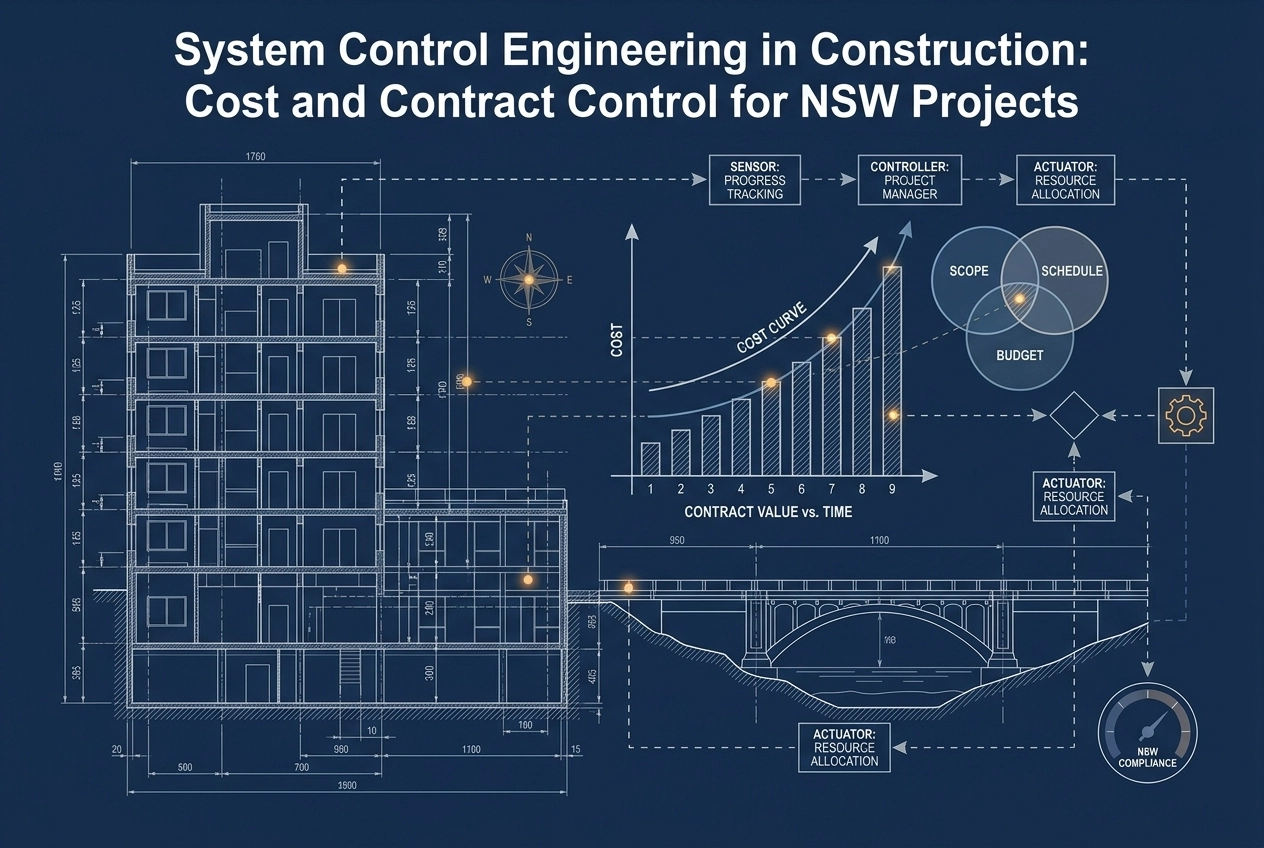
In industrial engineering, system control engineering describes a disciplined, feedback-driven methodology: establish target parameters, monitor live performance against those parameters, identify any deviation, and apply corrective action before the system drifts beyond recoverable limits. It is the logic underpinning process plants, power grids, and automated manufacturing lines. It is also, when applied with rigour, the logic that underpins effective quantity surveying and construction cost management.
In a quantity surveying context, system control engineering describes the structured, feedback-driven management of project costs, contracts, and commercial risk across the full project lifecycle, from initial feasibility and business case development through procurement, construction, and final account close-out. The core principle transfers precisely. Whether the system in question is a refinery or a transport infrastructure programme, the discipline is identical: set a baseline, measure actual performance in real time, identify variance early, and intervene before deviation becomes structurally unrecoverable.
This framing matters because it distinguishes a systems-based approach from informal or reactive cost monitoring. As explored in depth across quantity surveying in construction practice, the QS function spans cost planning, procurement strategy, contract administration, progress claim assessment, risk management, and final account settlement. A systems-based approach treats these as interconnected control functions within a single integrated workflow, not as isolated tasks assigned to different project stages or different personnel. Each function generates a feedback signal; each signal informs the next decision point.
The practical significance of this approach is acute in 2026. Construction costs remain structurally elevated above pre-2020 baselines, procurement is exposed to ongoing tariff and supply-chain disruption, and, as current cost management analysis confirms, contractors are losing money not primarily on materials but on process failures, which are precisely the breakdowns a control-engineering discipline is designed to prevent. For project owners, developers, and infrastructure funders operating under tighter board and financier tolerance for cost drift, a systems-based commercial management discipline is no longer a value-add. It is a baseline requirement for responsible project delivery.
Why Systematic Cost Control Matters in the Current Construction Environment
The construction environment entering 2026 presents a structurally more demanding context for project cost management than at any point in the preceding decade. Construction costs remain significantly elevated compared to pre-2020 baselines, and while headline inflation has moderated in some categories, the underlying cost floor has not retreated. S&P Global/CIPS Construction PMI readings running well below 50 into 2026 signal sustained contraction across housing, commercial, and retail construction segments, confirming that the sector is not recovering uniformly. For infrastructure owners, developers, and project managers, this means that cost baselines are being set in an environment where input cost volatility remains a structural feature rather than a temporary condition.
Labour availability compounds this challenge in the Australian market. Persistent shortages across skilled trades including civil works, mechanical, and electrical disciplines continue to create programme risk that translates directly into cost exposure. When trades are unavailable or sequencing is disrupted, idle preliminaries accumulate, subcontract packages are repriced under pressure, and contingency reserves are eroded before construction reaches practical completion. As Carnegie Mellon University's project management reference notes, the window for meaningful cost intervention sits firmly at the planning and design stage. Changes during construction carry disproportionate cost consequences, reinforcing the case for structured contingency planning and disciplined change control from project inception.
Procurement risk represents a further and increasingly significant variable. Global tariff policy uncertainty and supply-chain fragility mean that cost baselines established at tender are increasingly vulnerable to materials cost movement during the construction programme. Long-lead items, imported components, and commodity-linked materials are all exposed to repricing events that fall outside the control of either the principal or the contractor once contracts are executed without adequate price risk allocation mechanisms.
The Deloitte 2026 Engineering and Construction Industry Outlook positions the sector as managing sustained structural headwinds across input costs, workforce constraints, and supply-chain fragility collectively. These conditions have sharpened the governance expectations of funders, boards, and government agencies, who are operating with reduced tolerance for schedule slippage, uncontrolled cost drift, and procurement exposure. Demonstrating systematic cost control is no longer simply a financial management discipline; it has become a condition of stakeholder confidence and a governance requirement for capital program delivery. Infrastructure Australia performance data and AIQS benchmarking findings consistently identify inadequate front-end planning and weak cost control disciplines as primary drivers of cost overrun on major Australian projects, establishing clearly that the risk of overrun is not random but is structurally linked to the quality of systems applied from the earliest project stages.
Cost Planning as the Foundation of the Control System
Effective system control begins at the front end. Cost planning undertaken at the concept, feasibility, and business case stages establishes the baseline parameters against which all subsequent project cost performance is measured, assessed, and reported. As cost control methodology in systems engineering confirms, cost estimating serves diverse purposes across the system lifecycle and is central to project planning, budgeting, and control. A poorly defined early estimate does not merely introduce uncertainty at the outset; it propagates unreliable data through every downstream control stage, compounding the difficulty of meaningful variance analysis as the project progresses.
A rigorous cost plan, developed in accordance with AIQS practice standards and benchmarked against comparable NSW infrastructure and civil project data, provides the investment decision baseline that transforms cost reporting from a historical accounting exercise into a genuinely predictive control function. Feasibility studies and development cost models that account for procurement risk, design contingency, and realistic escalation allowances give owners, developers, and government agencies a credible cost envelope rather than an optimistic point estimate vulnerable to continual upward revision. In the current environment, where construction costs remain structurally elevated above pre-2020 levels and supply chain conditions remain volatile, an honest front-end cost model is not a conservative option; it is a commercial necessity.
Cost plan updates at each design gateway, from concept through schematic, design development, and contract documentation, function as the scheduled feedback cycles of the control system. Each gateway review compares the evolved design scope against the established baseline, identifying cost drift before it becomes entrenched in committed design decisions or procured packages. This iterative structure mirrors the feedback loop architecture that defines robust control engineering: inputs are assessed, deviations are identified early, and corrective action remains both practical and cost-effective.
The downstream consequences of weak front-end cost planning are significant and frequently underestimated. A poorly defined cost baseline produces unreliable variance reporting throughout construction, and critically, it undermines the commercial credibility of progress claim assessments and change order evaluations. When the baseline is contested or inadequately defined, every subsequent commercial decision, from payment schedules to variation entitlements, is argued against an uncertain foundation. Investing in rigorous cost planning at the front end is therefore not simply a planning discipline; it is the structural prerequisite that determines the integrity of the entire project control system.
Procurement and Contract Strategy as Structural Controls
Procurement strategy functions as the architectural layer of the entire project control system. Before a contract is executed, before a tender is issued, and before a design is finalised, the choice of delivery model determines how cost and commercial risk is allocated between owner and contractor for the duration of the project. The selection between a traditional lump sum arrangement under AS 4000, a design-and-construct model, a managing contractor approach, or a collaborative alliance structure is not an administrative formality. It is a structural engineering decision with direct commercial consequences that will shape every cost and contract control function that follows. As the Australian construction market operates across more than 660 active major public infrastructure projects in 2026, with construction cost escalation sustained at 4 to 6 percent annually, the risk allocation embedded at procurement stage has measurable financial consequences for owners throughout delivery.
The AS 4000 and AS 2124 contract frameworks, which remain widely used across NSW public and private sector infrastructure projects, embed specific mechanisms that function as direct cost controls. Provisional sums, prime cost items, variation procedures, and time-related cost provisions each represent a defined point at which commercial risk can transfer, expand, or be mitigated. These mechanisms require active management and structured administration, not passive acceptance. An owner who treats variation procedures as routine paperwork rather than a cost control instrument is effectively operating the project without a feedback loop. Independent quantity surveying input at the contract administration stage ensures these mechanisms are exercised with discipline and that emerging cost exposure is identified before it crystallises into formal claims.
Tender management and analysis represents a further control engineering function that is frequently underweighted. Evaluating contractor pricing strategies, benchmarking submitted rates against current market conditions, and reviewing contractor-held contingencies within a priced bill of quantities are all validation exercises. They test whether the awarded contract price reflects genuine market conditions or contains latent claim risk that will surface during construction. Selecting the appropriate procurement route influences cost certainty and risk allocation long before construction begins, and a tender that appears commercially competitive at award can carry significant embedded exposure if the underlying pricing has not been rigorously analysed.
Procurement timing for long-lead items, specialist subcontractors, and materials subject to supply-chain volatility requires structured risk assessment at the planning stage. In 2026, with tariff and trade policy uncertainty continuing to affect import-dependent materials pricing across Australian infrastructure projects, reactive procurement management after commitments are made is a demonstrably higher-risk approach. An independent quantity surveyor advising at the procurement planning stage provides owners with an objective analysis of risk allocation options, delivery model trade-offs, and supply-chain exposure before contracts are executed and before that risk becomes the owner's problem to absorb.
Contract Administration and Progress Claim Control Under NSW Law
Contract administration is the live monitoring and correction layer of the project control system. Once a contract is executed, the baseline is set: the awarded contract value, the scope definition, the programme, and the agreed contract conditions. From that point, contract administration translates that contractual baseline into active commercial management, continuously tracking actual cost performance against the awarded value, approved variations, and current cost forecast. On any infrastructure, civil, or significant construction project in NSW, this is not a passive record-keeping function. It is a real-time feedback mechanism that identifies cost drift, scope creep, and commercial risk at the earliest possible point, when corrective action is still available.
Progress Claim Assessment and Owner Cash Flow Protection
Progress claim assessment is one of the highest-frequency control functions in active project delivery. Each payment claim submitted by a contractor carries direct consequences for owner cash flow, contractor entitlement, and the integrity of the project cost forecast. Independent, rigorous assessment of each claim against actual works completed, materials on site, contractual entitlements, and approved variations is the mechanism that keeps the cost forecast anchored to reality. Where claims are assessed loosely, overpayment accumulates, contractor leverage increases, and the owner's ability to apply commercial pressure later in the project diminishes substantially.
Under the Building and Construction Industry Security of Payment Act 1999 (NSW), payment obligations are time-critical and legally enforceable. A respondent who fails to serve a valid payment schedule within the statutory timeframe after receiving a payment claim loses the right to contest the claimed amount and becomes exposed to summary judgment enforcement. Structured progress claim review processes, supported by a specialist quantity surveyor, ensure that payment schedules are issued within timeframes, that the assessed amount is properly substantiated, and that the owner's legal position is preserved without unnecessarily damaging the contractor relationship.
Variation Management as a Commercial Control Discipline
Variation management represents one of the highest-value control engineering functions on any significant project. Each variation claim requires assessment on three levels: whether the claimed scope change is contractually valid under the applicable conditions of contract; whether the quantum is supported by adequate contemporaneous documentation and rates consistent with the contract or market; and whether any claimed delay impact has been properly substantiated with programme evidence. Poor variation control is among the most common pathways through which project budgets deteriorate, as individually minor concessions accumulate into material cost overruns across a project lifecycle.
The AACE International Contracts and Claims body of knowledge explicitly identifies change-order management and claims avoidance as core cost engineering competencies, reflecting long-standing professional recognition that variation control is inseparable from cost forecast integrity.
Systematic contract administration, supported by rigorous contemporaneous records, also creates the audit trail that protects owners if post-project disputes arise. Well-maintained records of instructions, site meetings, correspondence, and valuations provide the evidentiary foundation for expert witness work if required, connecting front-end cost control discipline directly to downstream commercial protection.
Risk Management and Cost Change Control as Feedback Mechanisms
Within a systems control framework, risk registers, contingency management protocols, and cost forecasting tools are not administrative documents. They are the active feedback and correction mechanisms that allow the project team to detect emerging cost deviation early and intervene before it compounds into a material overrun. As the Carnegie Mellon Project Management reference framework establishes, project control procedures are primarily designed to identify deviations from the project plan. Without structured risk management embedded in the cost model, deviations accumulate silently until they become unmanageable.
A structured risk management process transforms risk from a vague qualifier into a measurable budget component. At each project stage, from concept through detailed design to construction, cost and commercial risks should be identified, assigned probability and impact assessments, and incorporated into a quantified, risk-adjusted cost forecast. This approach distinguishes between known-risk contingency, which is allocated against specific identified risks with assessed probability and cost impact, and management reserve, which is held for genuinely unforeseen events outside the project scope baseline. Maintaining this distinction preserves the analytical integrity of the cost model and enables credible reporting to project boards and financiers who require transparency rather than aggregate reserves of uncertain origin.
Contingency management must be active rather than passive. Releasing contingency drawdowns against identified risk events as they materialise, supported by formal documentation, maintains the validity of the forecast cost-to-complete. Treating contingency as an informal buffer to be drawn down without audit trail erodes confidence in the cost model and creates misalignment between reported and actual project exposure. Infrastructure owners and government agencies increasingly require contingency governance frameworks as a condition of project approval and funding release, reflecting the standard described in risk assessment and change control guidance published by institutional project delivery frameworks.
Cost change control operates as the correction input to the system. Formal change request procedures, requiring cost impact assessment before design decisions are approved, ensure the project cost model reflects current knowledge rather than the assumptions embedded at an earlier stage. Regular cost-to-complete forecasting, updated against actual expenditure, approved variations, and forecast remaining work, keeps the model live. Research published in 2026 on contingency synergy strategies combining reference class forecasting with project-specific risk data reinforces that the profession is actively advancing its methodological toolkit for quantified contingency management beyond simple percentage allowances.
On complex infrastructure projects across transport, utilities, energy, and water sectors, scope uncertainty and design development risk are structural features of the project type, not exceptional events. A systematic, risk-integrated cost control approach is the standard expected by infrastructure owners, government agencies, and financiers operating under tighter tolerance for cost drift in the current environment. Delivering that standard requires specialist commercial and cost management capability applied consistently across the full project lifecycle.
Digital Tools and the Evolution of Cost Control Engineering
The construction technology market reached USD 164.20 billion in 2026, with software accounting for 55% of the component segment. This investment reflects a structural shift already underway across the industry: integrated cost management platforms are replacing manual spreadsheets and disconnected reporting systems as the operational standard for project cost control. Modern platforms consolidate budget monitoring, cost change tracking, financial reporting, and stakeholder communication onto a single data environment, reducing the lag between financial events and management awareness. For infrastructure owners, government agencies, and project financiers operating under tighter cost tolerances, this real-time visibility is no longer a convenience but a project governance requirement.
Building Information Modelling has become a foundational component of systematic cost control at the design development stage. BIM-enabled quantity take-offs deliver measurably greater accuracy than manual methods, and clash detection before construction commences directly targets one of the most persistent sources of budget overrun in complex projects. Research from the Construction Industry Institute places rework at 5 to 9% of total project cost, while broader UK analysis measuring indirect costs and latent defects has recorded avoidable losses of 10 to 25% of project value. Approximately 30% of work performed on a typical construction site is rework. BIM-supported coordination at the design stage addresses this problem at its source, reducing the cost of late-stage design revision and improving the reliability of cost plans developed at feasibility and business case stages.
AI-assisted forecasting tools are now capable of processing large project datasets to identify cost patterns, flag emerging budget variances, and support scenario modelling across procurement and delivery options. Among firms that have already adopted AI, 94% plan to increase their investment, 68% report saving at least USD 50,000, and AI adopters report cost reductions of 10 to 25% on project delivery. However, as noted by the Young Quantity Surveyors community in their 2026 trending topics analysis, professional judgement remains essential. AI outputs require validation against contract frameworks, procurement conditions, site-specific risk factors, and the commercial realities of the NSW construction market. A quantity surveyor who understands AS 4000 contract structures, Security of Payment obligations, and local cost benchmarks adds the interpretive layer that automated tools cannot replicate.
The modern quantity surveyor in 2026 operates as a data-informed commercial advisor, combining digital platform proficiency, BIM literacy, and AI-assisted analysis with deep expertise in procurement strategy, risk management, and cost benchmarking. This integrated capability is what distinguishes systematic cost control engineering from routine budget tracking. Looking further ahead, blockchain-based contract platforms and digital twins are entering early adoption within major infrastructure programmes, offering the next generation of transparent, auditable, and continuously updated project control tools. Widespread adoption across the NSW construction market remains a medium-term prospect, requiring ongoing professional development and structured client education. Firms and owners that begin building capability and familiarity with these tools now will be better positioned when adoption reaches commercial scale.
Dispute Resolution as a Downstream Output of Cost Control Discipline
The documentary record generated through rigorous cost and contract control does not serve the project alone. It also serves as the evidentiary foundation upon which any subsequent commercial dispute will be assessed, argued, and resolved. Every cost plan, variation assessment, progress claim evaluation, meeting minute, and risk register entry produced through systematic project controls becomes a contemporaneous record that carries direct evidential weight in adjudication, arbitration, or litigation proceedings. This is not a secondary benefit of good cost management discipline; it is a structural output of the same system.
Expert witness services in construction disputes are fundamentally document-dependent. An expert engaged to provide quantum or delay analysis can only work with the records that exist. Where cost and contract control has been applied systematically from project inception, the expert has a complete, chronologically coherent evidentiary record to draw upon. Where project documentation is fragmented, inconsistent, or absent, even a legitimate claim becomes difficult to substantiate and expensive to reconstruct. A systematic approach to cost and contract administration from day one significantly strengthens the position of any party, whether owner or contractor, who finds themselves in dispute proceedings.
The most common dispute triggers in NSW construction projects align precisely with the control points that a systematic contract administration process addresses. Disputed variations, delay and disruption claims, defective works costs, and final account disagreements are all categories of dispute that turn, in large part, on the quality of the contemporaneous record. Under both AS 4000 and AS 2124 contract frameworks, specific notice and documentation requirements govern entitlement to variations and extensions of time. Failure to comply with these procedural obligations is one of the most common mechanisms by which otherwise valid claims are defeated. A structured contract administration process that actively monitors and records compliance with notice requirements is essential to preserving contractual rights before they are needed.
The release of AS 4000:2025 adds further weight to this connection. The updated standard introduces Dispute Avoidance Boards as an electable mechanism and shifts the default final resolution pathway from arbitration to litigation. These changes reinforce a broader industry direction: upstream investment in control and documentation reduces downstream dispute exposure and, where disputes cannot be avoided, positions parties more effectively at every escalation stage from executive negotiation through to formal proceedings.
The full-lifecycle value of a systems-based approach is therefore measurable not only in cost certainty achieved during delivery, but in dispute costs avoided or efficiently resolved after project close-out.
Applying System Control Engineering Across Infrastructure and Development Projects
Transport Infrastructure
Roads, rail, bridges, and transit corridors present some of the most demanding cost control environments in the construction sector. Scope uncertainty at inception, extended delivery timescales spanning multiple budget cycles, and layered procurement structures combining principal contractors, specialist subcontractors, and public sector governance frameworks all create conditions in which cost growth can accumulate incrementally and remain undetected until it becomes material. Infrastructure Australia's formal assessment framework recognises this explicitly, requiring proposals to progress through structured problem definition, option analysis, and business case development stages before capital commitment. Systematic cost control applied from business case through design development, procurement, and construction is not a refinement for transport projects; it is a structural requirement for managing the cost trajectories that have historically challenged major Australian programmes.
Energy and Utilities Infrastructure
Grid upgrades, renewable energy facilities, water treatment plants, and network augmentation programmes carry a distinct cost control profile shaped by specialist procurement risk and materials cost volatility. Copper, steel, and specialist electrical equipment are subject to global pricing pressures and supply-chain disruption that cannot be adequately managed through contingency alone. Infrastructure Australia's 2026 Priority List identifies clean energy transition and secure water supply as defined national priorities, confirming the capital volumes flowing into these sectors. Structured procurement advisory, cost change control protocols, and early-stage risk quantification are essential tools for clients committing capital to energy and utilities programmes where market conditions can shift materially between business case approval and contract execution.
NSW Commercial Development
Developers of commercial and mixed-use projects in New South Wales face a cost environment in which construction costs remain structurally elevated above pre-2020 baselines and skilled labour constraints continue to affect programme certainty. Feasibility analyses built on optimistic point estimates rather than risk-adjusted cost models expose developers to material budget shortfalls as projects advance through design and procurement. Systematic cost planning that accounts for escalation assumptions, programme risk, and procurement market conditions provides the analytical foundation for sound investment decisions and defensible business cases.
Specialist and Emerging Sectors
Life sciences facilities, advanced manufacturing plants, and data centres are absorbing a growing share of available development capital in 2026. These building typologies involve services-intensive construction, highly specialised fit-out requirements, and long-lead procurement of critical equipment that can span twelve to twenty-four months. Cost management on these projects demands practitioners with direct sector experience; generic cost planning benchmarks drawn from commercial office or industrial construction will produce unreliable estimates that create downstream exposure at procurement and construction stages.
Building Remediation and Retrofit
Remediation programmes and building retrofit works require the same disciplined cost control approach applied to new-build infrastructure. Structured defect rectification cost assessments, transparent budget frameworks, and rigorous contract administration protect building owners and strata corporations from cost escalation and contractor claim risk throughout complex remediation scopes. The unpredictable nature of defect discovery during works makes contingency management and change control protocols particularly critical, and the contractual protections available under NSW security of payment legislation only deliver value when the underlying documentation discipline is already in place.
Conclusion: Building a Stronger Control Framework for Your Next Project
System control engineering, applied to construction cost and contract management, is a practical and structured discipline. It begins with rigorous front-end cost planning, is sustained through disciplined procurement strategy and contract administration, and produces measurable benefits in cost certainty, risk management, and commercial outcomes across the entire project lifecycle.
In the 2026 NSW construction environment, with costs structurally elevated above pre-pandemic baselines, procurement exposure heightened by supply-chain disruption, and funders operating with reduced tolerance for budget deviation, a systems-based approach to cost and commercial control is a practical necessity. It is no longer sufficient to treat cost management as a periodic reporting function. It must be embedded as a continuous, feedback-driven discipline from project inception through to close-out.
Project owners, developers, contractors, and government agencies that invest in systematic cost control from the outset reduce their exposure to uncontrolled cost drift, procurement risk, and post-project dispute. Equally important, they improve their capacity to demonstrate credible cost governance to boards, financiers, and stakeholders who require transparent, well-documented evidence of commercial accountability.
Quantity Surveyors Sydney provides independent cost planning, procurement advisory, contract administration, and commercial management services across infrastructure, commercial, and development projects throughout NSW. Our services are structured to support clients at every stage of the project lifecycle, from early feasibility through to final account resolution.
Engaging independent cost and commercial expertise at the outset of a project, rather than reactively after overruns or disputes have emerged, remains the most reliable way to protect project budgets, manage risk, and achieve successful delivery outcomes.