
The decision between a single joint expert and party-appointed quantity surveying experts is often made under pressure, before a report is even commissioned. Yet this early strategic choice fundamentally shapes the cost, timetable and persuasiveness of the expert evidence that follows.
For litigators and solicitors weighing these options, the question is not simply whether a single expert witness is cheaper. It requires a disciplined framework that accounts for evidentiary weight, control over instructions and the realities of concurrent evidence.
This guide compares both models across cost, speed and the testing of expert testimony in court. It explains when a single joint expert produces a more persuasive number, and when two party-appointed QS experts are genuinely necessary. Readers will learn how the choice reshapes instructions to the expert, conferences and joint conferencing, and how each model's evidence is ultimately tested. It also confirms why jurisdiction and the applicable expert evidence rules must be verified before any report is written.
For infrastructure owners, contractors and project managers seeking cost certainty and effective risk allocation, getting the expert model right from the outset is a commercial and evidentiary priority.
Why the Cost Expert Decision Is Made Before Any Expert Witness Report Exists
The choice between a single joint expert and party-appointed QS experts is a case-management decision taken at the directions stage, before any expert witness report is drafted. It fixes how many reports are commissioned, who instructs them, who bears the cost, and how many competing quantum positions the court must reconcile. The choice is also difficult to reverse. A report prepared on the wrong model cannot simply be re-badged, because the joint or party-specific instructions, agreed assumptions and independence obligations differ fundamentally. This article is a practitioner framework drawn from quantity surveying practice in commercial and infrastructure construction disputes; that practice experience is kept distinct from external authority. Claims that one model is cheaper, faster or more persuasive are trade-offs to reason through, not measured findings; check them against the primary sources applicable to the matter before relying on them. The earlier that analysis is done, the less exposed the evidence strategy becomes. See The Economics of Pre-Legal QS Intervention Versus Litigation Expert Reports.
What a Single Joint Expert Actually Is
That model rests on a single appointment: one independent quantity surveyor, agreed between the parties or directed by the court, prepares one expert witness report for the court. The mechanics follow from that definition: jointly drafted or court-approved instructions, shared expert fees, one set of agreed assumptions, and no advocacy position for either side.
The independence duty is unchanged but more visible. An expert's overriding obligation runs to the court rather than the instructing party, and that is on show when one witness serves both sides.
The primary instruments are the Uniform Civil Procedure Rules Part 31, the applicable court's practice note, and the Expert Witness Code of Conduct. The Land and Environment Court publishes its own guidance on expert witness code of conduct and duties, but jurisdiction determines which instrument actually governs the appointment. What the resulting document must contain is set out in our guide to the expert witness report in construction disputes.
What Party-Appointed QS Experts Bring to a Dispute
The alternative is the party-appointed model: each side instructs its own quantity surveying expert, producing competing expert witness reports and two distinct quantum positions for the court to weigh. Its advantages are real. Each expert can develop a cost position fully, audit the opponent's measurement and rates, and place a favourable but defensible number before the court. The structural cost is equally real: two sets of expert fees, two timetables, two sets of assumptions, and a wider gap between the numbers for the parties or the court to bridge. Opposing reports usually diverge for explainable reasons, including different measurement approaches, rate sources, and treatment of variations, preliminaries and prolongation, not partisanship alone. The credibility risk is that a party-appointed expert whose figure cannot be traced to the underlying cost records loses persuasive force, however aggressively it is advanced. For related instruction and evidence issues, see our Frequently asked questions.
Cost, Timetable, Control and Evidentiary Weight Compared
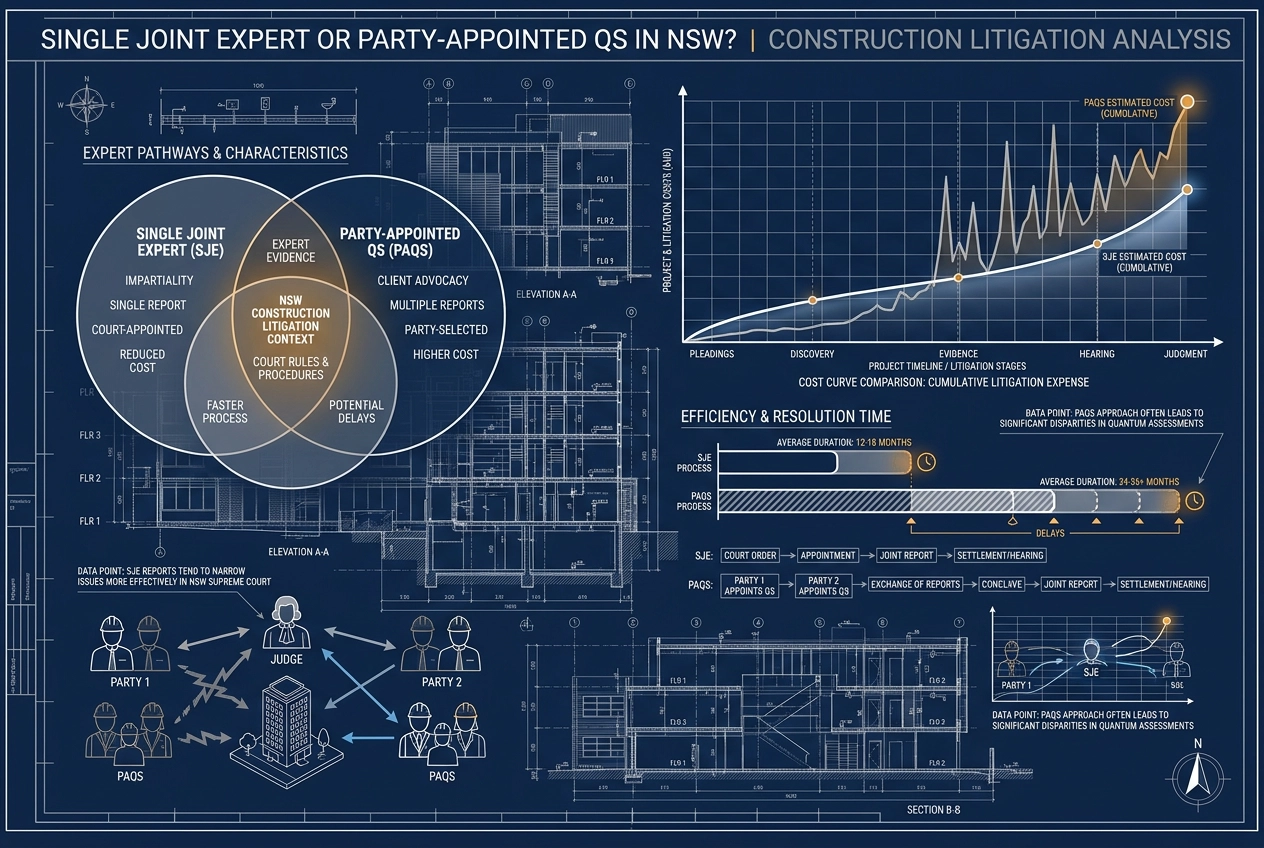
Weigh those advantages against five structural trade-offs. Cost is exposure, not a discount: a single expert witness removes a second expert witness report and one set of fees, but concentrates risk in one number; party-appointed experts double outlay while giving each side its own figure to defend. Timetable compresses under one expert by eliminating report exchange and a conferencing round; dual reports create sequential dependencies, so either slip delays the program. Control differs sharply: joint instructions must be neutral and answerable, limiting steering, while party instructions are shaped by each side's case theory, making scope, assumptions and methodology critical, particularly where quantum and delay issues are separated (Quantum vs. Delay Analysis: How Report Requirements Differ). Divergence narrows with one report, which can anchor earlier settlement; two reports preserve a wider range and may entrench positions before joint conferencing. Evidentiary weight turns on independence, transparent method and consistency with contemporaneous records, so a reasoned joint report is not automatically weaker than competing party reports.
When a Single Joint Expert Produces the Better Number
Those trade-offs point to a category of dispute where the single expert is the better commercial instrument. Apply five tests in sequence.
Proportionality. Where the disputed quantum is modest relative to the combined cost of two expert witness reports, one shared appointment is usually rational. Spending more on evidence than the issue is worth rarely serves either party.
Issue scope. A single expert suits one well-defined cost question: a variation assessment, the value of completed works, or measurement of a defined scope.
Methodology. Where both sides accept the same measurement standard and disagree only on inputs, one expert resolves the point more cleanly than two reports talking past each other.
Settlement. If both parties need a credible independent number to negotiate around, a single joint expert creates an anchor that adversarial reports rarely produce.
Timetable. Tight listings and early mediations favour the compressed program a single appointment allows. Our dispute resolution and expert witness services in infrastructure apply these tests when scoping an appointment.
Where the matter fails them, party-appointed experts remain necessary, as the next section explains.
When Two Party-Appointed QS Experts Are Genuinely Necessary
Where those tests fail, two party-appointed quantity surveying experts are defensible. Five triggers justify the extra outlay:
The cost claim fractures into discrete heads (measured works, variations, preliminaries, delay or prolongation), each demanding its own methodology and build-up.
A party must positively prove a contested cost case, such as loss of productivity or extended site overheads, rather than test another's figure. See labour cost in construction disputes and expert evidence.
The opponent's cost records, measurement basis or methodology require document-by-document audit, so an expert must report directly to that party.
Positions are irreconcilable, no jointly acceptable expert can be identified, or the court declines to direct one and leaves each side to file its own evidence.
A contested hearing will test competing quantum positions rather than settle them, so each side needs an expert witness able to defend its number under cross-examination.
That second report purchases evidential control, not duplication.
How the Choice Reshapes Instructions to the QS Expert
Once that threshold is crossed, the model chosen dictates how the brief is framed. In a single joint expert appointment, instructions are drafted jointly or approved by the court, so each question must be neutral, capable of one answer, and stripped of assumptions that favour either party's case theory. Party-appointed instructions do the opposite: they set scope, identify the cost documents relied on, tie the claim to the contractual basis, and prescribe the level of detail, from elemental breakdowns to measured rates and variation build-ups.
Both models demand the same discipline before the expert witness report is written: fix the scope boundary, date of assessment, GST treatment, exclusions and every assumption in writing. Confine the brief to quantum, cost methodology and standard of measurement. Do not ask a quantity surveying expert to opine on liability or contract construction. The same discipline that underpins sound BOQ preparation applies here. Draft with the joint conference and cross-examination in mind, because every assumption recorded in the instruction becomes a line of questioning later.
Conferences, Joint Conferencing and Concurrent Evidence
Those instructions also determine how conferencing is run. In practice, an expert conference is a meeting of the experts, without the parties present, to isolate the real areas of disagreement and produce a schedule of agreed and disputed matters. In a single joint expert model a joint conference rarely arises: with only one expert, the contest shifts to testing that expert against contemporaneous cost records and the factual witnesses. In the party-appointed model, the schedule usually becomes the cross-examination map, so each QS must be briefed on the opposing report, its rates and its assumptions before the conference. Concurrent evidence, often called hot-tubbing, in practice involves the experts giving evidence together and responding to each other's opinions; preparation demands fluency in the rival methodology, the rates adopted and the cost documents relied on. Confirm which practice note or procedural direction governs conferencing in the relevant NSW list, because the mechanics differ between forums.
How Each Model's Expert Witness Evidence Is Tested in Court
Once conferencing concludes, the contest moves to the witness box. A single expert witness is cross-examined by both sides, so the assumptions, documents relied on, methodology and the constraint imposed by joint instructions are attacked from two directions. Party-appointed experts are tested instead against contemporaneous cost records, the opposing expert witness report and the joint conference schedule; any gap between report and records is exploited quickly. In both models, traceability decides weight. A figure rebuilt from measurement, rates and project documents survives scrutiny; one that cannot is discounted or rejected, much like the evidence required in quantum meruit claims. Courts respond well to concessions the documents compel and poorly to numbers defended beyond them. The model chosen therefore determines how many witnesses face this testing and how much of the quantum case rests on a single voice when the expert witness in court is pressed.
Confirm Jurisdiction and the Applicable Expert Evidence Rules First
Before that testing strategy is fixed, confirm the forum and the rules that govern expert evidence in it. The forum dictates the model: identify whether the matter is proceeding in a NSW court or tribunal, which list, and which practice note or procedural direction controls expert evidence there. Uniform Civil Procedure Rules Part 31 and the relevant court practice notes govern expert evidence in NSW civil proceedings; consult the primary text directly rather than relying on paraphrases. The Land and Environment Court's expert witness code of conduct and duties guidance is directly relevant only where a matter falls within that court's jurisdiction, which its own material describes as dealing with planning, environmental and mining laws. Do not assume a commercial construction cost dispute sits there merely because it concerns development; verify jurisdiction case by case before recommending either model.
Getting the Expert Model Right Before the Report Is Written
With jurisdiction verified, apply the five tests above before instructions issue.
If those tests point to one expert, draft neutral questions jointly approved, and settle the documents and assumptions early. A single expert witness report is only as strong as its instructions.
If two are genuinely required, brief each quantity surveying expert on the opposing methodology before the joint conference, and ensure every figure in the expert witness report can be traced to project records. Be prepared to adapt these steps where the practice note or direction for the relevant list operates differently.
Treat the choice commercially, not merely procedurally, on the trade-offs compared above.
Conclusion
The choice between a single joint expert and party-appointed QS experts is a strategic commercial decision made long before any report is written. Three points stand out. First, the cost, timetable, control and evidentiary weight trade-offs compared above should frame the choice. Second, the five tests (proportionality, issue scope, methodology, settlement and timetable) provide a disciplined framework for that choice. Third, instructions matter: a single expert report is only as strong as the neutral questions and settled assumptions behind it, while two experts demand early briefing on opposing methodology and traceable figures.
Before drafting instructions, confirm the governing practice note or direction and verify jurisdiction case by case. Quantity Surveyors Sydney supports infrastructure clients with cost management, commercial management, and procurement advisory across the full project lifecycle. Get the expert model right at the outset, and your quantum case stands on solid ground from the first instruction.