
The lowest-priced tender in a Sydney construction market can appear to be the simplest route to an award recommendation. Yet that number often conceals a web of qualifications, priced exclusions and optimistic assumptions that surface as variations, disputes and administrative burden long after the contract is signed. For an intermediate procurement professional, the real test is not which bid sits at the bottom of a comparative schedule, but whether each bid has been reconciled on a like-for-like basis so the client can price risk rather than admire a headline figure.
This post explains how a developer quantity surveyor approaches that task through structured risk interrogation. It sets out why the cheapest bid is frequently the most expensive to administer, then builds a practical reconciliation framework covering priced exclusions, qualifications and conditions of tender, cash-flow realism and payment terms, and programme realism including preliminaries duration. It closes by showing how to convert bid deltas into a comparative risk assessment and document a defensible award recommendation. The aim is to help you move from a price line-up to an evidence-based award decision that withstands scrutiny.
Why the Lowest Sydney Bid Is Often the Most Expensive to Administer
A tender return is not a price. It is an offer with boundaries attached, and those boundaries determine what you actually pay later through variations, extensions of time and claims administration. A bidder can submit the lowest number in a Sydney commercial or infrastructure tender and still cost more than the second-lowest bidder, because the comparison has been run on a line-up rather than an analysis.
The mechanism is straightforward. A bid that has cut scope, contingency, preliminaries duration or supervision hours has not removed that cost. It has transferred it to the client post-award, where it resurfaces as rework, renegotiation and administrative effort. This is professional reasoning and observed practice rather than a sourced statistic; no dated Sydney or NSW market data supports a numerical claim about lowest versus second-lowest bidders, and the following observations should be read accordingly.
The staging in NSW buyer guidance reinforces why this matters. Supplier evaluation, negotiation and award, and post-award obligations are treated as distinct stages, with the after-award stage flagging disclosure obligations and special requirements for construction contracts (NSW buyer guidance). A recommendation that ranks raw totals collapses those stages into one decision and leaves the boundaries unexamined.
The stakes sit with the reader. Developers, infrastructure owners and project managers live with the commercial behaviour of the appointed contractor long after the tender report is signed. Understanding Sydney-specific cost factors developers must account for helps frame those conversations early.
This section sets out the checks a developer quantity surveyor applies so the award decision prices risk instead of the bottom line. The next section reframes tender analysis as risk interrogation, not a price line-up.
Risk Interrogation, Not a Price Line-Up
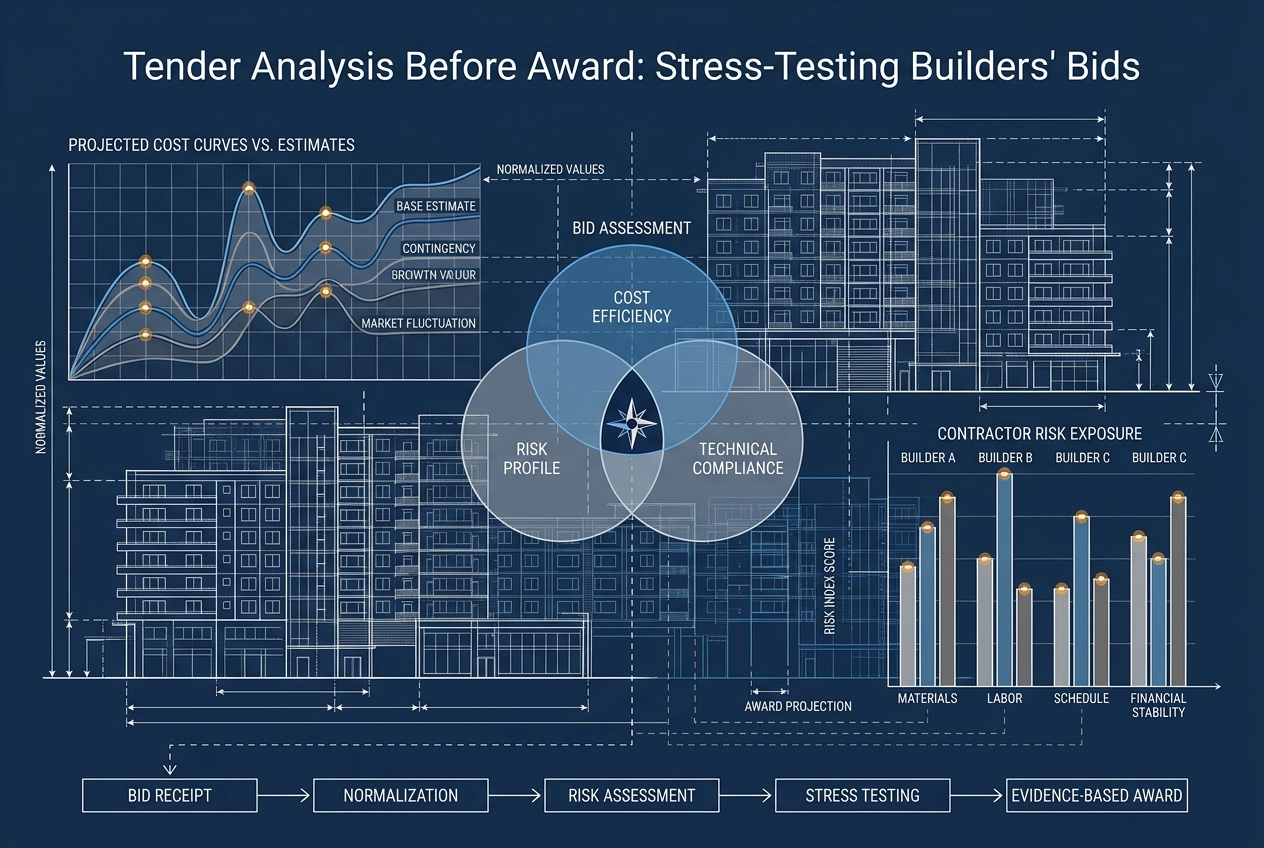
If a tender return is an offer with boundaries attached, the analysis that follows must interrogate those boundaries rather than rank the totals they sit on. Tender analysis in commercial and infrastructure procurement is a structured interrogation of four things in every bid: what has been priced, what has been excluded, what has been qualified, and what has been assumed about time, cash and site conditions.
Two Mental Models
The first model is a price line-up. It sorts the totals from lowest to highest and treats the top of the list as the answer. It is fast, it is auditable at a glance, and it compares numbers that are not measuring the same thing.
The second model is risk interrogation. Each bid is normalised back to a common scope, a common set of contract conditions and a common measurement basis. Only once the deltas are visible does any ranking occur.
The second model exists because tenders are rarely returned on identical scope, programme or risk allocation. One bidder prices rock excavation and another excludes it; one accepts the liquidated damages regime and another caps it; one tenders 60 weeks and another 48. Australian procurement guidance reflects this by defining value for money as a balanced judgement of financial and non-financial factors, including whole-of-life costs and procurement risk, rather than the lowest price (evaluation criteria guidance).
The Independent Role
An independent quantity surveyor has no commercial interest in which bidder wins. That detachment is what allows the analysis to challenge the numbers, the qualifications and the programme claims with equal rigour, and it underpins the procurement strategy and tender management discipline applied on infrastructure and commercial engagements.
Three Outputs
A proper analysis produces three things:
A normalised comparison placing every bid on the same baseline.
A priced risk register of bid-specific deltas, with the basis of each adjustment stated.
A recommendation that can be explained to a board, a financier or an audit function without relying on the bottom line alone.
The next step is building the reconciliation framework that makes normalisation possible.
Building the Reconciliation Framework: Comparing Bids Like-for-Like
The normalisation output is only as reliable as the baseline it is measured against.
1. Fix the baseline document set. Before any bid is ranked, a developer quantity surveyor fixes the tender drawings and specification revision, the well-prepared bill of quantities or schedule of rates, scope of works, conditions of contract and tender returnable schedules at one common issue point. Addenda are reconciled to that same point, because a bid priced against an earlier revision is a documentation difference, not a commercial one. NSW conditions of tendering commonly formalise addenda and alternative tender provisions, which is why the issue register must be controlled (Conditions of Tendering).
2. Normalise every bid. Map each return to the same scope, the same contract conditions and the same measurement basis. Differences should then reflect pricing decisions rather than documentation drift.
3. Test measurement consistency. Confirm whether rates include labour, plant, materials, waste, temporary works and disposal, and whether quantities align with the issued schedule.
4. Extract the common traps. Treat an alternative offer presented as the base offer, an unpriced item read as nil, a rate with no quantity attached and a provisional sum used to disguise scope uncertainty as items requiring separate analysis, not silent acceptance.
This framework also protects the client from its own documentation gaps. Where a variance traces back to the tender documents, it is a client risk, not a bidder discount. Exposing it before award allows the gap to be closed by addendum or priced as an allowance, rather than rewarded through ambiguity.
Check One: Priced Exclusions and What They Leave Behind
With bids normalised to a common baseline, the first substantive check is what each bidder has chosen not to price. A priced exclusion is work, supply, service or risk the bidder has consciously removed from its offer, so the tendered number is competitive only within the boundary it describes.
The exclusion families to test
Commercial and civil tenders commonly exclude ground conditions and rock, service diversions, dewatering, temporary works, statutory approvals and fees, testing and commissioning, security, cleaning and handover documentation. Each is real scope or real risk. None disappears because it is absent from the price.
Convert, estimate, add back
The analytical move is mechanical. A developer quantity surveyor converts every exclusion into a scope item, assigns a cost estimate range and a contingency allowance, then adds it back to the bid for comparison. A bidder excluding rock excavation is not cheaper by that amount until the rock is priced on a consistent basis.
Normal practice versus commercial positioning
Judgement is required. Some exclusions reflect standard market allocation; others are commercial positioning. The same exclusion can be acceptable from a bidder with a transparent allowance elsewhere and material from one using it to suppress the bottom line. Test whether the exclusion is disclosed, quantified and consistent with the bidder's methodology.
The administration consequence
Where an exclusion returns as a variation after award, the competitive tension of the tender is gone. The risk is that the client pays more for that scope than a like-for-like bid comparison would have produced, and the cost-plus risk inside fixed-price contracts becomes visible only when the first variation is assessed. Priced exclusions are therefore the first test of whether the tender is a price or a boundary.
Check Two: Qualifications, Departures and Conditions of Tender
A qualification differs from an exclusion in a way that matters commercially. An exclusion removes work from the offer; a qualification leaves the work in place but changes the terms on which the bidder will perform it. Risk allocation, liability, time and payment all shift, and the tendered price no longer reflects the contract the client intended to sign.
Reading the Departures
Interrogate each of the following as a deliberate commercial position, not an administrative slip:
Departures from the special conditions of contract
Capped or excluded liquidated damages
Liability limits below the contractual requirement
Latent conditions carve-outs that transfer ground risk back to the client
Rewritten extension of time entitlements
Changes to dispute resolution mechanics, including the stepped dispute provisions that determine how disagreements escalate
Why These Are the Hardest Deltas to Price
Qualifications are difficult because they carry no physical scope to measure. A latent conditions carve-out has no bill item; its cost is the probability of an unforeseen ground event multiplied by the client's likely exposure across the whole contract term. That expected value must be estimated and disclosed, not left to emerge during delivery.
The Practical Method
Work through three steps for each departure:
Assess it against the risk allocation the client intended under the tender conditions.
Quantify realistic exposure using consistent assumptions across bidders, and state where the figure is a range rather than a point estimate.
Present the outcome as a priced adjustment to the comparative position, or as a condition of acceptance if the client intends to negotiate the qualification away.
This is properly resolved at the negotiation and award stage. NSW buyer guidance separates evaluation from negotiate and award a contract, with documented rules, templates and contract clauses governing that stage, which is where each qualification is either accepted, priced or removed before execution.
Check Three: Cash-Flow Realism and Payment Terms
A qualification that shifts risk back to the client often does so for a reason rooted in the bidder's balance sheet. Cash flow is the next boundary to interrogate, and it carries more commercial weight than an accounting review implies.
A bid priced thin on working capital will meet identical payment terms with a materially different ability to fund delivery. The analysis therefore tests behaviour, not just numbers:
Schedule of rates versus lump sum. Progress claims under a schedule of rates track work done and are largely self-correcting; lump sum claims depend on milestone definitions, and thin bidders tend to claim early and often.
Mobilisation and early spend versus early claim. Does the bidder fund establishment costs before its first claim, or does the payment profile front-load?
Retention and security arrangements. Test whether the proposed security aligns with the contract's risk profile and the bidder's capacity to fund its own cash troughs.
Early payment or deposit structures. Where a bidder proposes an accelerated payment regime, price the funding cost of that structure against the base offer.
Mobilisation Versus Early Claim: Reading the Pattern
When a bidder prices a premium for early cash flow, it is telling the client what funding the job actually costs. That is legitimate commercial information, not grounds for automatic exclusion. Capture it as a priced adjustment and compare bids on that basis, rather than disqualifying a bidder for pricing honestly.
The security and insolvency dimension deserves a measured test: does the payment profile align with the security mechanism and the bidder's demonstrated capacity to carry the work through its cash troughs? A payment profile that keeps a thin contractor solvent by transferring risk to the client's balance sheet is a warning, not a comfort.
The comparison outcome should be explicit. A side-by-side cash-flow profile reveals whether a lower headline price is being financed by the client through early claims, or by the contractor's own resources. Where several bidders carry thin margins, that cumulative exposure compounds, as set out in our analysis of fixed-price contracts and labour cost risk.
The next check turns to programme realism, because cash flow and time-related preliminaries rise and fall together.
Check Four: Programme Realism and Preliminaries Duration
Cash flow tells you how a bidder funds the work; programme tells you how long that funding, and your preliminaries, must last. The programme test is whether the tendered duration is achievable with the stated resources, sequencing, approval lead times and site access assumptions, or whether it is a marketing programme built to win the job. Preliminaries are time-related costs, so a shorter tendered programme lowers preliminaries and produces a lower total that may not survive first contact with the site. The reverse risk is more expensive: a bidder who compresses preliminaries to win often seeks an extension of time and additional preliminaries later, converting a cheap bid into an expensive one. The extension of time machinery governs how that recovery is claimed. Extension of time procedures under construction contracts set the framework.
Test the build-up against the schedule curve, not the Gantt chart. Check labour and plant build-up against the programme curve, peak demand against stated resources, supervision coverage, procurement lead times for long-lead items, and interfaces with other packages.
A realistic programme makes progress claims, delay analysis and contract administration predictable, which is where client-side cost management effort is lowest. The programme assumptions you interrogate here should trace back to the stages of cost planning in construction.
A programme is a commercial claim. Price it as one before you accept it.
Pricing the Risk: Turning Bid Deltas into a Comparative Assessment
The four checks converge into a single deliverable: an adjusted comparative position for each bidder. Rather than a revised headline price, this is a schedule showing the tendered price, the estimated cost of exclusions added back, the priced value of qualifications, and a programme and cash-flow adjustment. Every bidder is then ranked on the same basis.
Discipline is what makes that schedule defensible. Apply identical rates and allowances to every bidder, show the basis for each adjustment line, and label any estimate that is a range as a range rather than a false point figure. A reader should be able to trace every dollar back to a tender document reference or a stated assumption, using current market benchmarks such as those in Stage Three: Trade-by-Trade Pricing at Current Market Rates to anchor the rates.
The next decision is a risk allocation one. For each material qualification, the client has three options: accept the bid at its qualified price and carry the exposure, negotiate the qualification away before award, or price it in and manage it through contract administration. That choice belongs in the recommendation, not left to post-award discovery.
Non-price criteria sit alongside adjusted price, not beneath it. Capability, methodology and resourcing belong in a structured evaluation matrix, weighted before tenders open. NSW guidance treats supplier selection as a documented, criteria-led stage, so adjusted price should sit as one input in that record rather than the verdict.
Two failure modes undermine the exercise. An unadjusted lowest-price recommendation hides risk inside the award, transferring it to administration. An adjustment process so aggressive it manufactures a preferred winner destroys credibility and invites challenge. The recommendation must be explainable to a board, a financier or an auditor.
Documenting a Defensible Award Recommendation
The adjustments are only as credible as the record behind them. A defensible recommendation documents the tender list, the evaluation criteria and weightings, the normalisation method, every adjustment with its stated basis, and the specific reasons the preferred bidder ranks first after adjustment.
That trail is not administrative housekeeping. Board approval, financier due diligence and audit review all test whether the reasoning is visible, and a challenge after award is answered from the file, not from recollection. Where the reasoning cannot be reconstructed by a reader who was not in the room, the recommendation is exposed.
Negotiation records complete the picture: what was clarified, what was negotiated, what the bidder agreed to change, and the resulting effect on price, programme, risk allocation and contract conditions. Each agreed change should be traceable to the final contract position.
Documentation also carries forward. NSW buyer guidance treats disclosure obligations, risks and special requirements for construction contracts as matters arising after a contract is awarded, so the tender report becomes the baseline against which contract administration is conducted.
The practical handover is the priced risk register. It moves directly into delivery as the watchlist for variation control, progress claim assessment and cost reporting, giving the contract administrator a pre-agreed view of where cost pressure was always likely to emerge.
Conclusion: Award on Priced Risk, Not on Bottom Line
The documentation trail closes the tender process, but it is the award decision itself that determines what you administer for the next twelve months. A cheapest tender is not a price; it is a number with conditions attached, and the cost of ignoring those conditions surfaces later as variations, claims and administration effort. Price the risk before you sign, or pay for it after.
Treat the four checks as a checklist: priced exclusions, qualifications and departures, cash-flow profile, and programme and preliminaries realism.
If you are mid-procurement: obtain a normalised comparative analysis and a priced risk register before the award recommendation is signed, not after the contract is executed. Once executed, the risk is yours at whatever price the contract allows.
If you are earlier in the cycle: build the tender documents, scope definition and returnable schedules so bids are genuinely comparable in the first place. Comparability is designed, not discovered at evaluation.
An independent developer quantity surveyor exists to make the award decision explainable, defensible and priced. That is the only form of comparison that holds up after commencement.